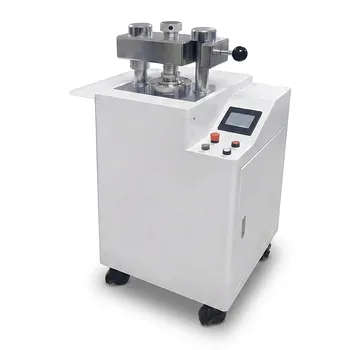
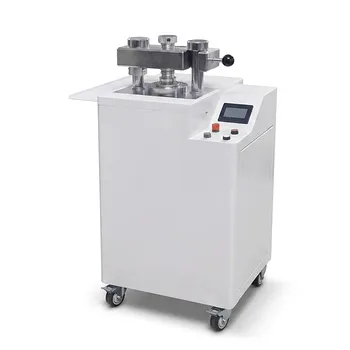
The laboratory press is the primary instrument used to transform micronized Covalent Organic Framework (COF) powders into dense, self-supporting solid-state electrolyte pellets. By applying high-precision uniaxial pressure, the press compacts loose particles into a specific thickness and geometry, ensuring the mechanical integrity required for battery integration. This process is essential for creating the physical contact between particles necessary for ion migration and electrochemical testing.
Core Takeaway: While the laboratory press is indispensable for achieving the density and structural form required for solid-state battery testing, the mechanical stress of compression represents a critical trade-off between physical durability and the preservation of the COF’s crystalline ion-transport pathways.
Structural Transformation and Densification
Achieving Precise Geometry and Mechanical Integrity
The laboratory press utilizes hydraulic force to mold COF powders into pellets with uniform thickness and controlled density. This structural stability is vital, as it allows the electrolyte to function as a separator that can withstand the mechanical pressures within a battery cell. Without this compaction, the material would remain a loose powder, incapable of maintaining a stable interface with the electrodes.
Elimination of Internal Porosity
High-pressure compaction, often reaching up to 370 MPa, is used to minimize microscopic voids between powder particles. By reducing internal porosity, the press establishes a continuous solid phase that facilitates efficient lithium-ion transport. This densification is a prerequisite for obtaining accurate and repeatable results during Electrochemical Impedance Spectroscopy (EIS) and other diagnostic tests.
Optimizing and Altering Ion Transport
Crystallographic Realignment in 2D COFs
In the case of 2D Covalent Organic Frameworks, the application of uniaxial pressure can induce a preferred crystallographic orientation. This mechanical force triggers the rearrangement of randomly distributed particles, effectively transforming disordered pores into aligned one-dimensional nanochannels. When successful, this alignment reduces grain boundary resistance and enhances the migration efficiency of lithium ions along the pressure axis.
The Challenge of Grain Boundaries
Despite the benefits of densification, the mechanical force of a laboratory press can be disruptive to the material's micro-structure. The physical compression process often introduces numerous grain boundaries and can significantly reduce the overall crystallinity of the COF. Because ion transport in COFs relies on a highly ordered lattice, these structural disruptions can hinder performance compared to alternative preparation methods.
Understanding the Trade-offs
Conductivity vs. Processability
A significant trade-off exists between the ease of pellet fabrication and the resulting ionic conductivity. While pressing is the standard for rapid prototyping and testing, pellet-type electrolytes often exhibit lower conductivity than COF thin films synthesized via solution-based methods. The "cold-pressing" approach prioritizes bulk density and mechanical robustness, sometimes at the expense of the refined crystalline order found in grown films.
Pressure-Induced Material Fatigue
Excessive or uneven pressure during the pressing cycle can lead to density gradients or internal micro-cracks. These flaws create non-uniform ion flux and potential "hot spots" for dendrite growth during battery cycling. Maintaining a balance between achieving a "bubble-free" dense state and avoiding the collapse of the COF’s internal pore structure is the primary challenge for researchers using a lab press.
How to Apply This to Your Research
Selecting the right pressing parameters is essential for balancing the structural and electrochemical requirements of a COF electrolyte.
- If your primary focus is accurate performance benchmarking: Use high-precision uniaxial pressure to ensure uniform thickness and density, which minimizes variables during EIS testing.
- If your primary focus is maximizing ion transport in 2D COFs: Focus on optimizing the pressure cycle to encourage the alignment of 1D nanochannels while monitoring for loss of crystallinity via X-ray diffraction (XRD).
- If your primary focus is mechanical durability in a cell: Prioritize the elimination of voids and the creation of a tight physical interface with the lithium metal anode, even if it results in a slight decrease in theoretical conductivity.
By mastering the laboratory press, researchers can bridge the gap between theoretical material properties and functional, testable solid-state battery components.
Summary Table:
| Key Function | Impact on COF Electrolytes | Research Benefit |
|---|---|---|
| Uniaxial Compaction | Transforms powder into dense, self-supporting pellets | Ensures mechanical integrity & battery cell integration |
| Porosity Reduction | Minimizes internal voids and gaps between particles | Improves ion migration & enables accurate EIS testing |
| Structural Alignment | Induces preferred orientation of 1D nanochannels | Enhances conductivity and reduces grain boundary resistance |
| Pressure Control | Balances densification with structural preservation | Prevents material fatigue and loss of crystallinity |
Elevate Your Battery Research with KINTEK Precision
Achieving the perfect balance between pellet density and crystalline integrity is critical for Covalent Organic Framework (COF) performance. KINTEK specializes in comprehensive laboratory pressing solutions tailored for advanced battery research.
Whether you require manual, automatic, heated, multifunctional, or glovebox-compatible models, or advanced cold and warm isostatic presses, our equipment ensures the high-precision uniaxial pressure needed for superior electrolyte preparation.
Ready to optimize your solid-state electrolyte results? Contact us today to discover how KINTEK can enhance your lab's efficiency and material performance.
References
- Rak Hyeon Choi, Hye Ryung Byon. Room‐Temperature Single Li <sup>+</sup> Ion Conducting Organic Solid‐State Electrolyte with 10 <sup>−4</sup> S cm <sup>−1</sup> Conductivity for Lithium‐Metal Batteries. DOI: 10.1002/aenm.202504143
This article is also based on technical information from Kintek Solution Knowledge Base .
Related Products
- Automatic Fluorescence Sample Preparation Press 40 Ton Lab Pellet Press for XRF Analysis
- Automatic XRF Pellet Press for Laboratory Spectrometry Sample Preparation
- Laboratory Hydraulic Pellet Press for XRF KBR FTIR Lab Press
- Lab Ring Press Mold for Sample Preparation
- Automatic Laboratory Hydraulic Press for XRF and KBR Pellet Pressing
People Also Ask
- What is the general process for preparing a sample pellet for XRF? Master Consistency for Accurate Analysis
- What are the advantages of preparing a sample as a dense pellet for XRF? Unlock High-Precision Trace Element Analysis
- What are the common operational types of lab pellet presses? Choosing the Right Manual, Automatic, or Hydraulic System
- What are the emerging trends in the design and materials of lab pellet presses? Modernize Your Lab Efficiency
- What are common lab pellet press issues? Expert Troubleshooting Guide for Reliable Material Research