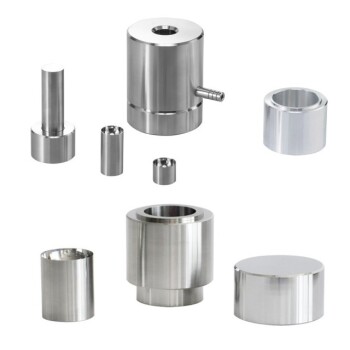
Precision metal molds are the cornerstone of accurate fluoroelastomer analysis, providing the standardized geometry required for repeatable scientific results. By ensuring exact thicknesses (typically 1 mm or 2 mm) and consistent dimensions, these molds eliminate geometric variables that would otherwise skew data in surface elemental determination and thermal aging penetration depth analysis. They create a controlled environment where heat conduction and mass loss are dictated by the material's inherent properties rather than physical irregularities.
The Core Takeaway: Precision metal molds transform specimen preparation from a variable-prone process into a standardized procedure, ensuring that analytical data—from mechanical strength to thermal stability—reflects the material’s true chemical composition rather than artifacts of its shape.
Standardizing Dimensions for Analytical Accuracy
Precision in Elemental and Thermal Analysis
Using precision molds ensures that fluoroelastomer specimens maintain uniform thicknesses, which is critical for surface elemental determination. When analyzing how far thermal aging penetrates a material, a standardized 1 mm or 2 mm thickness allows for precise depth profiling that can be compared across different batches.
Eliminating Geometric Variables
Varying dimensions can lead to inconsistent heat conduction and mass loss measurements during thermal testing. Precision molds provide a "level playing field," ensuring that any observed changes in weight or chemistry are due to the material's formulation rather than uneven surface areas or volumes.
Facilitating Comparative Material Science
To conduct a truly scientific comparison between different material compositions, every physical variable must be controlled. High-precision molds provide the standardized physical constraints necessary to ensure that differences in test results are statistically significant and attributable to the elastomer's chemistry.
Ensuring Mechanical and Structural Integrity
Adherence to Industry Standards
Precision molds are often designed to meet rigorous standards such as ASTM D-638 or ASTM D-790. This alignment ensures that specimens are shaped correctly for specific mechanical tests, including tensile, flexural, and impact strength evaluations.
The Importance of Edge and Surface Quality
A high-quality mold surface produces specimens with flat surfaces and defect-free edges. Even minor nicks or irregularities at the edge of a fluoroelastomer sample can act as stress concentrators, leading to premature failure and inaccurate mechanical data.
Preventing Experimental Error Through Surface Flatness
In advanced analytical testing, such as complex permittivity or magnetic permeability measurements, surface flatness is non-negotiable. Precision molds eliminate gaps between the sample and testing equipment (like waveguides), which reduces impedance matching errors and ensures the accuracy of reflection loss calculations.
Understanding the Trade-offs
Maintenance and Material Compatibility
While precision metal molds offer unmatched accuracy, they require meticulous maintenance to prevent surface degradation or oxidation, which can transfer defects to the specimens. Furthermore, certain fluoroelastomer formulations may exhibit high "stiction" to metal surfaces.
Risk of Mechanical Damage During Extraction
If a mold does not utilize proper release agents or liners, the force required to strip the polymer can cause mechanical injuries to the specimen. These microscopic tears or deformations can invalidate analytical results, particularly in sensitive microstructure analysis or thin-film testing.
How to Apply This to Your Project
Selecting the Right Approach for Your Goal
To achieve the most reliable analytical data, tailor your molding strategy to your specific testing requirements.
- If your primary focus is thermal stability and aging: Prioritize molds that guarantee strict thickness control (1 mm or 2 mm) to ensure uniform heat penetration and accurate mass loss data.
- If your primary focus is mechanical performance testing: Use industrial-grade precision molds that adhere to ASTM standards to ensure clean, burr-free edges and prevent eccentric loading during stress tests.
- If your primary focus is chemical or surface analysis: Ensure the mold surfaces are polished and contamination-free to prevent the transfer of impurities that could interfere with elemental determination.
- If your primary focus is dielectric or electromagnetic properties: Focus on achieving absolute surface flatness to eliminate air gaps between the specimen and the test fixture.
By treating specimen geometry as a critical experimental variable, you ensure that your analytical data remains a true reflection of the fluoroelastomer’s performance.
Summary Table:
| Feature | Key Benefit | Analytical Impact |
|---|---|---|
| Standardized Thickness | Uniform 1mm or 2mm dimensions | Accurate thermal aging & depth profiling |
| Surface Flatness | Eliminates air gaps during testing | Reliable dielectric & electromagnetic data |
| Edge Quality | Defect-free, burr-free samples | Consistent mechanical & tensile strength results |
| Thermal Consistency | Controlled heat conduction | Reliable mass loss data & chemical analysis |
Optimize Your Specimen Preparation with KINTEK
Precision in analytical testing begins with the quality of your sample. KINTEK specializes in comprehensive laboratory pressing solutions designed to eliminate variables and meet the most rigorous industry standards. Whether you are specialized in battery research or advanced polymer science, our range of equipment ensures your fluoroelastomer specimens are perfect every time.
Our versatile lineup includes:
- Manual & Automatic Presses for reliable, repeatable force application.
- Heated & Multifunctional Models for complex material formulations.
- Glovebox-Compatible Solutions for sensitive environmental testing.
- Cold and Warm Isostatic Presses for superior material density and uniformity.
Ensure your data reflects the true chemistry of your materials, not the flaws of your molds. Contact us today to find the ideal pressing solution for your lab!
References
- Javad Heidarian, Nor Mas Mira Abd Rahman. Improving the thermal properties of fluoroelastomer (Viton GF-600S) using acidic surface modified carbon nanotube. DOI: 10.1590/0104-1428.2044
This article is also based on technical information from Kintek Solution Knowledge Base .
Related Products
- Lab Polygon Press Mold
- XRF KBR Steel Ring Lab Powder Pellet Pressing Mold for FTIR
- XRF KBR Plastic Ring Lab Powder Pellet Pressing Mold for FTIR
- Square Lab Press Mold for Laboratory Use
- Lab XRF Boric Acid Powder Pellet Pressing Mold for Laboratory Use
People Also Ask
- What is the purpose of incorporating cartridge heaters into a lab press mold for MLCC block compression? Optimize Results
- How do the design and geometric precision of pressing molds and mandrels affect the quality of PTFE composite samples?
- What role do precision positioning and pressure molds play in single-lap joints? Ensure 100% Data Integrity
- What are the requirements for pressing molds when using SSCG? Key Materials for Complex Single Crystal Production
- How do industrial-grade pressure molds affect zinc metal pouch cells? Maximize Energy Density & Performance