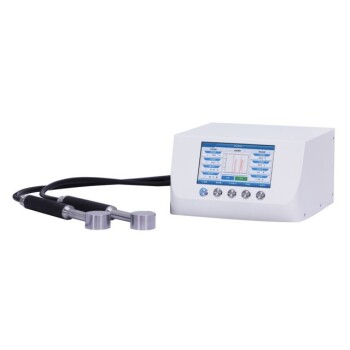
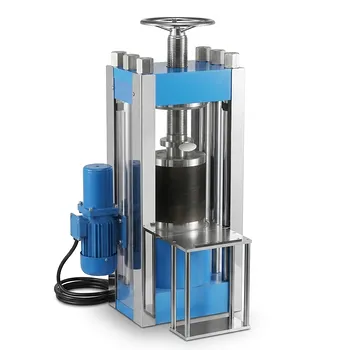
Thermal control equipment and high-pressure presses are the primary tools used to manipulate the structural symmetry and density of Argyrodite-type conductors. By precisely regulating the thermal environment, researchers can synthesize high-symmetry crystal phases that are otherwise unstable at room temperature. This enables the investigation of how specific atomic arrangements, particularly isolated anions, create the smooth energy potential surfaces required for rapid lithium-ion migration.
Core Takeaway: Heated laboratory presses and high-temperature furnaces allow researchers to stabilize high-symmetry phases and eliminate processing defects like porosity. These tools are essential for correlating a material's intrinsic crystal structure with its electrochemical performance.
Synthesizing High-Symmetry Crystal Phases
The Link Between Temperature and Symmetry
Argyrodite-type fast ion conductors often exhibit multiple crystal phases that change depending on the temperature. High-temperature phases typically possess higher symmetry, which is a critical factor in achieving superior ionic conductivity.
Using high-temperature furnaces, researchers can reach the specific thermal thresholds required to transition the material into these high-symmetry states. This allows for the study of how structural changes directly impact the movement of ions within the lattice.
Optimizing Ion Migration Pathways
Within these high-symmetry structures, isolated anions play a vital role in facilitating ion transport. They contribute to a smoother energy potential surface, which lowers the barrier for lithium-ion migration.
Heated laboratory equipment provides the precise environment necessary to stabilize these configurations. This stability is required to perform detailed analyses of how the atomic "landscape" promotes or hinders fast ion conduction.
The Synergy of Pressure and Temperature in Processing
Eliminating Internal Porosity
A high-pressure laboratory press is indispensable for compressing solid electrolyte powders into high-density pellets. High density is a prerequisite for accurate material characterization.
Without sufficient pressure, internal porosity can create artificial resistance. This leads to inaccurate readings during Electrochemical Impedance Spectroscopy (EIS), masking the material's intrinsic ionic conductivity and activation energy.
Synchronized Field Application
Advanced heated hydraulic presses allow for the synchronization of temperature and pressure fields within the mold. This simultaneous application allows researchers to direct the induction or inhibition of specific phase transitions during the molding process.
This technique is used to prepare functional materials with specific textures or pre-stressed states. By regulating the strain within the material, researchers can further tune the ion-conduction properties of the Argyrodite structure.
Investigating Phase Stability and Kinetics
Evaluating Metastable States
High-temperature tools are also used to evaluate the thermal stability of phases induced by high pressure. Some materials may exist in a metastable state that reverts to a different phase when heat is applied.
By monitoring these transitions, researchers can define the specific kinetic conditions required for phase recovery. This data is crucial for understanding how long a high-performance phase will last under operating conditions.
Defining Recovery Parameters
Controlled thermal treatment helps establish the exact temperature and time required for a material to return to its equilibrium phase. This provides a clear window into the material's operational limits.
Understanding these recovery kinetics ensures that the fast-ion conductor remains in its most conductive state during its intended use in a battery or electrochemical cell.
Understanding the Trade-offs
Equipment Limitations and Material Integrity
While high temperatures and pressures are necessary, they introduce the risk of material degradation or chemical decomposition. Excessive heat can lead to the loss of volatile components, which shifts the stoichiometry of the Argyrodite conductor.
Complexity of Processing Controls
Achieving a perfectly uniform temperature field across a compressed pellet is technically challenging. Thermal gradients within the sample can result in non-uniform phase distribution, where the core of the pellet differs structurally from the surface.
Applying These Tools to Your Research
How to Apply This to Your Project
- If your primary focus is maximizing ionic conductivity: Utilize high-temperature furnaces to target high-symmetry phases while ensuring the material is rapidly quenched to preserve that state at room temperature.
- If your primary focus is accurate material characterization: Use a high-pressure press to achieve near-theoretical density in your pellets, ensuring that EIS measurements reflect intrinsic properties rather than processing defects.
- If your primary focus is structural engineering: Employ a heated hydraulic press to synchronize pressure and temperature, allowing you to manipulate material strain and induce specific textures.
By masterfully controlling the thermal and mechanical forces applied to Argyrodite-type conductors, you can unlock the full potential of these materials for the next generation of solid-state energy storage.
Summary Table:
| Equipment Type | Key Mechanism | Research Benefit |
|---|---|---|
| High-Temp Furnace | Thermal symmetry regulation | Stabilizes high-symmetry phases for faster ion migration. |
| Laboratory Press | High-pressure densification | Eliminates porosity to reveal intrinsic ionic conductivity. |
| Heated Hydraulic Press | Synchronized heat & pressure | Enables precise control over phase recovery and textures. |
| Isostatic Press | Uniform omnidirectional force | Ensures structural homogeneity in solid electrolyte pellets. |
Elevate Your Battery Research with KINTEK Precision
Unlock the full potential of Argyrodite-type fast ion conductors with KINTEK’s comprehensive laboratory pressing solutions. We specialize in high-performance equipment designed to meet the rigorous demands of solid-state electrolyte development, including:
- Manual & Automatic Presses: For consistent, high-density pellet preparation.
- Heated & Multifunctional Models: To synchronize thermal and pressure fields for phase stabilization.
- Glovebox-Compatible Systems: Ensuring material integrity for air-sensitive battery chemistries.
- Cold & Warm Isostatic Presses (CIP/WIP): For achieving maximum theoretical density and structural uniformity.
Ready to eliminate processing defects and optimize ion migration pathways? Contact KINTEK today to find the perfect pressing or thermal solution for your specialized research needs.
References
- Qifan Yang, Hong Li. New fast ion conductors discovered through the structural characteristic involving isolated anions. DOI: 10.1038/s41524-025-01559-9
This article is also based on technical information from Kintek Solution Knowledge Base .
Related Products
- Infrared Heating Quantitative Flat Plate Mold for Precise Temperature Control
- Lab Double Plate Heating Mold for Laboratory Use
- Automatic High Temperature Heated Hydraulic Press Machine with Heated Plates for Lab
- Warm Isostatic Press for Solid State Battery Research Warm Isostatic Press
- Lab Cylindrical Press Mold for Laboratory Use
People Also Ask
- How do precision temperature-controlled heating plates function in electrolyte thermal stability storage experiments?
- What is the importance of a precision temperature-controlled heating module? Ensure Aluminum-Cadmium Thermal Stability
- How does heating platen precision affect rubber specimens? Achieve uniform density and reliable testing results.
- How are thin polymer films produced for spectroscopic analysis? Expert Guide to Heat and Low-Pressure Methods
- What accessories and field services can be used to optimize the capabilities of presses? Maximize Your Lab Performance