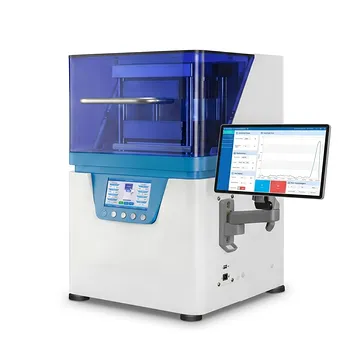
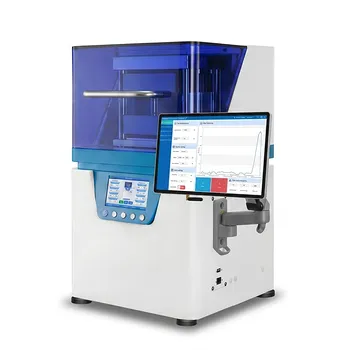
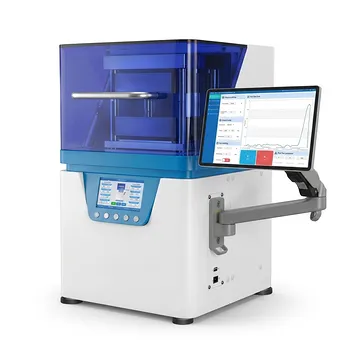
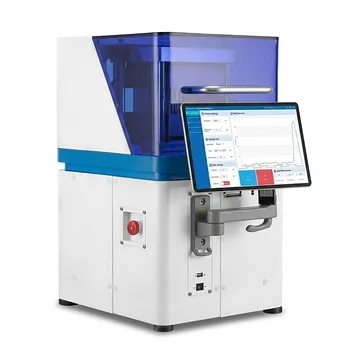
A high-performance laboratory hydraulic press is the critical instrument used to consolidate loose AISI H13 steel powder into a stable "green body" by applying precise pressures typically ranging from 700 MPa to 1000 MPa. This process facilitates particle rearrangement and mechanical interlocking, allowing the material to reach approximately 75% of its theoretical density. Reaching this specific density level is a non-negotiable prerequisite for achieving high densification during subsequent pressureless sintering.
The laboratory hydraulic press serves as the foundation of the powder metallurgy workflow, transforming loose AISI H13 particles into a geometrically defined compact with sufficient mechanical strength for handling. By providing precise, repeatable pressure control, it ensures the internal density uniformity required for predictable carbide distribution and final mechanical stability.
Achieving Critical Densification and Microstructure
Facilitating Mechanical Interlocking
At pressures reaching 1000 MPa, the hydraulic press forces AISI H13 particles to undergo mechanical interlocking and rearrangement. This high-pressure environment overcomes the internal friction of the powder mass, eliminating large voids and establishing the initial physical contact between particles.
Reaching the 75% Density Threshold
The primary role of the press is to achieve a green density of approximately 75% of the theoretical maximum. This specific density level is vital because it creates the necessary "skeleton" of the part, ensuring that subsequent pressureless sintering can effectively close remaining pores.
Ensuring Carbide Distribution
High-precision pressure control ensures that the internal density remains uniform throughout the compact. This uniformity is essential for the even distribution of carbides during heat treatment, which ultimately dictates the wear resistance and toughness of the finished tool steel.
The Mechanics of Uniaxial Consolidation
The Three Stages of Compaction
The hydraulic press guides the AISI H13 powder through three distinct physical stages: particle rearrangement, inter-particle sliding, and plastic deformation. As the unidirectional pressure increases, the particles transition from simply filling gaps to physically deforming, which creates the "cold welds" necessary for mechanical integrity.
Geometric and Structural Definition
By applying force within a precision die, the press consolidates loose powder into a specific geometry, such as a disc or rectangular block. This "green compact" possesses the mechanical strength required to undergo further processing, such as cold isostatic pressing or sintering, without crumbling.
Establishing the Coordination Number
The press increases the average coordination number, or the number of contact points between individual powder spheres. Increasing these contact points reduces the distance between particle centers, providing the geometric foundation for "neck growth" during the sintering phase.
Foundation for Engineering and Simulation
Generating Pressure-Displacement Curves
Beyond simple fabrication, the laboratory press is a diagnostic tool used to generate accurate pressure-displacement curves. These curves provide the empirical data necessary to understand how AISI H13 powder behaves under specific loads.
Validating Numerical Simulations
The data captured during pressing serves as the foundation for finite element analysis (FEA) in programs like ABAQUS. By inputting experimental results into custom subroutines, researchers can ensure that numerical simulations of the compaction process are authentic and accurate.
Understanding the Trade-offs
The Challenge of Wall Friction
In uniaxial die compaction, friction between the powder and the die walls is a significant limitation. This friction can lead to pressure attenuation, where the force at the center of the compact is lower than at the surface, resulting in density gradients.
Geometric Limitations
Uniaxial pressing is generally limited to relatively simple shapes with a low height-to-diameter ratio. As the part becomes taller, the non-uniform distribution of pressure becomes more pronounced, which can lead to warping or cracking during the sintering stage.
How to Apply This to Your Project
Making the Right Choice for Your Goal
- If your primary focus is high-strength tool production: Prioritize a press capable of maintaining a steady 1000 MPa load to ensure the 75% density threshold is met for optimal sintering.
- If your primary focus is material research and simulation: Use the press to capture detailed pressure-displacement data to calibrate your finite element models and predict powder behavior.
- If your primary focus is microstructural uniformity: Focus on high-precision pressure control and die lubrication to minimize internal stress gradients and ensure even carbide distribution.
By mastering the precise application of force, the laboratory hydraulic press bridges the gap between loose powder and a high-performance industrial material.
Summary Table:
| Feature | Specification/Role | Benefit for AISI H13 Steel |
|---|---|---|
| Compaction Pressure | 700 MPa - 1000 MPa | Reaches ~75% theoretical green density |
| Physical Stages | Rearrangement & Plastic Deformation | Establishes cold welds and mechanical integrity |
| Density Uniformity | Precision Pressure Control | Ensures even carbide distribution and toughness |
| Diagnostic Output | Pressure-Displacement Curves | Provides empirical data for FEA & simulations |
| Geometric Definition | Uniaxial Die Consolidation | Creates stable green bodies for further processing |
Elevate Your Material Research with KINTEK Pressing Solutions
Achieving the critical 75% density threshold for AISI H13 steel requires precision and power. KINTEK specializes in comprehensive laboratory pressing solutions designed to meet the rigorous demands of powder metallurgy and battery research.
Whether you need manual, automatic, heated, multifunctional, or glovebox-compatible models, or require high-density results through cold and warm isostatic presses, KINTEK provides the reliability your project deserves.
Ready to optimize your compaction process and validate your simulations?
Contact KINTEK experts today for a tailored solution.
References
- Robert Besler, Rolf Janßen. Effect of Processing Route on the Microstructure and Mechanical Properties of Hot Work Tool Steel. DOI: 10.1590/1980-5373-mr-2016-0726
This article is also based on technical information from Kintek Solution Knowledge Base .
Related Products
- Automatic High Temperature Heated Hydraulic Press Machine with Heated Plates for Lab
- 24T 30T 60T Heated Hydraulic Lab Press Machine with Hot Plates for Laboratory
- Automatic Heated Hydraulic Lab Press with Programmable Touch Screen Controls and Precision Temperature Regulation
- Automatic Heated Hydraulic Lab Press 120x120mm Plate Fully Automated Material Research Press
- Laboratory Hydraulic Press Lab Pellet Press Machine for Glove Box
People Also Ask
- Function of a Laboratory Hydraulic Press with Heated Platens in SSE? Enhance Battery Density & Conductivity
- What are the requirements for electrode pressing with high-viscosity ionic liquids like EMIM TFSI? Optimize Performance
- How does a laboratory heated hydraulic press facilitate PBN sample prep for WAXS? Achieve Precise X-Ray Scattering
- What are the industrial applications of heated hydraulic presses? Master Heat & Force for Precision Manufacturing
- Why is a laboratory hydraulic press with heating plates required for PLA/TEC films? Achieve Precise Sample Integrity