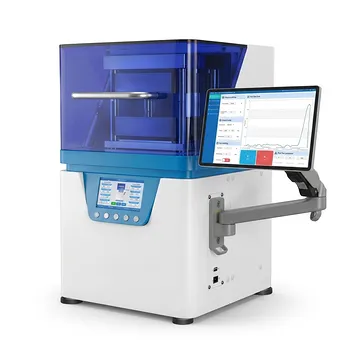
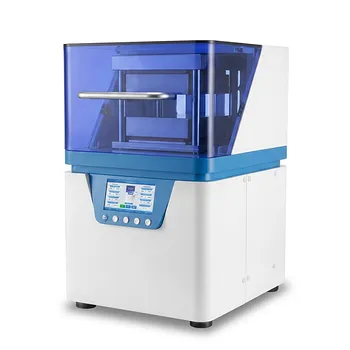
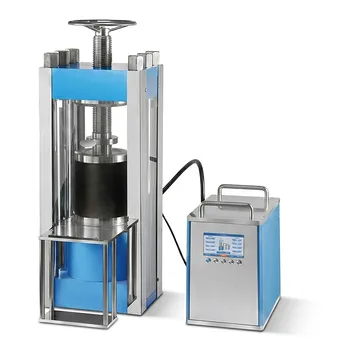
The electrically heated plate vulcanizing press is the critical hardware responsible for the final chemical and physical transformation of nanocomposite compounds. It provides the simultaneous high temperature (typically 150°C–160°C) and high pressure required to initiate cross-linking reactions. This process converts a plasticized mixture of rubber and nanofillers into a stable, three-dimensional elastomeric network within a precise steel mold.
Core Takeaway: The vulcanizing press serves as both a chemical reactor and a precision forming tool, ensuring that nanocomposites achieve full cross-linking density and standardized physical dimensions required for valid performance testing.
Driving the Chemical Transformation
Facilitating Cross-linking Reactions
The press provides the thermal energy necessary to activate vulcanizing agents like sulfur or peroxide. This activation triggers the chemical bonding of linear molecular chains into a three-dimensional network structure.
This transformation is what changes a raw, "plastic" compound into a finished elastomer. Without this controlled heat, the material remains a viscous mixture rather than a functional solid.
Integrating Nanofillers into the Matrix
For nanocomposites, the press ensures that a stable network forms between the rubber molecular chains and fillers like Carbon Nanotubes (CNTs). This integration is vital for the material to exhibit practical mechanical strength and specialized properties.
Precise control over the thermal field ensures this reaction is uniform throughout the specimen. Inconsistent heating can lead to "dead spots" where the nanofillers are not properly anchored to the polymer matrix.
Ensuring Structural and Geometric Integrity
Eliminating Internal Defects
The high pressure (often 20 MPa or higher) serves to compress the compound and eliminate internal air bubbles. This results in a high-density specimen free from the voids that cause premature failure.
Continuous pressure also helps to eliminate internal material stresses. This stabilization ensures that the finished sheet does not warp or shrink once removed from the press.
Achieving Standardized Geometry
The press forces the material to conform to the exact dimensions of a steel mold, typically producing sheets of a specific thickness, such as 2 mm. This geometric precision is non-negotiable for mechanical performance testing standards.
Consistent thickness and low surface roughness are essential for comparative research. This standardization ensures that differences in test results are due to the material's composition, not its physical shape.
Understanding the Trade-offs
Thermal Gradients and Uniformity
If the heating plates are not calibrated, thermal gradients can occur across the mold. This leads to non-uniform vulcanization, where the center of a specimen may be under-cured while the edges are over-cured.
Risk of Over-vulcanization
Excessive time or temperature in the press can lead to thermal degradation of the rubber matrix. This often results in increased brittleness and a significant loss of elasticity, undermining the benefits of the added nanocomposites.
Pressure Calibration Issues
Inadequate or fluctuating pressure during the cycle can result in density variations. If the pressure is too low, the specimen may remain porous; if too high, it may cause flash (excess material leakage), leading to dimensional inaccuracies.
How to Optimize the Pressing Process
Tailoring Parameters to Research Goals
- If your primary focus is mechanical strength: Ensure the press is set to the exact "ideal vulcanization time" to maximize the 3D network density without inducing brittleness.
- If your primary focus is flame retardancy: Maintain a stable thermal field at 160°C to facilitate the formation of a spatial network that remains stable in high-temperature environments.
- If your primary focus is standardized testing (ISO/ASTM): Use high-precision steel molds and 30-bar pressure to ensure a consistent 2 mm thickness and a defect-free surface finish.
By precisely controlling the intersection of heat and pressure, the vulcanizing press transforms raw chemical mixtures into representational samples that reveal the true potential of nanocomposite engineering.
Summary Table:
| Key Role | Physical/Chemical Impact | Typical Parameters |
|---|---|---|
| Chemical Activation | Triggers 3D cross-linking for elastomeric networks | 150°C – 160°C |
| Defect Elimination | Removes internal voids and stabilizes material stress | ≥ 20 MPa Pressure |
| Geometric Precision | Standardizes specimen thickness for testing compliance | Precision Steel Molds |
| Filler Integration | Ensures uniform dispersion of CNTs and nanofillers | Controlled Thermal Field |
Optimize Your Specimen Fabrication with KINTEK
Precise control over heat and pressure is the foundation of reliable nanocomposite research. KINTEK specializes in comprehensive laboratory pressing solutions designed to meet the rigorous standards of modern material science and battery research.
Our extensive range of equipment ensures you achieve maximum cross-linking density and defect-free results:
- Manual & Automatic Models: Tailored for varying laboratory throughput.
- Heated & Multifunctional Presses: Providing the stable thermal fields required for advanced polymers.
- Glovebox-Compatible Designs: Ideal for sensitive materials in controlled environments.
- Cold & Warm Isostatic Presses: For specialized high-density applications.
Don't let inconsistent hardware compromise your data. Contact us today to find the perfect pressing solution for your lab.
References
- Przemysław Rybiński, Tomasz Gozdek. Effect of modified graphene and carbon nanotubes on the thermal properties and flammability of elastomeric materials. DOI: 10.1007/s10973-016-5841-8
This article is also based on technical information from Kintek Solution Knowledge Base .
Related Products
- Split Automatic Heated Hydraulic Press Machine with Heated Plates
- Automatic High Temperature Heated Hydraulic Press Machine with Heated Plates for Lab
- Heated Hydraulic Press Machine With Heated Plates For Vacuum Box Laboratory Hot Press
- Automatic Heated Hydraulic Press Machine with Heated Plates for Laboratory
- Laboratory Split Manual Heated Hydraulic Press Machine with Hot Plates
People Also Ask
- What are the requirements for electrode pressing with high-viscosity ionic liquids like EMIM TFSI? Optimize Performance
- How does a laboratory heated hydraulic press facilitate PBN sample prep for WAXS? Achieve Precise X-Ray Scattering
- What are the industrial applications of heated hydraulic presses? Master Heat & Force for Precision Manufacturing
- Why is a laboratory hydraulic press with heating plates required for PLA/TEC films? Achieve Precise Sample Integrity
- Function of a Laboratory Hydraulic Press with Heated Platens in SSE? Enhance Battery Density & Conductivity