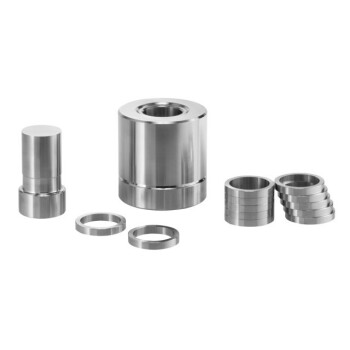
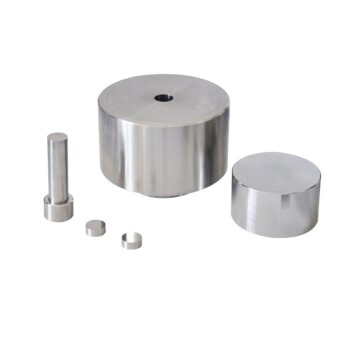
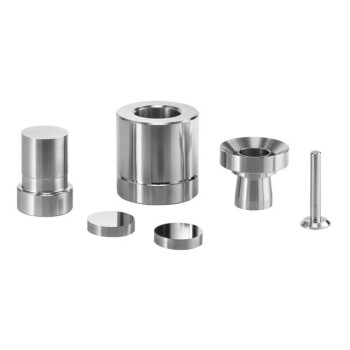
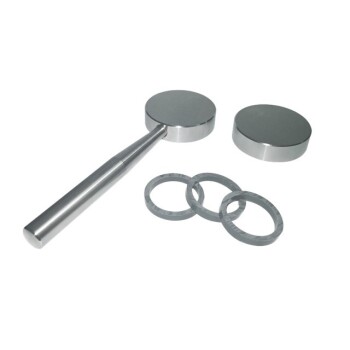
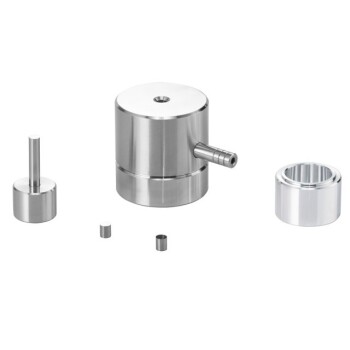
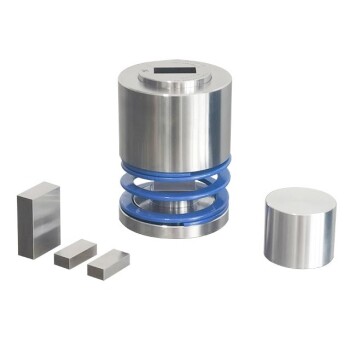
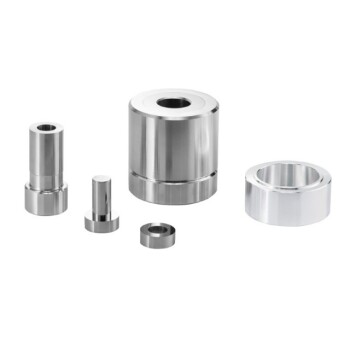
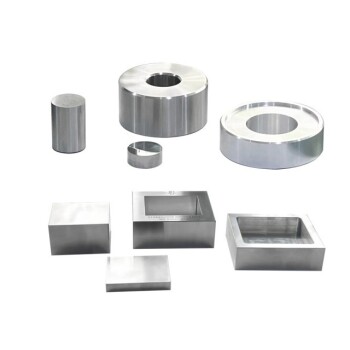
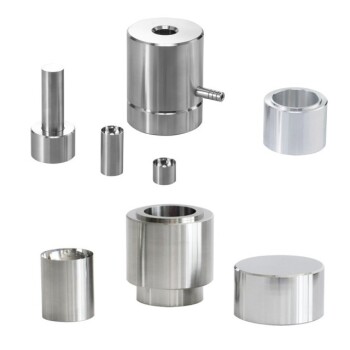
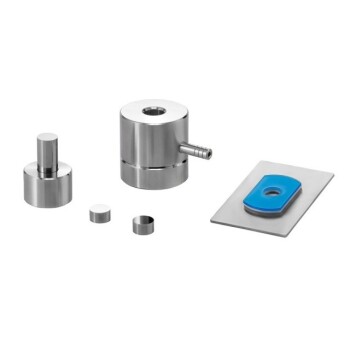
Standardized steel molds are the primary tool for ensuring specimen integrity and geometric precision. These molds allow for the creation of specimens with exact dimensions—typically 100mm in height and 50mm in diameter—which are essential for eliminating stress concentration and obtaining reliable mechanical data during uniaxial compression.
Core Takeaway: High-strength steel molds provide the rigid geometric constraints necessary to eliminate experimental artifacts caused by irregular specimen shapes. By standardizing dimensions and surface quality, researchers ensure that test results reflect the inherent properties of the rock-analog material rather than flaws in the specimen's geometry.
Ensuring Geometric Accuracy and Uniform Stress
Maintaining the Standardized Aspect Ratio
Following the standards of the International Society for Rock Mechanics (ISRM), specimens must maintain a specific height-to-diameter ratio. Standardized steel molds ensure a consistent 100mm x 50mm cylindrical shape, which is critical for calculating the elastic modulus and compressive strength.
Eliminating Stress Concentration
Irregularities in a specimen’s shape or non-parallel end-faces lead to stress concentration and eccentricity during loading. Steel molds provide the precision required to control geometric dimensions and end-face flatness, ensuring uniform pressure distribution across the entire cross-section of the specimen.
Preventing Stress Eccentricity
Even minor dimensional errors can cause the load to be applied unevenly, a phenomenon known as stress eccentricity. By using high-rigidity molds, the test area remains regular, ensuring the authenticity of bond strength and crack evolution data.
Structural Integrity During Specimen Preparation
Resistance to Grouting and Lateral Pressure
During the pouring and initial setting phases of cement mortar or other analogs, materials exert lateral pressure on the mold. The high rigidity of industrial-grade steel prevents the mold from bowing or deforming, which would otherwise compromise the specimen's final dimensions.
Withstanding Laboratory Press Tonnage
In cases where GRAM specimens are formed through high-pressure pressing, the mold must withstand massive tonnage without permanent deformation or fracture. High-strength steel or cemented carbide ensures the mold maintains its geometric outline even under extreme compressive forces.
Superior Sealing and Stability
Steel molds offer superior sealing compared to softer materials, preventing slurry loss during the curing process. This stability is vital for maintaining the uniformity of the rock-analog matrix and ensuring that the specimen’s density is consistent throughout.
Optimizing Surface Quality and Demolding
Reducing Demolding Resistance
Precision-polished interior surfaces of steel molds significantly reduce demolding resistance. This allows the specimen to be removed without incurring surface chips or internal micro-cracks that could prematurely trigger failure during a compression test.
Ensuring Surface-Sensitive Accuracy
Smooth surfaces and neat edges are fundamental requirements for surface-sensitive physical property testing. Standardized molds produce a "clean" specimen that allows for more accurate observation of crack evolution patterns during axial loading.
Understanding the Trade-offs
The Challenge of Maintenance and Wear
While steel molds are durable, they are susceptible to corrosion and abrasive wear over time, especially when using gritty rock-analog materials. Any pitting or scratching on the interior surface can translate to flaws in the specimen, necessitating regular inspection and polishing.
Initial Cost vs. Data Reliability
The initial investment in high-precision steel molds is significantly higher than that for plastic or disposable alternatives. However, the use of inferior molds often results in higher data variance, potentially requiring a larger sample size to achieve statistical significance.
How to Apply This to Your Project
Recommendations for Specimen Preparation
- If your primary focus is standardizing mechanical properties: Use high-strength steel molds that strictly adhere to the 50mm x 100mm ISRM cylinder dimensions to ensure data comparability.
- If your primary focus is high-pressure compaction: Select molds made of cemented carbide or heat-treated steel to prevent permanent mold deformation under press machine tonnage.
- If your primary focus is crack pattern visualization: Prioritize molds with precision-polished internal surfaces to minimize surface defects that could lead to "false" crack initiations.
By utilizing standardized steel molds, you transition from gathering inconsistent data to producing definitive, repeatable mechanical insights that withstand scientific scrutiny.
Summary Table:
| Benefit | Impact on Test Accuracy | Key Feature |
|---|---|---|
| Geometric Precision | Eliminates stress concentration and eccentricity | ISRM standard 100mm x 50mm dimensions |
| High Rigidity | Prevents deformation under high lateral pressure/tonnage | Industrial-grade high-strength steel or carbide |
| Surface Quality | Minimizes micro-cracks and surface defects during demolding | Precision-polished interior surfaces |
| Superior Sealing | Maintains consistent density and prevents slurry loss | Tight-tolerance engineering for material stability |
Elevate the precision of your research with KINTEK’s comprehensive laboratory pressing solutions. Whether you are preparing GRAM specimens for rock mechanics or conducting advanced battery research, our range of manual, automatic, heated, and glovebox-compatible models—including cold and warm isostatic presses—ensures your materials meet the highest standards of integrity and consistency. Contact us today to find the perfect pressing and molding solution for your laboratory requirements!
References
- Luigi Massaro, Yasuhiro Yamada. New granular rock-analogue materials for simulation of multi-scale fault and fracture processes. DOI: 10.1017/s0016756821001321
This article is also based on technical information from Kintek Solution Knowledge Base .
Related Products
- XRF KBR Steel Ring Lab Powder Pellet Pressing Mold for FTIR
- Lab Double Plate Heating Mold for Laboratory Use
- Lab Anti-Cracking Press Mold
- Lab XRF Boric Acid Powder Pellet Pressing Mold for Laboratory Use
- XRF KBR Plastic Ring Lab Powder Pellet Pressing Mold for FTIR
People Also Ask
- What considerations are important regarding the die size of an XRF pellet press? Optimize for Your XRF Spectrometer and Sample
- Why are pellets used in XRF analysis, and what is their limitation? Boost Accuracy and Speed in Your Lab
- What is the general process for preparing a sample pellet for XRF? Master Consistency for Accurate Analysis
- What are the differences between manual and automatic XRF pellet presses? Choose the Right Press for Your Lab's Needs
- What are the main methods for preparing XRF pellets? Boost Accuracy and Efficiency in Your Lab