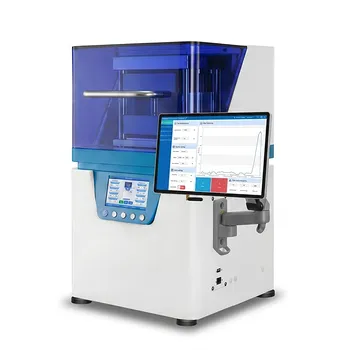
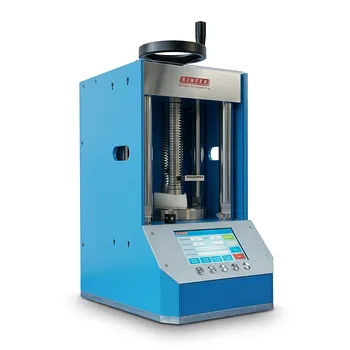
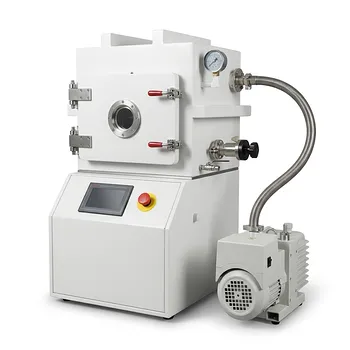
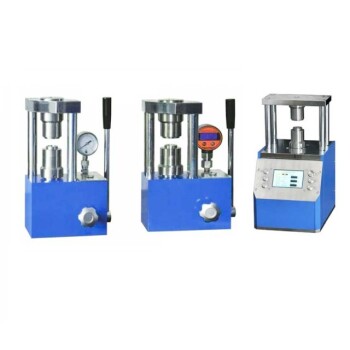
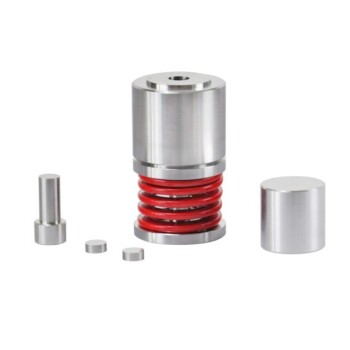
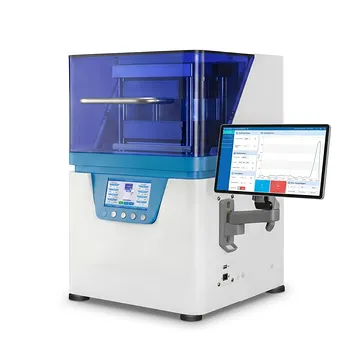
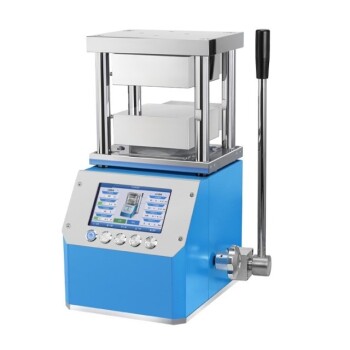
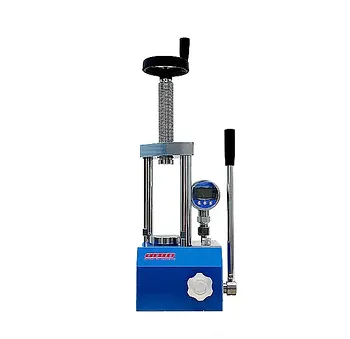
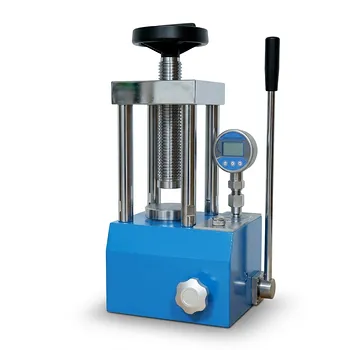
The use of a high-pressure laboratory hydraulic press is fundamental to the successful fabrication of Ti-3Al-2.5V alloy components via powder metallurgy. By applying precise pressures—often reaching 700 MPa or higher—the press achieves the high green density required to transform loose powder into a cohesive "green compact." This process ensures mechanical interlocking, prevents structural failure during handling, and establishes the critical particle-to-particle contact needed for effective solid-state sintering.
Core Takeaway: A high-pressure hydraulic press is necessary to induce plastic deformation and mechanical interlocking in Ti-3Al-2.5V powder, creating a dense "green" part that can survive handling and possesses the internal contact points required for high-quality sintering.
Achieving Structural Integrity Through Densification
The Role of High Green Density
High green density is the primary metric for a successful compaction stage. For Ti-3Al-2.5V, a laboratory press must provide enough force to reach densities that prevent the compact from delaminating or crumbling during ejection from the mold.
Inducing Plastic Deformation
Titanium alloys require significant force to overcome inter-particle resistance. High-pressure presses, sometimes reaching up to 1.6 GPa, force fine particles into the internal pores of larger particles, resulting in relative densities as high as 97.5%.
Mechanical Interlocking and Cold Welding
The extreme axial pressure induces a cold welding effect by exposing bare metal surfaces. This creates strong mechanical bonds between the Ti-3Al-2.5V particles, providing the "green strength" necessary for the part to maintain its shape without adhesives.
Preparing the Foundation for Sintering
Establishing Atomic Diffusion Pathways
Sintering relies on atomic diffusion, which only occurs where particles touch. High-pressure compaction maximizes these contact points, significantly reducing the distance atoms must travel to bond during the subsequent heat treatment.
Providing the Driving Force for Sintering
A dense green compact contains stored mechanical energy that acts as a driving force for solid-state sintering. This high initial density reduces sintering shrinkage, which is vital for maintaining the dimensional accuracy of the final component.
Eliminating Internal Porosity
By forcing particles to rearrange and pack tightly, the hydraulic press eliminates large gaps and internal density gradients. This ensures that the final sintered product has low porosity and superior mechanical properties, such as tensile strength and fatigue resistance.
Understanding the Trade-offs and Pitfalls
Pressure vs. Tooling Wear
While higher pressures generally lead to better density, they also increase the wear and tear on precision molds and dies. Consistently operating at the upper limits of a press can lead to die fatigue or structural failure of the compaction tooling.
The Risk of Entrapped Air
Compacting too quickly can trap air within the powder mass, leading to micro-cracks or internal voids. Precise control over the loading speed (e.g., 0.6 MPa/s) is required to allow air to escape as the particles rearrange.
Elastic Recovery and Delamination
If the pressure is released too abruptly, the metal particles may undergo "spring-back" or elastic recovery. This internal stress can cause the compact to crack or delaminate immediately upon ejection from the die.
How to Apply This to Your Project
To achieve the best results with PM Ti-3Al-2.5V alloy powder, your compaction strategy should align with your final performance requirements.
- If your primary focus is maximum mechanical strength: Utilize pressures toward the higher end of the spectrum (700 MPa+) to maximize green density and minimize final porosity.
- If your primary focus is dimensional precision: Ensure a slow, controlled loading speed and a sufficient pressure-holding phase to eliminate density gradients and reduce sintering shrinkage.
- If your primary focus is preventing structural defects: Use an automatic hydraulic press with precise ejection speed control to minimize the risk of delamination caused by elastic recovery.
A high-pressure laboratory hydraulic press is not merely a tool for shaping powder, but the critical engine for establishing the microstructural foundation of the finished alloy.
Summary Table:
| Key Factor | Impact on PM Ti-3Al-2.5V Fabrication | Critical Technical Requirement |
|---|---|---|
| Densification | Achieves up to 97.5% relative density by filling internal pores. | Pressure range up to 700 MPa - 1.6 GPa |
| Structural Integrity | Induces cold welding and mechanical interlocking for green strength. | High axial force to overcome resistance |
| Sintering Success | Maximizes particle contact points for efficient atomic diffusion. | Uniform compaction without density gradients |
| Defect Control | Prevents delamination and micro-cracking during ejection. | Precise loading (e.g., 0.6 MPa/s) & ejection control |
Optimize Your Alloy Development with KINTEK Precision
Elevate your materials science research with KINTEK’s industry-leading laboratory pressing solutions. Whether you are perfecting PM Ti-3Al-2.5V alloy components or advancing battery research, our comprehensive range of manual, automatic, heated, and multifunctional presses provides the extreme pressure and precision required for superior green density.
From glovebox-compatible models to specialized cold and warm isostatic presses, KINTEK equipment is designed to eliminate internal porosity and prevent structural defects like delamination. Contact KINTEK today to discuss how our tailored pressing solutions can enhance your laboratory's efficiency and results.
References
- L. Bolzoni, E. Gordo. Investigation of the factors influencing the tensile behaviour of PM Ti–3Al–2.5V alloy. DOI: 10.1016/j.msea.2014.05.017
This article is also based on technical information from Kintek Solution Knowledge Base .
Related Products
- Automatic High Temperature Heated Hydraulic Press Machine with Heated Plates for Lab
- 24T 30T 60T Heated Hydraulic Lab Press Machine with Hot Plates for Laboratory
- Automatic Heated Hydraulic Press Machine with Heated Plates for Laboratory
- Automatic Hydraulic Hot Press with Large Plate and Precision Temperature Control for Advanced Material Sample Preparation and Industrial Research
- Automatic Heated Hydraulic Press Machine with Hot Plates for Laboratory
People Also Ask
- Function of a Laboratory Hydraulic Press with Heated Platens in SSE? Enhance Battery Density & Conductivity
- What are the requirements for electrode pressing with high-viscosity ionic liquids like EMIM TFSI? Optimize Performance
- How does a laboratory heated hydraulic press facilitate PBN sample prep for WAXS? Achieve Precise X-Ray Scattering
- What are the industrial applications of heated hydraulic presses? Master Heat & Force for Precision Manufacturing
- Why is a laboratory hydraulic press with heating plates required for PLA/TEC films? Achieve Precise Sample Integrity