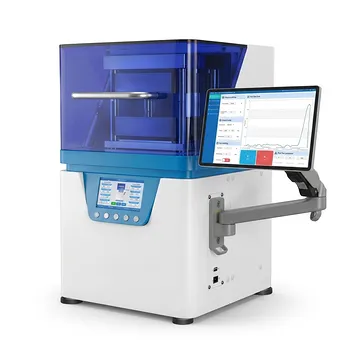
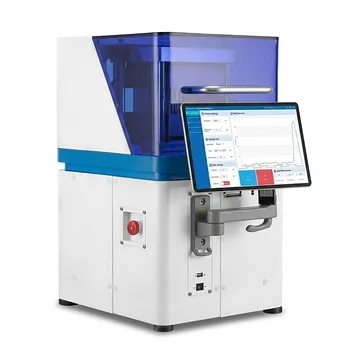
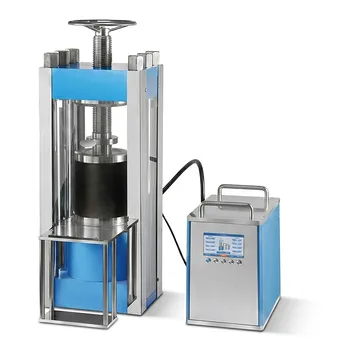
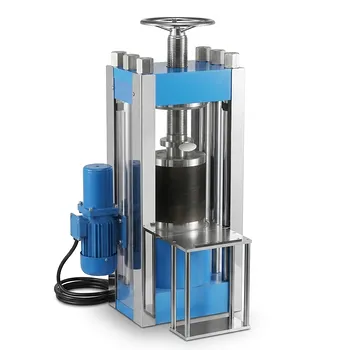
The laboratory heated press is the essential tool for transforming loose, soft fiber samples into rigid, stable specimens suitable for microscopic analysis. By applying simultaneous high temperature and pressure, the press thermally embeds acetylated cotton knit fabrics into polypropylene (PP) granules to create a unified composite material. This process provides the structural support necessary for high-precision cross-sectional cutting with a diamond knife, which is required to observe acetyl group penetration via micro-infrared spectroscopy.
Core Takeaway: A laboratory heated press creates a stable, uniform composite by melting a polymer matrix around soft fibers. This rigid encapsulation is the only way to achieve the clean, precise cross-sections needed for detailed chemical mapping of the fiber’s interior.
The Role of Thermal Embedding in Sample Preparation
Creating a Rigid Support Matrix
Natural fibers like cotton are inherently soft and flexible, making it nearly impossible to cut a clean, undeformed cross-section without support. To solve this, polypropylene (PP) serves as a support medium that encases the fibers, holding them in a fixed position during the cutting process.
Utilizing Simultaneous Heat and Pressure
The heated press utilizes upper and lower platens to apply heat (often around 180°C) and high pressure (ranging from 50 bar to 6 tons) to remelt PP granules or films. This ensures the polymer flows completely around the cotton knit structure, creating a solid composite block without damaging the underlying chemical properties of the acetylated fibers.
Enabling High-Precision Sectioning
Once the composite is formed and cooled, it can be approached with a diamond knife. The rigidity provided by the PP matrix allows the knife to slice through both the polymer and the cotton fibers simultaneously, producing a perfectly flat surface for micro-infrared spectroscopy.
Enhancing Specimen Quality and Consistency
Eliminating Internal Air Pockets
One of the primary technical challenges in composite molding is trapped air, which can distort spectroscopic results or cause structural failure during cutting. The high pressure of the laboratory press eliminates internal air pockets, ensuring the specimen has a stable geometric dimension and uniform density.
Standardizing Thermal History
The press allows for precise control over the heating time and cooling rate, which is critical for the material's final physical properties. By providing a consistent thermal history, the press ensures that any subsequent testing—whether for acetyl penetration or tensile strength—is performed on a standardized sample free from processing stresses.
Achieving Uniform Thickness
For chemical mapping and spectroscopy, the thickness of the sample must be consistent across the entire surface. The press uses metal molds to ensure the final composite film or block has a uniform thickness, which is a requirement for standardized characterization.
Understanding the Trade-offs and Risks
Managing Thermal Degradation
While heat is necessary to melt the PP matrix, excessive temperatures can degrade the acetyl groups or the cotton fibers themselves. Choosing the correct temperature is a delicate balance between achieving a full melt of the polymer and preserving the chemical integrity of the sample.
Impact of Cooling Rates
If the composite is cooled too quickly, it can develop internal stresses or become brittle, leading to cracking during the diamond knife sectioning. Conversely, cooling too slowly may alter the crystallinity of the polypropylene, potentially affecting how the matrix supports the fibers.
Sample Deformation Under Pressure
While high pressure is required to remove voids, excessive force can crush or flatten the cotton knit fabric. This deformation can lead to inaccurate measurements of acetyl group penetration depth, as the original geometry of the fiber cross-section may be distorted.
Applying This Process to Your Research
How to Apply This to Your Project
To achieve the best results when embedding fibers for cross-sectional analysis, your approach should vary based on your specific analytical goal:
- If your primary focus is Chemical Mapping (Spectroscopy): Prioritize the elimination of air pockets and the preservation of fiber chemistry by using the minimum temperature required for a full PP melt.
- If your primary focus is Structural Geometry: Focus on the cooling rate to ensure the matrix is sufficiently rigid to prevent fiber "smearing" or deformation during the diamond knife cut.
- If your primary focus is Standardized Mechanical Testing: Use the press to strictly control thermal history and eliminate internal stresses to ensure repeatable tensile and hardness results.
By precisely controlling the environment in which the composite is formed, you ensure that the resulting data reflects the true properties of the fibers rather than artifacts of a poor preparation process.
Summary Table:
| Feature | Role in Sample Preparation | Technical Benefit |
|---|---|---|
| Thermal Embedding | Melts PP matrix around soft cotton fibers | Creates a rigid, stable specimen for cutting |
| High Pressure | Eliminates internal air pockets | Ensures uniform density and geometric stability |
| Temperature Control | Standardizes thermal history | Preserves chemical integrity of acetyl groups |
| Precision Molds | Defines final composite shape | Achieves uniform thickness for spectroscopy |
Elevate Your Material Analysis with KINTEK Precision
Achieving the perfect fiber cross-section requires more than just heat—it requires precise control and reliability. KINTEK specializes in comprehensive laboratory pressing solutions tailored for demanding research environments. Whether you are conducting battery research or advanced textile analysis, our extensive range of equipment ensures your samples are prepared to the highest standards.
Our Solutions Include:
- Heated & Multifunctional Presses: Ideal for thermal embedding and composite molding.
- Manual & Automatic Models: Flexible options for every laboratory scale.
- Specialized Systems: Glovebox-compatible models and cold/warm isostatic presses (CIP/WIP).
Don't let poor sample preparation compromise your spectroscopic data. Partner with KINTEK for consistent, high-quality results.
Contact Our Experts Today to find the ideal pressing solution for your research.
References
- Satoru Onodera, Akira Isogai. Acetylation of cotton knitted fabrics for improved quick drying after water absorption. DOI: 10.1007/s10570-024-05846-4
This article is also based on technical information from Kintek Solution Knowledge Base .
Related Products
- Automatic Large Format Laboratory Heated Hydraulic Press 400x400mm Plate Capacity
- 24T 30T 60T Heated Hydraulic Lab Press Machine with Hot Plates for Laboratory
- Heated Hydraulic Press Machine with Heated Plates for Vacuum Box Laboratory Hot Press
- Automatic Heated Hydraulic Lab Press 120x120mm Plate Fully Automated Material Research Press
- Laboratory Split Manual Heated Hydraulic Press Machine with Hot Plates
People Also Ask
- What role does a Laboratory Heated Hydraulic Press play in rubber vulcanization? Master Precision Specimen Molding
- How does a laboratory heated hydraulic press improve the performance of dried composite solid-state membranes? Guide
- What are the industrial applications of heated hydraulic presses? Master Heat & Force for Precision Manufacturing
- Why is it necessary to reduce the temperature to 80 °C before releasing pressure? Lock Wood Stability & Density
- How does a heated laboratory hydraulic press contribute to the formation of dense mycelium-based materials? Expert Tips