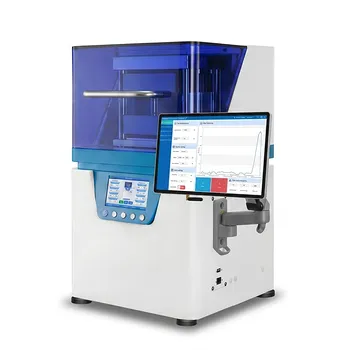
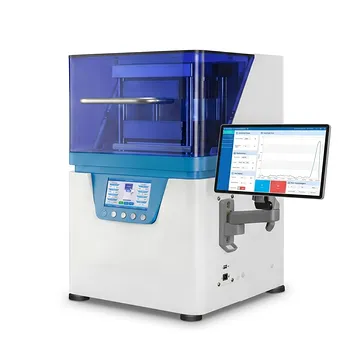
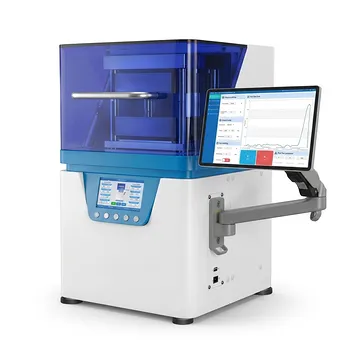
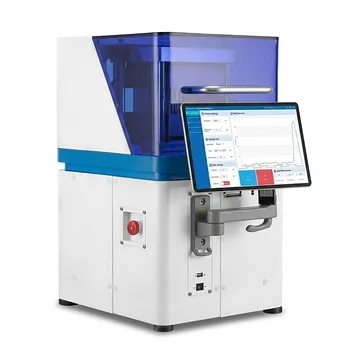
The electric heating hydraulic press is the indispensable mechanism for vulcanization because it simultaneously provides the thermal energy required for chemical cross-linking and the mechanical force necessary for physical density. Specifically, it maintains a constant high-temperature environment (typically around 160°C) to trigger vulcanizing agents while applying high pressure (often 14 MPa or higher) to ensure the rubber compound is free of air bubbles and takes the exact shape of the mold.
Core Takeaway: The press serves as a dual-purpose reactor that converts a plastic, linear NR/NBR mixture into a durable, three-dimensional elastic network. It achieves this by precisely controlling the kinetic energy (heat) and the material compaction (pressure) required for structural integrity.
The Role of Thermal Energy in Chemical Synthesis
Triggering the Cross-Linking Reaction
Natural Rubber (NR) and Nitrile Butadiene Rubber (NBR) initially exist as linear molecular chains with limited strength. The electric heating plates provide the specific thermal energy required to activate accelerators and vulcanizing agents, such as sulfur or peroxides.
Developing the Three-Dimensional Network
At sustained high temperatures, transverse chemical bonds form between these molecular chains, creating a "cross-linked" network. This transformation is what changes the material from a soft, moldable paste into a high-elasticity elastomer.
Maintaining Temperature Uniformity
Electric heating systems allow for precise plate control, ensuring that the NR/NBR composite reaches its optimal cure state ($t_{90}$) throughout the entire sample. Inconsistent heat would lead to localized weak spots where the rubber is either under-cured or thermally degraded.
Mechanical Force and Structural Integrity
Eliminating Internal Voids and Bubbles
As the rubber is heated, trapped air and volatile gases can form internal defects. The hydraulic system applies intense pressure—often exceeding 200 kg/cm²—to force these gases out of the compound before it solidifies.
Ensuring Mold Cavity Precision
High pressure ensures that the viscous rubber compound flows into every corner of the steel mold. This is critical for achieving dimensional stability and ensuring the final NR/NBR product meets exact engineering specifications.
Maximizing Material Density
By compacting the molecular structure during the chemical reaction, the press increases the final density of the specimen. This results in superior mechanical properties, such as higher tensile strength and better resistance to wear.
Understanding the Trade-offs and Risks
The Risk of Thermal Scorching
If the electric heating is not precisely calibrated, the outer layers of the NR/NBR composite may "scorch" or over-vulcanize before the center is cured. This creates a brittle surface and a soft, unstable core.
Pressure-Related Flash and Defect
Excessive hydraulic pressure can cause "flash," where excess rubber is forced out of the mold seams, leading to material waste and intensive post-processing. Conversely, insufficient pressure leads to porous rubber with poor mechanical modulus.
Calibration Complexity
Maintaining a perfect balance between temperature, pressure, and time requires frequent machine calibration. Small deviations in the hydraulic seals or heating elements can lead to an entire batch of composites failing quality standards.
How to Apply These Principles to Your Process
Final Recommendations for Implementation
- If your primary focus is Maximum Durability: Prioritize the precision of the hydraulic pressure setting to ensure high material density and the exclusion of all internal micro-bubbles.
- If your primary focus is Chemical Uniformity: Invest in advanced electric temperature controllers to maintain a deviation of less than ±1°C across the heating plates.
- If your primary focus is Rapid Prototyping: Determine the exact $t_{90}$ time using a moving die rheometer before setting the press cycle to prevent over-vulcanization and energy waste.
By mastering the intersection of thermal kinetics and mechanical compression, you ensure that NR/NBR composites achieve their full theoretical strength and elasticity.
Summary Table:
| Parameter | Role in Vulcanization | Impact on Final Composite |
|---|---|---|
| Thermal Energy (Heat) | Triggers chemical cross-linking ($t_{90}$) | High elasticity and thermal stability |
| Mechanical Force (Pressure) | Eliminates voids and ensures mold flow | Superior tensile strength and density |
| Precise Control | Prevents thermal scorching and flash | Dimensional precision and material savings |
Elevate Your Composite Research with KINTEK
Unlock the full potential of your Natural Rubber and Nitrile Butadiene Rubber composites with KINTEK’s industry-leading laboratory pressing solutions. Whether you are conducting cutting-edge battery research or developing high-performance elastomers, our range of manual, automatic, heated, and multifunctional models—including specialized glovebox-compatible and isostatic presses—provides the precision your process demands.
Ready to optimize your vulcanization results? Contact our experts today to find the perfect press for your lab's needs!
References
- H. Boukfessa, B. Boudjema. The effect of carbon black on the curing and mechanical properties of natural rubber/ acrylonitrile- butadiene rubber composites. DOI: 10.22201/icat.24486736e.2021.19.3.1686
This article is also based on technical information from Kintek Solution Knowledge Base .
Related Products
- Automatic Heated Hydraulic Press Machine with Heated Plates for Laboratory
- Automatic Heated Hydraulic Press Machine with Hot Plates for Laboratory
- Automatic Hydraulic Heat Press Machine with Multi Stage Programmable Control and Integrated Water Cooling Plate Size 180x180mm
- Automatic High Temperature Heated Hydraulic Press Machine with Heated Plates for Lab
- Automatic Heated Hydraulic Lab Press 120x120mm Plate Fully Automated Material Research Press
People Also Ask
- Function of a Laboratory Hydraulic Press with Heated Platens in SSE? Enhance Battery Density & Conductivity
- Why is a laboratory hydraulic press with heating plates required for PLA/TEC films? Achieve Precise Sample Integrity
- What is the function of a manual heated press for PLA 2D scaffolds? Achieve Precise Material Densification
- What are the requirements for electrode pressing with high-viscosity ionic liquids like EMIM TFSI? Optimize Performance
- How does a laboratory heated hydraulic press facilitate PBN sample prep for WAXS? Achieve Precise X-Ray Scattering