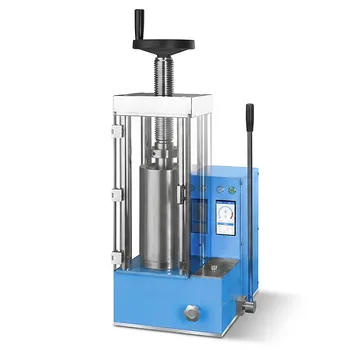
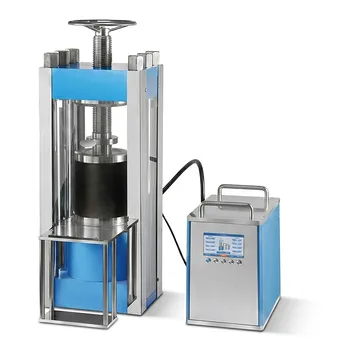
The electric heating laboratory press is the fundamental catalyst for the chemical transformation of Nitrile Butadiene Rubber (NBR)-keratin composites. It provides the simultaneous application of a precise high-temperature environment (typically 160°C) and constant mechanical pressure required to trigger vulcanization. This process converts the raw, plastic rubber compound into a durable elastomer with a stable, three-dimensional network structure.
The laboratory press is indispensable because it delivers the precisely controlled thermal energy needed to activate cross-linking agents and the mechanical force required to eliminate internal defects, ensuring the composite achieves its target mechanical and thermal properties.
Driving the Chemical Cross-Linking Reaction
Activation of Vulcanizing Agents
The press acts as a thermal engine to trigger the chemical reaction of agents like dicumyl peroxide (DCP). Without reaching a specific temperature threshold, such as 160°C, these agents remain dormant, and the rubber cannot transition from a plastic state to an elastic one.
Formation of the 3D Macromolecular Network
Under the heat supplied by the press, macromolecular chains are prompted to combine through transverse chemical bonds. This creates a three-dimensional spatial network that defines the final hardness, thermal stability, and elasticity of the NBR-keratin composite.
Achieving Optimal Vulcanization Time (s90)
Precise temperature control allows researchers to reach the optimal vulcanization time, often referred to as s90. This ensures the material is fully cured throughout its entire thickness without over-processing the exterior.
Mechanical Consolidation and Structural Integrity
Elimination of Internal Defects and Voids
The high pressure (often reaching 1500 psi or 14 MPa) ensures that the rubber compound fills the mold cavity entirely. This force excludes internal air bubbles and gases produced during the reaction, resulting in a dense, uniform material free of internal weak points.
Precision in Specimen Geometry
A laboratory press maintains stable pressure to produce specimens with exact dimensions, such as a 2 mm thickness. This precision is critical for meeting international standards for mechanical performance testing, such as tensile or tear strength assessments.
Promoting Interfacial Bonding
In complex composites like NBR-keratin, pressure drives the rubber matrix to make intimate contact with the reinforcement particles. This physical proximity promotes the formation of chemical bonds or physical interactions at the interface, substantially increasing the material's overall peel strength and durability.
Understanding the Trade-offs
Temperature Sensitivity and Degradation
While heat is necessary for vulcanization, excessive temperature or prolonged exposure can lead to thermal degradation of the NBR or the keratin biological filler. This can result in brittleness or a loss of tensile strength, making precise PID temperature control essential.
Pressure Balance and Flash Formation
Insufficient pressure leads to "porosity" or incomplete mold filling, whereas excessive pressure can cause "flash" (excess material leaking from the mold). Maintaining a balanced, continuous pressure is vital for material uniformity and minimizing waste.
Equipment Calibration Requirements
The reliability of the results depends entirely on the calibration of the platens. If the heating plates provide uneven temperature distribution, the composite will exhibit inconsistent cross-link density, leading to localized failures during stress testing.
How to Apply This to Your Project
Making the Right Choice for Your Goal
- If your primary focus is maximizing mechanical strength: Ensure the press maintains a constant high pressure (at least 14 MPa) to eliminate voids and maximize the density of the 3D network.
- If your primary focus is evaluating heat resistance: Utilize the press to maintain a precise, stable temperature (e.g., 160°C) to ensure the cross-link density is uniform and the polymer chains are fully stabilized.
- If your primary focus is standardized material testing: Prioritize a press with high-precision plates to guarantee consistent specimen thickness and surface finish across all samples.
By mastering the balance of temperature and pressure provided by the laboratory press, you ensure that the NBR-keratin composite transitions from a raw mixture into a high-performance engineering material.
Summary Table:
| Key Factor | Function in Vulcanization | Resulting Benefit |
|---|---|---|
| Temperature (160°C) | Activates cross-linking agents (DCP) | Formation of stable 3D macromolecular network |
| High Pressure (14 MPa) | Eliminates air bubbles and internal voids | Dense, uniform material with high structural integrity |
| Precision Control | Maintains optimal curing time (s90) | Uniform specimen thickness and consistent mechanical data |
| Interfacial Bonding | Drives contact between matrix and filler | Enhanced peel strength and durability of the composite |
Elevate Your Composite Research with KINTEK
Achieving the perfect vulcanization of NBR-keratin composites requires the pinnacle of thermal and mechanical precision. KINTEK specializes in comprehensive laboratory pressing solutions, offering manual, automatic, heated, multifunctional, and glovebox-compatible models, as well as cold and warm isostatic presses widely applied in battery research and advanced polymer science.
Don't let inconsistent pressure or temperature fluctuations compromise your research data. Our high-precision equipment ensures your materials meet the most rigorous international testing standards.
Ready to optimize your lab results? Our technical experts are standing by to help you select the ideal pressing system for your specific application.
Contact KINTEK Today to Enhance Your Laboratory Efficiency
References
- G. Janowska, A. Przepiórkowska. Thermal properties and combustibility of elastomer–protein composites. DOI: 10.1007/s10973-012-2796-2
This article is also based on technical information from Kintek Solution Knowledge Base .
Related Products
- Cylindrical Lab Electric Heating Press Mold for Laboratory Use
- Automatic Heated Hydraulic Press Machine with Heated Plates for Laboratory
- Automatic Heated Hydraulic Press Machine with Hot Plates for Laboratory
- 24T 30T 60T Heated Hydraulic Lab Press Machine with Hot Plates for Laboratory
- Automatic High Temperature Heated Hydraulic Press Machine with Heated Plates for Lab
People Also Ask
- How does a laboratory electric heated press ensure sample quality? Optimize SiR-EPDM vulcanization and molding.
- What role does a laboratory electric heated press play in polymer composite fabrication? Key for Standardized Specimens
- What role does a laboratory electric heating press play in NBR molding? Master Vulcanization & Material Density
- Why is a laboratory electric heating press required for PP/EPDM molding? Achieve Superior Specimen Integrity
- What is the purpose of incorporating cartridge heaters into a lab press mold for MLCC block compression? Optimize Results