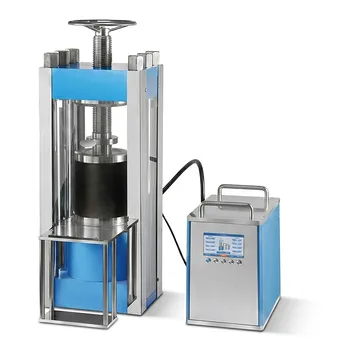
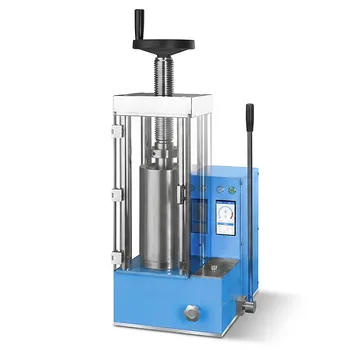
The laboratory electric heated press is the primary tool for converting raw polymer composites into standardized, high-density test specimens through controlled compression molding. By simultaneously applying precise thermal energy and high mechanical pressure, the press eliminates internal air voids and ensures uniform thickness across the material. This process is critical for producing specimens that yield reliable, repeatable data during subsequent mechanical and physical testing.
The laboratory electric heated press serves as the bridge between raw material and standardized data, utilizing thermal-mechanical coupling to ensure structural homogeneity. It transforms heterogeneous mixtures into dense, defect-free plates that accurately reflect a material's intrinsic properties.
Achieving Structural Integrity Through Pressurized Degassing
The Elimination of Internal Voids
The primary function of the press is to remove air pockets and internal defects that naturally occur during the mixing of composite materials. By applying high pressure—often reaching 300 kN—the machine forces out trapped gases, a process known as pressurized degassing.
Maximizing Material Density
As the polymer matrix reaches its melting point or glass transition temperature, the application of force ensures the material attains its maximum theoretical density. High-pressure environments (such as 150 kN to 300 kN) are essential to minimize density gradients and ensure the specimen is physically robust.
Optimizing Interfacial Compatibility
In composites containing fillers, such as ceramic particles, the heated press facilitates the penetration of polymer chains into microscopic gaps. This interfacial bonding is crucial for enhancing properties like ionic conductivity or mechanical reinforcement, which would otherwise be compromised by air gaps.
Ensuring Geometric and Physical Standardization
Precision Control of Specimen Thickness
Standardized testing, such as UL94 flammability or tensile strength tests, requires specimens with consistent thickness and smooth surfaces. The heated press uses precision-ground platens and metal molds to maintain stable geometric dimensions across the entire sample plate.
Reducing Experimental Data Scatter
Non-uniform specimens lead to high variability in test results, making it difficult to draw scientific conclusions. By providing a stable environment of consistent temperature and pressure, the press ensures that every specimen produced has a uniform physical structure, significantly reducing data scatter.
Simulation of Industrial Processes
Laboratory presses allow researchers to simulate industrial-scale hot-pressing on a benchtop level. This enables the study of how manufacturing parameters, such as specific temperature programs or pressure cycles, will affect the final product's performance in a commercial setting.
Controlling Material Morphology and Rheology
Regulation of Crystallization Behavior
The cooling phase of the press cycle is just as critical as the heating phase, particularly for polymers like Poly(lactic acid) (PLA). Programmed cooling rates allow researchers to precisely regulate the crystallization behavior and microscopic morphology of the specimen.
Understanding Phase Transition Kinetics
Because the press provides a controlled thermal environment, it is an essential tool for studying rheological behavior and phase separation. Researchers can observe how polymers flow and bond at specific temperatures, which is vital for developing multi-layer composite systems.
Managing Residual Stresses
Controlled heating and cooling cycles help to relax the polymer chains, significantly reducing residual stresses within the molded plate. This stability prevents the specimens from warping or cracking prematurely during or after the fabrication process.
Understanding the Trade-offs and Limitations
Thermal Gradient Challenges
While heated presses offer precision, large platens can sometimes experience temperature fluctuations across their surface. If the heating is not perfectly uniform, the specimen may exhibit different physical properties at the edges compared to the center.
Material Degradation Risks
Subjecting polymers to high temperatures for extended periods—such as holding at 220°C for degassing—carries the risk of thermal degradation. Users must carefully balance the need for a fully molten state with the material's sensitivity to heat to avoid compromising chemical integrity.
Pressure-Induced Morphology Changes
Excessive pressure can occasionally force fillers to migrate or orient in ways that do not reflect typical application conditions. Researchers must calibrate pressure levels to ensure they are densifying the material without unintentionally altering its internal fiber or filler orientation.
How to Apply This to Your Project
When utilizing a laboratory electric heated press, your operational parameters should be dictated by your specific material goals and testing requirements.
- If your primary focus is mechanical strength testing: Prioritize high-pressure degassing and slow cooling cycles to maximize density and minimize internal residual stresses.
- If your primary focus is optical or surface characterization: Ensure the use of polished metal molds and precise temperature distribution to achieve maximum surface flatness and uniform thickness.
- If your primary focus is thermal or flammability testing (UL94/LOI): Focus on producing specimens with high geometric consistency to ensure your results adhere to international standardization protocols.
By mastering the balance of temperature, pressure, and time, you transform a simple material mixture into a high-fidelity specimen capable of producing definitive scientific insights.
Summary Table:
| Key Feature | Research Benefit | Critical Parameter |
|---|---|---|
| Pressurized Degassing | Removes internal voids and air pockets | Pressure (up to 300 kN) |
| Thermal-Mechanical Coupling | Ensures maximum theoretical density | Melting Point / Tg |
| Geometric Standardization | Consistent thickness for UL94/tensile tests | Platen Parallelism |
| Controlled Cooling | Regulates crystallization and morphology | Cooling Rate |
| Residual Stress Relief | Prevents warping and premature cracking | Annealing Cycle |
Optimize Your Specimen Fabrication with KINTEK
Precision in material testing begins with a perfectly prepared specimen. KINTEK specializes in comprehensive laboratory pressing solutions tailored for advanced research. Whether you are conducting cutting-edge battery research or developing next-generation polymer composites, our range of equipment provides the thermal-mechanical precision you need.
Our Solutions Include:
- Manual & Automatic Heated Presses for reliable compression molding.
- Multifunctional & Glovebox-Compatible Models for sensitive environments.
- Cold and Warm Isostatic Presses (CIP/WIP) for uniform material densification.
Ensure structural homogeneity and reduce experimental data scatter in your lab today. Contact KINTEK Experts to Find Your Solution.
References
- Mihai Georgescu, Dana Gurău. The Influence of Compatibiliser on the Properties of Polymer Composites. DOI: 10.24264/lfj.17.1.7
This article is also based on technical information from Kintek Solution Knowledge Base .
Related Products
- Cylindrical Lab Electric Heating Press Mold for Laboratory Use
- Heated Hydraulic Press Machine with Heated Plates for Vacuum Box Laboratory Hot Press
- 24T 30T 60T Heated Hydraulic Lab Press Machine with Hot Plates for Laboratory
- Automatic Large Format Laboratory Heated Hydraulic Press 400x400mm Plate Capacity
- Automatic Heated Hydraulic Press Machine with Hot Plates for Laboratory
People Also Ask
- How does a laboratory electric heated press ensure sample quality? Optimize SiR-EPDM vulcanization and molding.
- What role does a laboratory electric heating press play in NBR molding? Master Vulcanization & Material Density
- Why is a laboratory electric heating press required for PP/EPDM molding? Achieve Superior Specimen Integrity
- What is the purpose of incorporating cartridge heaters into a lab press mold for MLCC block compression? Optimize Results
- Which lab press parameters are critical for PLA sheet quality? Master Temperature, Pressure & Cooling