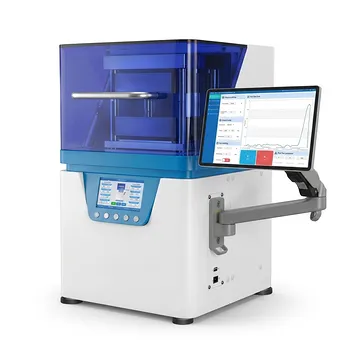
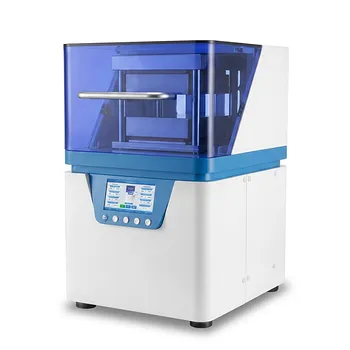
The electric heating plate press is the essential catalyst for transforming raw Styrene-Butadiene Rubber (SBR) from a plastic, moldable mass into a durable, elastic composite. It provides a precisely controlled environment of high temperature (typically around 160°C) and constant hydraulic pressure. This dual-action environment triggers the chemical cross-linking reactions necessary to finalize the material's structural integrity and mechanical properties.
An electric heating plate press is required to bridge the gap between chemical activation and physical shaping. By providing simultaneous heat and pressure, it ensures that cross-linking agents create a uniform three-dimensional network while eliminating internal defects like air bubbles.
The Role of Thermal Energy in Vulcanization
Triggering the Chemical Reaction
The primary purpose of the electric heating plates is to supply the thermal energy required to activate cross-linking agents, such as sulfur or peroxides (e.g., dicumyl peroxide). At specific temperatures, usually near 160°C, these agents react with the SBR macromolecular chains.
Forming the Three-Dimensional Network
As the temperature remains stable, the rubber molecular chains undergo a transformation, combining through transverse chemical bonds. This creates a spatial network structure that shifts the rubber from a plastic state to a vulcanized state.
Ensuring Thermal Stability
Precise temperature control is vital for determining the final thermal stability and hardness of the SBR composite. Without a stable heat source, the cross-link density would be uneven, leading to localized weak points in the finished product.
The Necessity of High-Pressure Application
Eliminating Internal Defects
Constant hydraulic pressure—often reaching levels like 1500 psi—is critical for forcing the rubber compound to flow into every corner of the steel mold. This pressure effectively expels air bubbles and prevents the formation of internal voids that would otherwise compromise the material’s strength.
Ensuring Dimensional Accuracy
The press maintains a uniform pressure environment that guarantees the rubber specimen achieves stable geometric dimensions. This is particularly important in laboratory settings where standardized samples (e.g., 50 x 10 x 4 mm) are required for accurate oxygen index or mechanical testing.
Improving Material Density
High pressure ensures that the rubber and various fillers are packed tightly, resulting in a dense specimen formation. This density is fundamental to achieving high elasticity and high tensile strength in the final SBR product.
Understanding the Trade-offs and Risks
Consequences of Thermal Fluctuation
If the heating plates fail to maintain a constant temperature, the SBR may experience "under-curing" or "over-curing." Under-curing leaves the rubber tacky and weak, while over-curing can make the material brittle and prone to premature degradation.
Risks of Pressure Loss
A drop in pressure during the vulcanization cycle can lead to porosity within the composite. These microscopic holes act as stress concentrators, significantly reducing the mechanical durability and life expectancy of the rubber.
Equipment Calibration Needs
While electric presses offer superior control, they require regular calibration and pressure compensation. Failure to monitor these settings can lead to inconsistencies between batches, making it difficult to achieve standardized material uniformity.
How to Optimize Vulcanization for Your Goal
Application Recommendations
- If your primary focus is Maximum Mechanical Strength: Ensure the press is calibrated for precise pressure compensation to achieve the highest possible cross-link density.
- If your primary focus is Dimensional Precision for Testing: Prioritize the use of high-quality steel molds paired with a press that offers uniform heat distribution across the entire plate surface.
- If your primary focus is Material Uniformity: Closely monitor the temperature stability of the electric plates to prevent localized variations in the rubber’s three-dimensional network.
The controlled application of heat and pressure through an electric heating plate press is the only way to guarantee that SBR composites achieve their intended structural and functional potential.
Summary Table:
| Feature | Role in SBR Vulcanization | Key Benefit |
|---|---|---|
| High Temperature | Triggers sulfur or peroxide cross-linking | Converts rubber from plastic to a durable elastic state |
| Hydraulic Pressure | Forces material flow and expels air bubbles | Eliminates internal defects and increases material density |
| Thermal Stability | Maintains a constant 160°C environment | Prevents under-curing and ensures uniform hardness |
| Pressure Uniformity | Maintains stable geometric dimensions | Essential for standardized testing and dimensional accuracy |
Elevate Your Rubber Composite Research with KINTEK
Achieve unparalleled precision in your vulcanization process with KINTEK’s comprehensive laboratory pressing solutions. Whether you are developing SBR composites or conducting advanced battery research, our high-performance manual, automatic, heated, and multifunctional models provide the exact thermal and pressure control required for material integrity. From glovebox-compatible units to cold and warm isostatic presses, we deliver the tools necessary for flawless material density and structural stability.
Contact KINTEK today to find your perfect laboratory pressing solution!
References
- Przemysław Rybiński, Marek Jóźwiak. Thermal stability and flammability of styrene–butadiene rubber (SBR) composites. DOI: 10.1007/s10973-012-2871-8
This article is also based on technical information from Kintek Solution Knowledge Base .
Related Products
- Automatic Heated Hydraulic Press Machine with Heated Plates for Laboratory
- Automatic High Temperature Heated Hydraulic Press Machine with Heated Plates for Lab
- Automatic Heated Hydraulic Press Machine with Hot Plates for Laboratory
- Cylindrical Lab Electric Heating Press Mold for Laboratory Use
- Split Automatic Heated Hydraulic Press Machine with Heated Plates
People Also Ask
- Function of a Laboratory Hydraulic Press with Heated Platens in SSE? Enhance Battery Density & Conductivity
- Why is a laboratory hydraulic press with heating plates required for PLA/TEC films? Achieve Precise Sample Integrity
- What is the function of a manual heated press for PLA 2D scaffolds? Achieve Precise Material Densification
- What are the requirements for electrode pressing with high-viscosity ionic liquids like EMIM TFSI? Optimize Performance
- How does a laboratory heated hydraulic press facilitate PBN sample prep for WAXS? Achieve Precise X-Ray Scattering