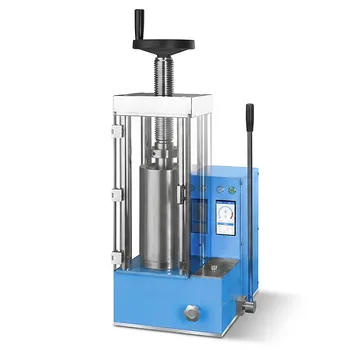
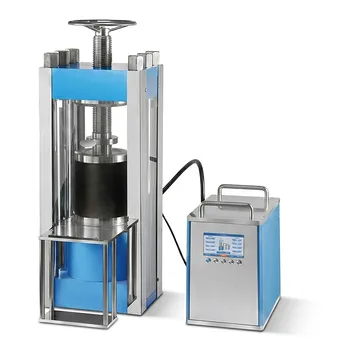
Precise cooling and pressure control are the primary mechanisms used to permanently "lock" wood fibers in their compressed state. By maintaining specific pressure levels while lowering temperatures to approximately 70°C, laboratory presses prevent the wood from returning to its original thickness. This integrated control ensures the densified hardwood achieves a stable target density and maintains its structural integrity without the common risk of "spring-back."
The integration of cooling and pressure control transforms wood densification from a temporary deformation into a permanent material change. This synergy is essential for neutralizing the internal stresses that would otherwise cause the wood to expand and lose its mechanical enhancements.
The Science of Structural Stabilization
Overcoming the Spring-Back Effect
Wood is a naturally viscoelastic material, meaning it possesses a "shape memory" that triggers an elastic recovery once a load is removed. Without sustained pressure during a specific cooling phase, the compressed cells will immediately expand, negating the gains in density and strength.
Locking the Cellular Matrix
The cooling phase in a laboratory press allows the wood to stabilize while the cell structures are still deformed. By reducing the temperature to 70°C or lower before releasing pressure, the press effectively sets the cellular matrix into its new, high-density configuration.
Managing Internal Vapor Pressure
Maintaining pressure until the wood drops below the boiling point of water is a critical safety and quality measure. This prevents internal steam from expanding rapidly, which could otherwise cause the wood layers to delaminate or "explode" upon the release of the press.
Achieving Precision Through Molecular Control
Reaching the Glass Transition Temperature
To compress hardwood without shattering its fibers, the press must reach approximately 140°C to plasticize the lignin and hemicellulose. Precise temperature control ensures these amorphous components transition from a rigid state to a rubbery state, allowing for significant deformation.
Relieving Viscoelastic Tension
During the sustained pressure-holding phase, the press helps eliminate residual stresses within the wood fibers. This relaxation period is vital for ensuring that the final laminated composite does not warp or twist when exposed to environmental changes.
Ensuring Experimental Repeatability
High-precision pressure control allows researchers to achieve exact densification degrees, typically between 10% and 40%. This level of accuracy is necessary to maintain a consistent tangent modulus and density distribution across multiple samples.
Understanding the Trade-offs
Process Throughput vs. Dimensional Stability
While rapid cooling increases the number of samples a lab can produce, it often results in higher internal stress and greater shape memory effect. A slower, controlled cooling curve is required for maximum dimensional stability, even though it reduces overall throughput.
Pressure Intensity and Fiber Integrity
Increasing pressure to reach higher densities can improve hardness, but exceeding the wood's structural limits can cause micro-fractures. If pressure is not ramped and held with precision, the material may suffer a permanent loss in mechanical performance despite its higher density.
Thermal Gradients and Uniformity
In larger samples, the center cools much slower than the surface, which can create a density gradient. Precise thermal management is required to ensure the entire thickness of the hardwood reaches the "locking" temperature simultaneously.
How to Apply This to Your Project
Recommendations for Hardwood Densification
- If your primary focus is Dimensional Stability: Prioritize a slow cooling phase under constant pressure until the core temperature is well below 70°C.
- If your primary focus is Mechanical Strength: Focus on precise temperature control to reach the glass transition point of 140°C, ensuring fibers are plasticized before applying peak pressure.
- If your primary focus is Material Consistency: Utilize high-precision load displays and multi-stage pressure gradients to ensure repeatable density distributions across all samples.
By mastering the intersection of thermal management and mechanical load, you ensure that densified hardwood remains a reliable, high-performance material.
Summary Table:
| Feature | Function in Densification | Key Benefit |
|---|---|---|
| Precise Cooling | Lowers wood temperature to <70°C | Permanently "locks" fibers & prevents spring-back |
| Pressure Control | Sustained load during cooling phase | Neutralizes internal stress & prevents expansion |
| Heat Management | Reaches ~140°C glass transition | Plasticizes lignin to allow deformation without fracture |
| Vapor Control | Pressure held below boiling point | Prevents internal steam from causing delamination |
Master Your Material Research with KINTEK
Achieving perfect hardwood densification or material stabilization requires precise synergy between thermal management and mechanical load. At KINTEK, we specialize in comprehensive laboratory pressing solutions tailored for high-precision applications.
Our extensive range includes manual, automatic, heated, multifunctional, and glovebox-compatible models, as well as cold and warm isostatic presses (CIP/WIP). While these tools are essential for wood science, they are also widely applied in advanced battery research and ceramic engineering, ensuring repeatable results and superior material integrity.
Don't let inconsistent density or structural recovery compromise your research. Partner with KINTEK for the precision your lab deserves.
Contact our experts today to find your ideal pressing solution!
References
- Katharina M黮ler, Edwin Zea Escamilla. Mechanical Characterisation of Densified Hardwood with Regard to Structural Applications. DOI: 10.32604/jrm.2020.09483
This article is also based on technical information from Kintek Solution Knowledge Base .
Related Products
- Lab Round Bidirectional Press Mold
- Electric Isostatic Pressing Machine 40 Tons Automatic Laboratory Powder Compacting Press
- Automatic Laboratory Hydraulic Press for XRF and KBR Pellet Pressing
- Manual Laboratory Hydraulic Press Lab Pellet Press
- Automatic Laboratory Hydraulic Press Lab Pellet Press Machine
People Also Ask
- What is the purpose of incorporating cartridge heaters into a lab press mold for MLCC block compression? Optimize Results
- What is the function of a pressing tool in thermoplastic panels? Master Precision Shaping & Fusion Bonding
- Why is precise cooling management of the lab press mold necessary? Protect Core Integrity in Thermoforming
- Why is a high-performance laboratory molding press critical for in-situ electrolyte formation? Unlock Battery Success
- How do the design and geometric precision of pressing molds and mandrels affect the quality of PTFE composite samples?