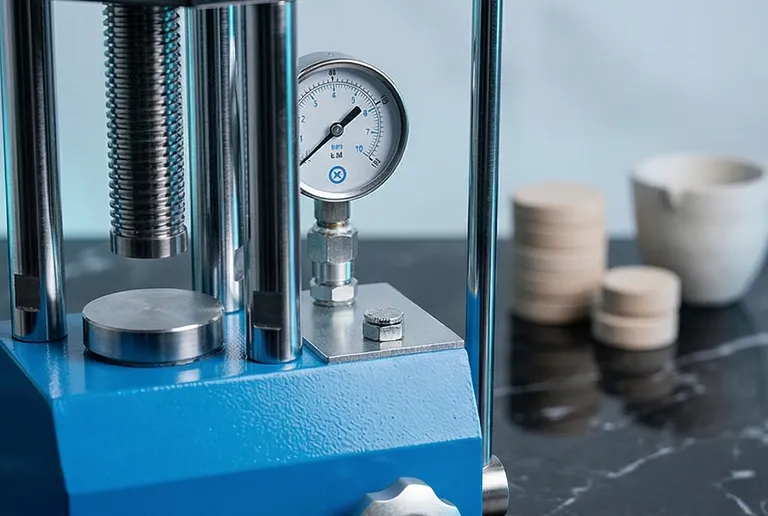
In the world of advanced materials, we often romanticize the furnace. We focus on the searing heat of sintering, where powders fuse into solid reality.
But the success of a ceramic like Li3/8Sr7/16Ta3/4Hf1/4O3 (LSTH) is rarely decided in the heat. It is decided in the cold, mechanical silence of the laboratory press.
If sintering is the "event," pressing is the "strategy." Without a meticulously prepared green body, the furnace is merely a place where expensive powders go to crack, warp, or fail.
The Geometry of Silence: Overcoming the Void
Raw LSTH powder is essentially a chaotic collection of particles separated by air. This air is the enemy of densification.
A laboratory press acts as the architect of order. By applying uniaxial or vertical force, it performs two critical tasks:
- Evacuation: It physically expels trapped air that would otherwise act as a barrier to atomic diffusion.
- Interlocking: It forces particles and binders into a physical embrace, creating "green strength"—the ability of the sample to be handled without crumbling into dust.
In this stage, we are not just making a shape; we are establishing the initial density. This density is the blueprint for everything that follows.
The Sintering Bridge: Atoms Need a Path
Why do we strive for a "high-density" green body? Because atoms cannot jump across a vacuum.
For LSTH to reach its target 98 percent relative density, material must migrate. It moves across the contact points between particles.
A laboratory press maximizes the inter-particle contact area. More contact points mean more "highways" for material migration.
When the green body is dense and uniform:
- Sintering temperatures can be lowered, as the particles are already in close proximity.
- Shrinkage becomes predictable, reducing the risk of macroscopic cracks.
- The microstructure remains uniform, ensuring the final ceramic performs as intended in battery research.
The Psychology of Pressure: The Risk of Perfection
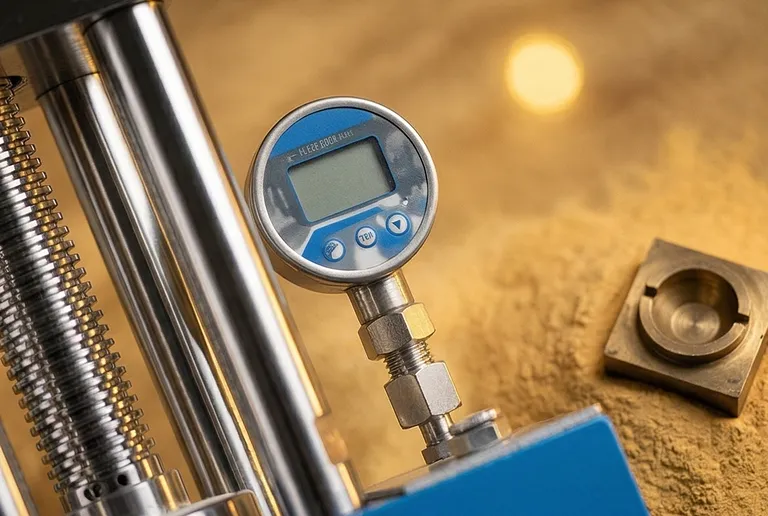
In engineering, more of a good thing is not always better. Pressure is no exception.
The laboratory press operator must navigate a narrow corridor between "not enough" and "too much."
The Friction Problem
As the press pushes down, friction occurs between the LSTH powder and the mold walls. This creates pressure gradients. The center of your pellet may be less dense than the edges. If these gradients are too steep, the ceramic will warp in the furnace, a victim of its own internal stress.
The Phenomenon of "Capping"
If you apply excessive pressure, the material stores elastic energy. When the press releases, that energy can cause the green body to split into horizontal layers—a failure known as capping.
Achieving a 98% density requires a "holding time"—often a patient 90 seconds—to allow the particles to settle into their new reality without structural trauma.
Strategic Decision-Making in Lab Pressing
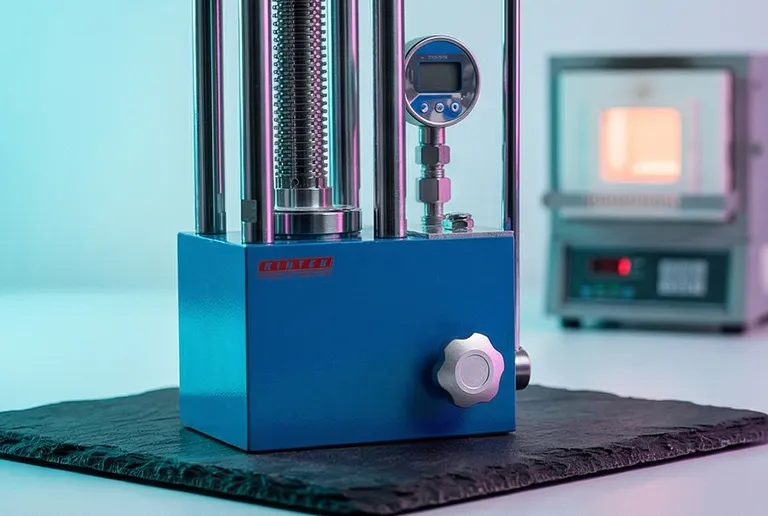
| Research Goal | Recommended Pressing Strategy | Impact on LSTH |
|---|---|---|
| Maximum Density | High-tonnage automatic pressing | Direct path to 98% relative density |
| Complex Geometries | Custom mold sets with binder optimization | Maintains structural integrity |
| Structural Uniformity | Isostatic Pressing (CIP/WIP) | Eliminates internal density gradients |
| Sensitive Environments | Glovebox-compatible systems | Prevents contamination in battery research |
The KINTEK Standard: Precision in Every Pellet
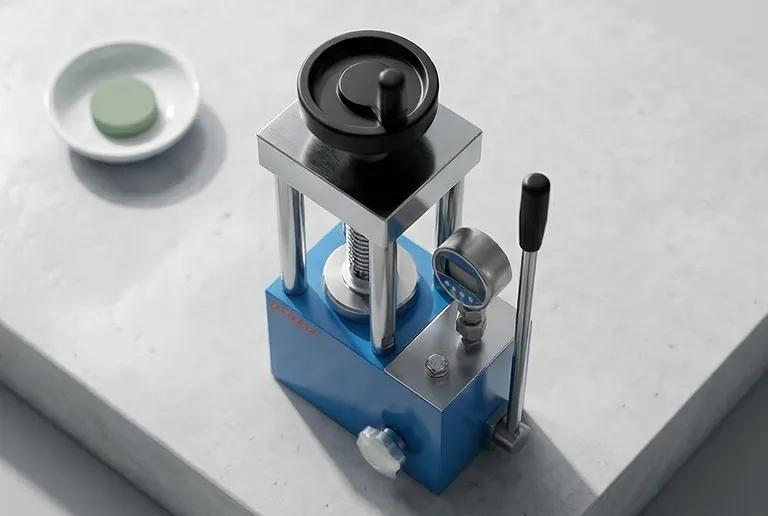
The path to a perfect LSTH ceramic is paved with precise mechanical force. At KINTEK, we provide the tools that turn powder into potential.
From manual and automatic presses for rapid prototyping to heated and multifunctional models for complex material synthesis, our solutions are engineered for the rigors of modern battery research. For those chasing the ultimate in uniformity, our cold and warm isostatic presses eliminate the "friction" variable entirely, ensuring every millimeter of your green body is consistent.
The furnace may finish the job, but the press starts it. Ensure your research has the foundation it deserves.
Related Products
- Lab Round Bidirectional Press Mold
- Automatic Heated Hydraulic Press Machine with Hot Plates for Laboratory
- Laboratory Hydraulic Press Lab Pellet Press Machine for Glove Box
- Special Shape Lab Press Mold for Laboratory Applications
- Manual Laboratory Hydraulic Pellet Press Lab Hydraulic Press
Related Articles
- The Physics of Trust: A Disciplined Approach to Laboratory Press Safety and Reliability
- The Anatomy of Repeatability: Deconstructing the Modern Laboratory Press
- The Unseen Variable: Why Your Lab Press Dictates Your Data's Integrity
- The First Principle: Why Lab Press Installation Governs a Decade of Data
- From Powder to Proof: The Unseen Force in Material Science



















