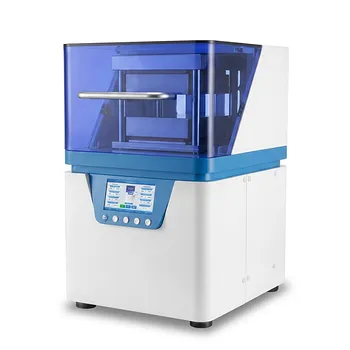
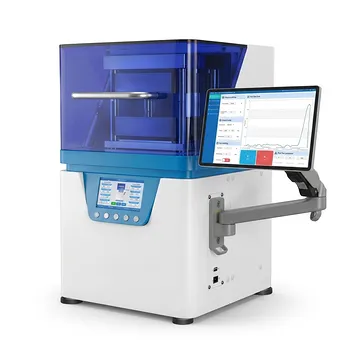
The laboratory heated hydraulic press is the critical driver of both chemical bonding and physical densification in nano-composite particleboards. By applying precise thermal energy (150°C to 180°C) and mechanical pressure (typically 4 MPa), the press facilitates the cross-linking of adhesives and ensures a dense internal structure. This dual-action process, enhanced by the presence of conductive nanoparticles, directly dictates the board's final strength, moisture resistance, and elasticity.
Core Takeaway: A laboratory heated hydraulic press transforms a loose mixture into a high-performance composite by using controlled heat to accelerate resin polymerization and high pressure to eliminate internal voids. The integration of nanoparticles further optimizes this process by improving heat transfer to the core of the board.
Optimizing Chemical Cross-linking through Thermal Control
Accelerating Resin Polymerization
The press provides a stable thermal environment, typically ranging from 150°C to 180°C, which is essential for the urea-formaldehyde resin to cure. This heat initiates the chemical cross-linking of the adhesive, transforming it from a liquid state into a rigid solid matrix.
Enhanced Core Heating via Nanoparticles
When metal oxide nanoparticles with high thermal conductivity are added to the composite, the press can transfer heat more effectively to the core. This deeper penetration ensures that the center of the particleboard reaches the required temperature quickly, preventing "under-cured" centers.
Uniform Curing and Internal Bond Strength
Consistent heat distribution results in significant improvements in internal bond strength. By ensuring every layer of the board cures at a similar rate, the press creates a cohesive structure capable of resisting delamination.
Achieving Structural Density and Void Elimination
Mechanical Densification and Plastic Flow
The application of high pressure, such as 4 MPa, drives particle rearrangement and plastic deformation within the mold. This force pushes the particles closer together, allowing the softened resin to flow and fill microscopic gaps between fibers.
Elimination of Internal Pores
The laboratory press is instrumental in removing internal pores and air bubbles that could otherwise become points of failure. This elimination of defects results in a dense, isotropic sheet with uniform mechanical properties throughout its volume.
Maintaining Morphological Characteristics
Because the press uses uniaxial pressure without intense flow stretching, it preserves the intrinsic morphological characteristics of the composite. This allows researchers to study the material in a non-oriented state, providing a clean baseline for performance testing.
Improving Dimensional Stability and Performance
Resistance to Thickness Swelling
By facilitating a more complete chemical bond and a denser structure, the pressing stage significantly reduces thickness swelling. A well-pressed nano-composite is less prone to absorbing water, which preserves its structural integrity in humid environments.
Increasing the Modulus of Elasticity (MOE)
The synergy of heat, pressure, and nanoparticles increases the modulus of elasticity, making the board stiffer and more capable of supporting loads. The press ensures the nanoparticles are effectively locked within the polymer chains through intercalation or exfoliation.
Surface Quality and Precision
The flat, heated platens of the laboratory press ensure that the final product has specific dimensions and a smooth surface. This precision is vital for meeting industrial standards and ensuring the repeatability of laboratory experiments.
Understanding the Trade-offs and Risks
Risks of Internal Stress and Warping
Rapid cooling or uneven pressure application can lead to internal stress or warping of the boards. To mitigate this, a controlled pressure-holding cooling phase is often necessary to ensure the composite reaches sufficient rigidity before removal.
Potential for Over-curing
While high temperatures accelerate production, excessive heat or prolonged pressing times can lead to over-curing. This can make the resin brittle, potentially decreasing the impact resistance of the particleboard.
Thermal Gradients in Thick Samples
In very thick boards, a "temperature lag" can occur between the surface and the core. Even with conductive nanoparticles, the press must be carefully calibrated to avoid a density gradient, where the surface is significantly denser than the middle.
How to Apply This to Your Project
When utilizing a laboratory heated hydraulic press for nano-composite development, your settings should be dictated by your specific performance goals.
- If your primary focus is Maximum Structural Strength: Prioritize higher pressure (approx. 4-5 MPa) and the inclusion of high-conductivity metal oxide nanoparticles to ensure a fully cured core and high internal bond strength.
- If your primary focus is Dimensional Stability in Humid Environments: Focus on optimizing the temperature (160°C+) and holding time to ensure maximum cross-linking of the resin, which minimizes thickness swelling.
- If your primary focus is Researching Material Anisotropy: Use the press to create non-oriented, isotropic samples as a baseline, ensuring your pressure is applied uniaxially without lateral stretching.
By precisely mastering the balance of thermal energy and mechanical force, you can leverage the laboratory press to unlock the full performance potential of advanced nano-composite materials.
Summary Table:
| Pressing Factor | Influence on Nano-Composite | Key Benefit |
|---|---|---|
| Thermal Energy (150-180°C) | Accelerates resin cross-linking and curing | Higher internal bond strength |
| Mechanical Pressure (4 MPa) | Drives densification and eliminates voids | Uniform density and elasticity |
| Nanoparticle Integration | Enhances core heat transfer conductivity | Faster curing and thermal stability |
| Controlled Cooling | Reduces internal stress and warping | Improved dimensional precision |
Elevate Your Composite Research with KINTEK
Unlock the full potential of your advanced materials with KINTEK’s precision pressing technology. KINTEK specializes in comprehensive laboratory pressing solutions, offering manual, automatic, heated, multifunctional, and glovebox-compatible models, as well as cold and warm isostatic presses widely applied in battery research and high-performance composites.
Our equipment provides the precise thermal and mechanical control necessary to optimize resin polymerization and eliminate internal defects, ensuring your nano-composites meet the highest industrial standards.
Ready to enhance your lab's capabilities? Contact KINTEK today to find your ideal pressing solution!
References
- Luana Cristal Lirya Silva, Cristiane Inácio de Campos. Influence of Pressing Temperatures on Physical–Mechanical Properties of Wood Particleboards Made with Urea-Formaldehyde Adhesive Containing Al2O3 and CuO Nanoparticles. DOI: 10.3390/polym16121652
This article is also based on technical information from Kintek Solution Knowledge Base .
Related Products
- Heated Hydraulic Press Machine with Heated Plates for Vacuum Box Laboratory Hot Press
- Automatic High Temperature Heated Hydraulic Press Machine with Heated Plates for Lab
- Automatic Heated Hydraulic Lab Press with Programmable Touch Screen Controls and Precision Temperature Regulation
- Automatic Hydraulic Heat Press Machine with Multi Stage Programmable Control and Integrated Water Cooling Plate Size 180x180mm
- Automatic Hydraulic Hot Press with Large Plate and Precision Temperature Control for Advanced Material Sample Preparation and Industrial Research
People Also Ask
- How does a laboratory heated hydraulic press facilitate PBN sample prep for WAXS? Achieve Precise X-Ray Scattering
- What are the requirements for electrode pressing with high-viscosity ionic liquids like EMIM TFSI? Optimize Performance
- What are the industrial applications of heated hydraulic presses? Master Heat & Force for Precision Manufacturing
- Function of a Laboratory Hydraulic Press with Heated Platens in SSE? Enhance Battery Density & Conductivity
- How are heated hydraulic presses utilized in the preparation of thin films? Key Mechanisms and Applications