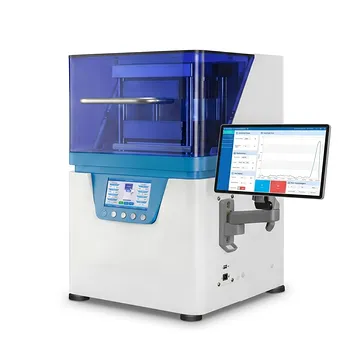
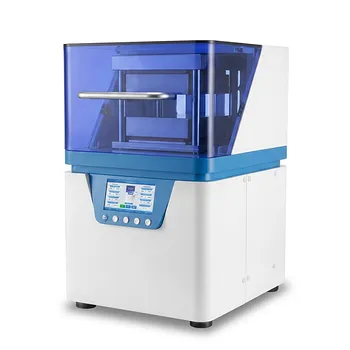
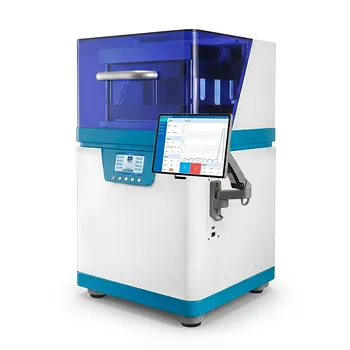
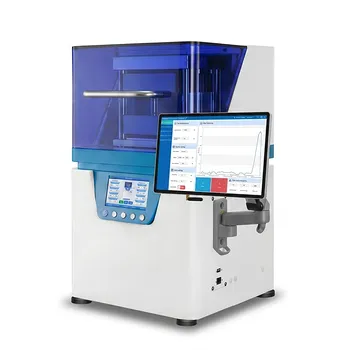
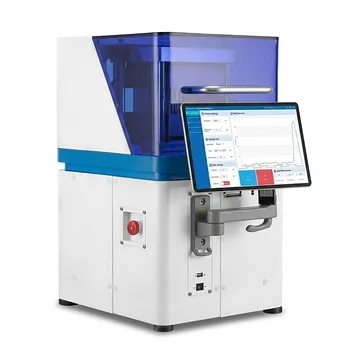
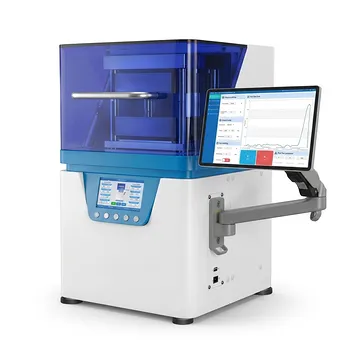
A hydraulic press equipped with heated platens serves as the combined thermal and mechanical engine of the Thermoplastic Resin Transfer Molding (TP-RTM) process. It provides a uniform temperature field (typically between 130-180 °C) to drive the in-situ anionic polymerization of monomers while simultaneously supplying the clamping force required for mold sealing and the compression necessary to control the part's final thickness and fiber volume fraction.
The heated hydraulic press transforms raw monomers and fiber preforms into a high-performance composite by precisely synchronizing chemical reaction kinetics via temperature control and physical consolidation via hydraulic pressure.
Driving the Chemical Synthesis
Initiating In-Situ Polymerization
The heated platens maintain the specific thermodynamic conditions required to trigger the anionic polymerization of caprolactam monomers. Without this precise heat, the chemical reaction that converts the liquid monomer into a solid polyamide matrix would not occur within the mold.
Ensuring Thermal Uniformity
Consistency across the platen surface ensures that the entire part undergoes polymerization at the same rate. This uniform temperature field prevents internal stresses and ensures that the finished composite has consistent mechanical properties from edge to center.
Managing Viscosity and Flow
By providing precise heat, the press maintains the resin at a low viscosity during the initial injection phase. This allows the liquid to thoroughly saturate the fiber preform, ensuring that no dry spots remain before the polymerization reaction solidifies the matrix.
Mechanical Integrity and Structural Precision
Providing Mold Sealing Force
During the injection of the monomer, the hydraulic system generates a massive clamping force to keep the mold halves perfectly aligned and sealed. This prevents "flash" (leaking resin) and allows the system to maintain the internal pressures required for a successful mold fill.
Controlling Fiber Volume Fraction
The press allows for the precise compression of the fiber preform to a specific height. By controlling the gap between the platens, the equipment dictates the final thickness of the part and the ratio of fibers to resin, which are the primary factors in the material's strength-to-weight ratio.
Achieving Material Densification
Through a continuous pressure-holding process, the hydraulic press forces the resin into every microscopic gap within the reinforcement layers. This action eliminates internal pores and voids, resulting in a dense, high-quality composite plate that meets industrial standards.
Understanding the Trade-offs
Thermal Inertia and Cycle Times
Heated platens are often thick and heavy to ensure durability, which leads to high thermal inertia. This means they are slow to change temperatures, potentially lengthening the "cooling" phase of the manufacturing cycle compared to more agile heating methods.
The Risk of Thermal Degradation
If the temperature is not strictly monitored, the resin can be exposed to excessive heat for too long, leading to chemical degradation. This breaks down the polymer chains, significantly reducing the impact resistance and lifespan of the final product.
Pressure Distribution Challenges
While hydraulic systems are powerful, achieving perfectly even pressure across very large surface areas can be difficult. Any deflection in the platens can lead to variations in the thickness of the composite, affecting the dimensional stability of the part.
Applying This to Your Project
Making the Right Choice for Your Goal
The success of the TP-RTM process depends on how you balance the thermal and mechanical inputs of your press.
- If your primary focus is maximum structural strength: Prioritize the pressure-holding phase to ensure the complete elimination of voids and the highest possible densification.
- If your primary focus is rapid production: Optimize the temperature settings to the highest safe limit for the monomer to accelerate the polymerization reaction time.
- If your primary focus is dimensional precision: Utilize a press with high-accuracy displacement control to ensure consistent thickness across multiple production runs.
By mastering the dual functions of heat and pressure, you can ensure the production of consistent, high-performance thermoplastic composites.
Summary Table:
| Function Category | Key Role in TP-RTM | Benefit to Finished Composite |
|---|---|---|
| Thermal | Driving In-Situ Polymerization | Transforms liquid monomers into solid polymer matrices |
| Thermal | Ensuring Thermal Uniformity | Prevents internal stresses and ensures consistent properties |
| Mechanical | Providing Clamping Force | Keeps molds sealed to prevent resin flash and leaks |
| Mechanical | Controlling Fiber Volume | Dictates final part thickness and strength-to-weight ratio |
| Mechanical | Material Densification | Eliminates internal pores and voids for high-density parts |
Optimize Your TP-RTM Process with KINTEK
Achieving the perfect balance of thermal polymerization and mechanical consolidation is critical for high-performance battery research and material science. KINTEK specializes in comprehensive laboratory pressing solutions designed to meet these rigorous demands.
Whether you need manual, automatic, heated, multifunctional, or glovebox-compatible models, our equipment ensures the precise temperature and pressure control required for successful TP-RTM and isostatic pressing.
Ready to enhance your lab's efficiency and material quality?
Contact our experts today to find the ideal pressing solution for your specific application!
References
- James J. Murray, Conchúr M. Ó Brádaigh. Effect of glass fibre sizing on the interfacial properties of composites produced using in-situ polymerised Polyamide-6 transfer moulding. DOI: 10.1016/j.compositesb.2022.109743
This article is also based on technical information from Kintek Solution Knowledge Base .
Related Products
- Heated Hydraulic Press Machine with Heated Plates for Vacuum Box Laboratory Hot Press
- Automatic High Temperature Heated Hydraulic Press Machine with Heated Plates for Lab
- Automatic Heated Hydraulic Lab Press with Programmable Touch Screen Controls and Precision Temperature Regulation
- Automatic Hydraulic Heat Press Machine with Multi Stage Programmable Control and Integrated Water Cooling Plate Size 180x180mm
- Automatic Hydraulic Hot Press with Large Plate and Precision Temperature Control for Advanced Material Sample Preparation and Industrial Research
People Also Ask
- How does a laboratory heated hydraulic press facilitate PBN sample prep for WAXS? Achieve Precise X-Ray Scattering
- What are the requirements for electrode pressing with high-viscosity ionic liquids like EMIM TFSI? Optimize Performance
- What are the industrial applications of heated hydraulic presses? Master Heat & Force for Precision Manufacturing
- Function of a Laboratory Hydraulic Press with Heated Platens in SSE? Enhance Battery Density & Conductivity
- How are heated hydraulic presses utilized in the preparation of thin films? Key Mechanisms and Applications