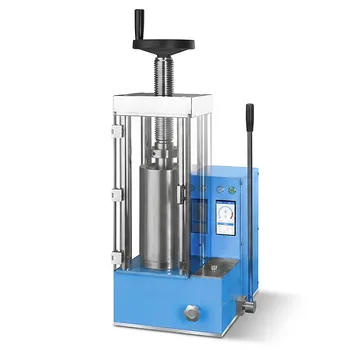
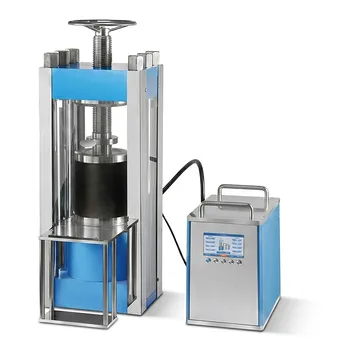
High-precision laboratory pressing is the essential bridge between raw coal powder and valid XPS data, as it eliminates physical irregularities that would otherwise distort chemical signatures. By compressing finely ground coal into dense, thin pellets at specific pressures (typically 8 t/cm²), the press ensures the sample surface is perfectly flat and the internal particles are tightly packed. This standardization is required to minimize signal scattering and maintain the integrity of the sample within the high-vacuum environment of an X-ray Photoelectron Spectrometer.
The core value of a laboratory press lies in its ability to create a uniform, high-density surface that stabilizes the electric field during testing. This process eliminates "differential charging" and signal noise, providing the repeatable foundation necessary for identifying sensitive chemical species like nitrogen peaks (N-5 and N-6).
Optimizing Surface Geometry for Signal Integrity
The Impact of Surface Roughness
XPS is an extremely surface-sensitive technique that analyzes only the top few nanometers of a material. If a coal sample is uneven or loose, the emitted photoelectrons scatter off surface irregularities, leading to signal loss and "shadowing" effects. A high-precision press creates a mirror-like flatness that ensures the X-ray beam hits the sample uniformly.
Maintaining Consistent Sample Height
The focal point of an XPS detector is incredibly narrow. Using a press to achieve a consistent sample height ensures that every pellet sits at the exact same distance from the analyzer. This consistency prevents energy shifts in the data that are caused by physical positioning rather than chemical state.
Ensuring Stability in High-Vacuum Environments
Preventing Sample Dispersion
XPS analysis must be conducted in a high-vacuum environment to allow photoelectrons to reach the detector without colliding with gas molecules. Loose coal powder can "fluidize" or fly out of the sample holder when the vacuum pumps engage. Pressing the powder into a structurally sound pellet ensures the sample remains intact and does not contaminate the expensive vacuum chamber.
Minimizing Void Effects and Outgassing
Internal air pockets or "voids" in a powder sample can cause slow outgassing, making it difficult to reach the required vacuum levels for testing. High-pressure pelletization (up to 8 t/cm²) collapses these voids, creating a dense "green body" that is vacuum-compatible and chemically stable.
Mastering Charge Control and Data Accuracy
Eliminating Differential Charging
Coal is often a poor conductor, meaning it can develop a localized surface charge when hit by X-rays. If the sample surface is uneven or contains gaps, this charge is distributed non-uniformly—a phenomenon known as differential charging. A high-precision press creates a tightly packed particle network that helps establish a stable electric field, allowing charge neutralizers (flood guns) to work effectively.
Resolving Critical Nitrogen Peaks
The accuracy of binding energy data for nitrogen species, such as N-5 and N-6 peaks, depends entirely on a stable energy scale. By ensuring a uniform surface and controlled charging environment, the laboratory press allows researchers to distinguish between these closely related chemical states with high resolution. Without this precision, the peaks would blur together, rendering the analysis inconclusive.
Understanding the Trade-offs
The Risk of Over-Compression
While high pressure is necessary for density, exceeding the recommended pressure limits (like 8 t/cm²) can occasionally lead to mechanical alterations or sample deformation. If the pressure is too high, the pellet may become brittle and crack, or the surface may become contaminated by the material of the pressing mold.
The Problem of Insufficient Pressure
Using a low-quality press or insufficient force results in "soft" pellets that crumble easily. These pellets often suffer from internal structural variations, which lead to inconsistent density gradients. This inconsistency introduces measurement errors in porosity and adsorption capacity, which can skew the interpretation of the coal's physical and chemical characteristics.
Applying Pressing Techniques to Your Research
To achieve the best results in your spectroscopic analysis, your preparation strategy should align with your specific research objectives.
- If your primary focus is high-resolution chemical mapping: Use a high-precision press to achieve maximum surface flatness, which minimizes scattering and allows for the precise identification of nitrogen and sulfur species.
- If your primary focus is comparative material studies: Focus on the repeatability of the pressing force to ensure that every sample has the exact same density gradient and height, eliminating physical variables between tests.
- If your primary focus is structural integrity under vacuum: Prioritize a high-pressure hold time to ensure that all internal voids are collapsed, preventing sample "blowout" or excessive outgassing during the vacuum ramp-up.
Ultimately, the laboratory press transforms a chaotic powder into a standardized analytical specimen, ensuring that the resulting data reflects the coal's true chemistry rather than its physical preparation.
Summary Table:
| Key Benefit | Impact on XPS Analysis | Research Value |
|---|---|---|
| Mirror-Like Flatness | Eliminates signal scattering & shadowing | Enhances signal integrity |
| Structural Density | Prevents sample dispersion in high vacuum | Protects vacuum chambers |
| Height Consistency | Prevents energy shifts in the detector | Ensures repeatable data |
| Void Elimination | Minimizes outgassing for faster vacuum | Improves testing efficiency |
| Stable Electric Field | Resolves sensitive N-5/N-6 chemical peaks | Accurate species identification |
Elevate Your Analytical Precision with KINTEK
Don’t let poor sample preparation compromise your research. KINTEK specializes in comprehensive laboratory pressing solutions, offering a versatile range of manual, automatic, heated, multifunctional, and glovebox-compatible models, as well as cold and warm isostatic presses.
Whether you are conducting advanced battery research or complex coal spectroscopy, our high-precision presses provide the surface uniformity and vacuum stability necessary for valid, repeatable data. Contact KINTEK today to find the perfect pressing solution tailored to your laboratory's needs!
References
- Dongna Liu, Shangqing Zhang. The Occurrence and Distribution of Nitrogen in Coal of Different Ranks and Densities. DOI: 10.3390/min14060549
This article is also based on technical information from Kintek Solution Knowledge Base .
Related Products
- Automatic Hydraulic Hot Press with Large Plate and Precision Temperature Control for Advanced Material Sample Preparation and Industrial Research
- Automatic Heated Hydraulic Lab Press with Programmable Touch Screen Controls and Precision Temperature Regulation
- Special Shape Lab Press Mold for Laboratory Applications
- Lab Round Bidirectional Press Mold
- 24T 30T 60T Heated Hydraulic Lab Press Machine with Hot Plates for Laboratory
People Also Ask
- What are the specific features and applications of hydraulic hot press machines? Precision Solutions for Modern Labs
- How does an automatic hydraulic press operate? Achieve Precision and Consistency in Lab Pelleting
- What are the advantages and common applications of an automatic hydraulic press? Elevate Your Lab's Precision
- What is the technical significance of setting a precise dwell time? Achieve Peak Material Density and Stability
- When is an automatic hydraulic press more suitable than a manual press? Scale Your Lab with Precision & Speed