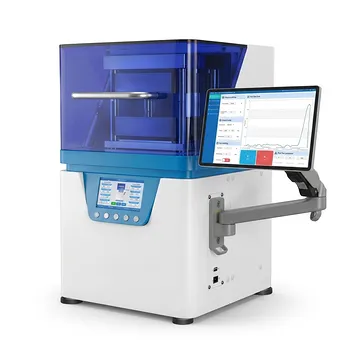
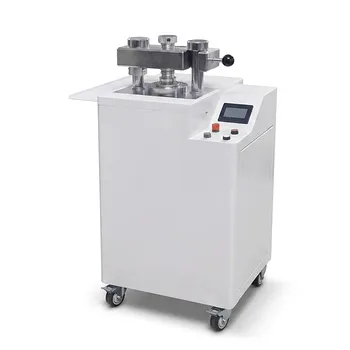
The primary function of a high-precision laboratory hydraulic press is to induce controlled displacement and rearrangement of randomly packed spheres. By applying uniaxial pressure, the press forces these spheres into a specific axial alignment, increasing the average coordination number—the number of contact points between individual spheres—while simultaneously reducing the distance between their centers.
This process transforms loose, hollow spheres into a stable "green body" skeleton, establishing the essential physical contact points and geometric foundation required for subsequent sintering neck growth.
The Mechanics of Uniaxial Compaction
Displacement and Rearrangement
In its initial state, a hollow sphere mixture consists of randomly distributed particles with significant void spaces. The hydraulic press applies uniaxial force to move these spheres into a more compact, organized configuration along the axis of pressure.
This rearrangement is the first step in converting a loose collection of components into a singular, cohesive material. Without this controlled movement, the resulting composite would lack the structural uniformity needed for advanced applications.
Increasing the Coordination Number
As the press reduces the volume of the mixture, the average coordination number—or the number of neighboring spheres touching any single sphere—increases. This increase is critical because it multiplies the potential sites for bonding during later processing stages.
A higher coordination number ensures that the mechanical load is distributed across more points of contact. This enhances the overall structural integrity of the hollow sphere skeleton.
Establishing the Structural Foundation
Formation of the Hollow Sphere Skeleton
The primary goal of compaction is to establish the initial physical contact between spheres. This creates a self-supporting skeleton that defines the internal architecture of the composite material.
By forming this skeleton, the press ensures the material can be handled as a green body. This intermediate state has enough mechanical strength to maintain its shape before it undergoes high-temperature treatment.
Geometric Preparation for Sintering
The hydraulic press provides the geometric foundation necessary for "neck growth" during the sintering process. Sintering requires particles to be in close proximity so that atoms can diffuse across contact points to form solid bridges.
By precisely controlling the distance between sphere centers, the press dictates how effectively these necks will form. This directly influences the final density and mechanical properties of the finished composite.
The Role of Precision and Pressure Control
Uniform Density and Stress Reduction
High-precision presses are designed to distribute pressure uniformly within the mold. This prevents the formation of internal stress gradients and density variations that could lead to cracking or warping.
Uniformity is especially vital in hollow sphere composites, where non-uniform pressure could cause localized crushing of the fragile spheres. Precision ensures the spheres rearrange without losing their structural hollow form.
Achieving Specific Green Body Geometry
The press consolidates loose powder or spheres into a specific shape, such as a disc or cylinder, using matching steel molds. This defines the final dimensions of the sample and ensures consistency across different batches.
Establishing this dimensionally consistent sample base is a prerequisite for high-pressure processing or spectroscopic analysis. It allows researchers to produce standardized samples for rigorous physical characterization.
Understanding the Trade-offs
Structural Fragility vs. Compaction Density
The most significant challenge in compacting hollow sphere composites is the risk of sphere fracture. While higher pressure increases density and coordination numbers, exceeding the crush strength of the spheres destroys the lightweight properties of the composite.
Technical advisors must balance the need for a dense skeleton with the mechanical limits of the hollow spheres. Over-compaction leads to a solid-like matrix, defeating the purpose of using hollow precursors.
Friction and Wall Effects
During uniaxial compaction, friction between the spheres and the mold walls can lead to pressure loss. This results in the "top" of the sample being denser than the "bottom," creating a non-homogeneous material.
To mitigate this, lubrication or double-action pressing (where pressure is applied from both ends) may be necessary. Ignoring these effects can result in a composite with inconsistent thermal or acoustic insulation properties.
How to Apply This to Your Project
Making the Right Choice for Your Goal
To achieve the best results with a laboratory hydraulic press, you must align your pressure settings with your specific material objectives.
- If your primary focus is maximizing lightweight properties: Use the minimum pressure required to reach the percolation threshold, ensuring the hollow spheres remain intact.
- If your primary focus is mechanical load-bearing: Aim for a higher coordination number through increased pressure, even if it results in slight deformation of the sphere walls.
- If your primary focus is subsequent sintering efficiency: Prioritize the precision of center-to-center distances to ensure uniform neck growth across the entire skeleton.
Precision compaction is the bridge between a loose mixture of spheres and a high-performance engineered composite.
Summary Table:
| Function | Impact on Material | Importance for Process |
|---|---|---|
| Displacement & Rearrangement | Reduces void spaces and aligns spheres axially | Converts loose mixture into a cohesive skeleton |
| Increased Coordination Number | Multiplies contact points between neighboring spheres | Provides more sites for bonding during sintering |
| Center Distance Reduction | Shortens the distance between sphere centers | Establishes the geometric foundation for neck growth |
| Uniform Pressure Control | Eliminates internal stress gradients | Prevents sphere fracturing and ensures consistent density |
Elevate Your Research with KINTEK Precision
Maximize the potential of your material science projects with KINTEK’s comprehensive laboratory pressing solutions. Whether you are conducting advanced battery research or developing lightweight composites, our range of equipment is designed to meet your specific compaction needs:
- Versatile Models: Manual, automatic, heated, and multifunctional presses.
- Specialized Applications: Glovebox-compatible models and both cold/warm isostatic presses.
- Precision Performance: Achieve the exact coordination number and green body density required for superior sintering results.
Don't compromise on your structural integrity. Contact KINTEK today to find the perfect pressing solution for your laboratory!
References
- Isao Taguchi, Michio KURASHIGE. Macroscopic Conductivity of Uniaxially Compacted, Sintered Balloon Aggregates. DOI: 10.1299/jtst.2.19
This article is also based on technical information from Kintek Solution Knowledge Base .
Related Products
- Automatic Hydraulic Hot Press with Large Plate and Precision Temperature Control for Advanced Material Sample Preparation and Industrial Research
- Automatic Heated Hydraulic Lab Press with Programmable Touch Screen Controls and Precision Temperature Regulation
- 24T 30T 60T Heated Hydraulic Lab Press Machine with Hot Plates for Laboratory
- Automatic High Temperature Heated Hydraulic Press Machine with Heated Plates for Lab
- Laboratory Hydraulic Press 2T Lab Pellet Press for KBR FTIR
People Also Ask
- What are the specific features and applications of hydraulic hot press machines? Precision Solutions for Modern Labs
- How does an automatic hydraulic press operate? Achieve Precision and Consistency in Lab Pelleting
- What are the advantages and common applications of an automatic hydraulic press? Elevate Your Lab's Precision
- What is the technical significance of setting a precise dwell time? Achieve Peak Material Density and Stability
- When is an automatic hydraulic press more suitable than a manual press? Scale Your Lab with Precision & Speed