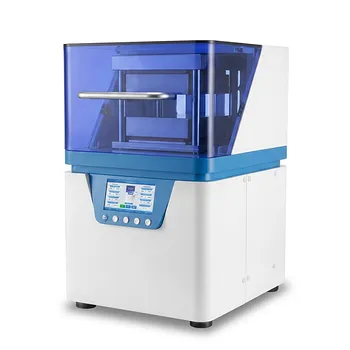
A high-precision hot press acts as the critical consolidation engine for CF/PA12 composite femoral stems. During the compression molding phase, it provides a synchronized environment of 250°C thermal energy and constant external pressure. This dual action melts the PA12 thermoplastic matrix and forces it to fully impregnate the carbon fiber braided sleeve, transforming raw materials into a high-performance medical implant.
The high-precision hot press is the decisive factor in achieving the low-porosity, dense microstructure required for the mechanical reliability of orthopedic stems. By precisely controlling the transition of the PA12 matrix from a solid to a melt under pressure, the machine eliminates internal voids and ensures a robust interfacial bond.
Facilitating Matrix Melt and Fiber Impregnation
Reaching the Thermal Threshold
The PA12 matrix requires a precise temperature of 250°C to reach its molten state. The hot press maintains this stable thermal energy to ensure the thermoplastic flows consistently through the complex geometry of the femoral stem mold.
Achieving Full Infiltration
Under high external pressure, the molten PA12 is forced into the microscopic gaps of the carbon fiber braided sleeve. This thorough "wet-out" is essential to ensure every fiber is encapsulated, which prevents the formation of weak spots that could lead to premature failure.
Controlling Resin Distribution
The precision of the press allows for accurate resin content control across the entire part. This ensures that the carbon fiber and PA12 are distributed uniformly, which is vital for the balanced mechanical properties required in a weight-bearing femoral stem.
Ensuring Dense Solidification and Structural Integrity
Eliminating Internal Porosity
High-precision pressure control effectively removes air bubbles and internal voids that naturally occur during the stacking of composite layers. Low porosity is a non-negotiable requirement for medical implants to prevent material fatigue and ensure long-term biocompatibility.
Optimizing Multilayer Consolidation
The hot press applies constant pressure during the solidification phase of the multilayer composites. This creates a dense, unified mass with high-quality microstructures, ensuring the stem can withstand the rigorous stresses of human locomotion.
Reducing Internal Stresses
By providing a controlled environment for both heating and cooling, the press helps minimize processing internal stresses. This results in test specimens and final products that possess uniform macroscopic dimensions and standardized mechanical properties.
Understanding the Trade-offs and Technical Risks
The Risk of Thermal Inconsistency
If the temperature fluctuates below the required 250°C, the PA12 will not reach the necessary viscosity for full infiltration. This leads to "dry" fiber zones where the matrix fails to bond with the reinforcement, significantly weakening the stem.
The Impact of Pressure Variations
Inadequate pressure results in high internal porosity and irregular thickness. Conversely, excessive pressure can cause "resin bleed-out," where too much matrix is squeezed out of the mold, leaving the composite with an incorrect fiber-to-matrix ratio.
Material Degradation
While heat is necessary for melting, exceeding the optimal temperature range can lead to the thermal degradation of the PA12 polymer. This compromises the structural integrity of the composite and could potentially release degradation byproducts that are unsuitable for medical use.
How to Apply This to Your Fabrication Process
A successful fabrication strategy depends on aligning the press parameters with your specific quality requirements.
- If your primary focus is mechanical longevity: Prioritize a press that maintains constant, stable pressure throughout the entire solidification cycle to maximize density and eliminate fatigue-inducing voids.
- If your primary focus is dimensional accuracy: Utilize a press with high-precision heated plates to ensure uniform heat distribution, which minimizes internal stresses and ensures the stem matches the mold geometry exactly.
- If your primary focus is production consistency: Implement a press with segmented pressure and temperature controls to standardize the impregnation phase, ensuring every femoral stem meets strict medical-grade benchmarks.
Masterful control over the hot press environment transforms raw carbon fiber and PA12 into a sophisticated, medically-viable composite structure.
Summary Table:
| Fabrication Step | Role of High-Precision Hot Press | Critical Outcome |
|---|---|---|
| Matrix Melting | Maintains stable thermal energy at 250°C | Ensures PA12 flows through complex mold geometries |
| Fiber Impregnation | Applies constant external pressure | Eliminates internal voids and creates a robust bond |
| Consolidation | Precise resin content & distribution control | Achieves high-density microstructure and mechanical strength |
| Cooling/Solidification | Controlled environment for stress reduction | Minimizes internal stresses and ensures dimensional accuracy |
Elevate Your Composite Fabrication with KINTEK Precision
Achieving the mechanical reliability required for medical-grade CF/PA12 implants demands absolute control over temperature and pressure. KINTEK specializes in comprehensive laboratory pressing solutions designed to meet these rigorous standards. Our diverse range includes:
- Manual & Automatic Presses for versatile lab workflows.
- Heated & Multifunctional Models for precise thermal consolidation.
- Glovebox-Compatible Systems for sensitive research environments.
- Cold & Warm Isostatic Presses widely utilized in advanced battery research and composite development.
Ready to eliminate porosity and enhance the structural integrity of your materials? Our experts are here to help you select the ideal pressing solution for your specific application.
Contact KINTEK Today to Optimize Your Lab Process
References
- Melissa Campbell, L’Hocine Yahia. Performance of CF/PA12 composite femoral stems. DOI: 10.1007/s10856-007-3073-y
This article is also based on technical information from Kintek Solution Knowledge Base .
Related Products
- Automatic Hydraulic Hot Press with Large Plate and Precision Temperature Control for Advanced Material Sample Preparation and Industrial Research
- Automatic High Temperature Heated Hydraulic Press Machine with Heated Plates for Lab
- Automatic Heated Hydraulic Lab Press with Programmable Touch Screen Controls and Precision Temperature Regulation
- Warm Isostatic Press for Solid State Battery Research Warm Isostatic Press
- Split Automatic Heated Hydraulic Press Machine with Heated Plates
People Also Ask
- What are the specific features and applications of hydraulic hot press machines? Precision Solutions for Modern Labs
- How does an automatic hydraulic press operate? Achieve Precision and Consistency in Lab Pelleting
- What are the advantages and common applications of an automatic hydraulic press? Elevate Your Lab's Precision
- What is the technical significance of setting a precise dwell time? Achieve Peak Material Density and Stability
- When is an automatic hydraulic press more suitable than a manual press? Scale Your Lab with Precision & Speed