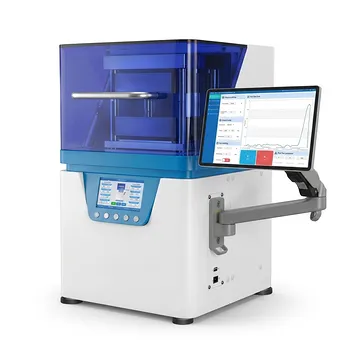
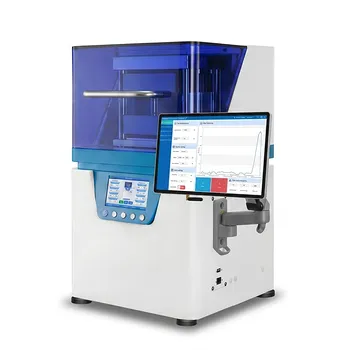
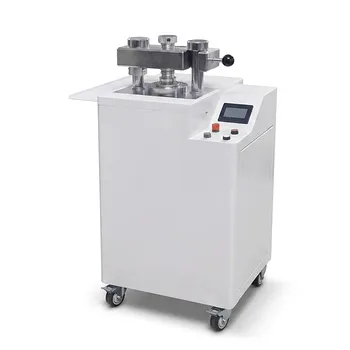
A laboratory high-pressure hydraulic press is the fundamental bridge between raw powder synthesis and functional solid-state battery testing. It is essential for LATP research because it applies the precise, high-magnitude force—often between 300 and 400 MPa—required to transform loose powders into dense, uniform "green bodies." Without this controlled densification, the material remains porous, resulting in poor ionic conductivity and unreliable experimental data.
The core purpose of a hydraulic press in solid electrolyte research is to maximize particle-to-particle contact while eliminating internal voids. This mechanical consolidation is the physical foundation for achieving high ionic conductivity and ensuring the structural integrity of the electrolyte during sintering and battery assembly.
Optimizing Electrochemical Performance
Minimizing Grain Boundary Resistance
Solid electrolytes like LATP rely on the seamless movement of ions across particle boundaries. A hydraulic press applies high-pressure cold press molding to increase physical contact points between oxide or halide particles.
By reducing the gaps between these particles, the press significantly lowers grain boundary resistance. This is a prerequisite for achieving the high ionic conductivity levels required for viable solid-state batteries.
Eliminating Microporous Defects and Air Voids
Loose powder contains significant amounts of trapped air and internal voids that act as insulators. The hydraulic press facilitates the rearrangement and plastic deformation of particles to exclude this air.
Eliminating these microporous defects ensures a higher relative density. This high level of densification is critical for obtaining accurate data during Electrochemical Impedance Spectroscopy (EIS) testing.
Ensuring Structural Integrity and Consistency
Formation of Robust Green Bodies
The "green body" is the compressed powder pellet before it undergoes high-temperature sintering. A high-precision press ensures these pellets have uniform density and consistent dimensions.
This uniformity prevents deformation, warping, or cracking during the subsequent sintering stages. A structurally sound green body is essential for producing a final ceramic electrolyte that can survive the rigors of lab handling.
Substrate Preparation for Protective Films
In advanced LATP research, the electrolyte often requires functional coatings, such as hexagonal boron nitride (h-BN) protective films. The hydraulic press provides the flat, sturdy, and smooth substrate necessary for these coatings to adhere correctly.
A precise surface prevents mechanical damage during the coating process. It also ensures that the interface between the electrolyte and the protective layer is uniform, which is vital for long-term cycling stability.
Reliability of Experimental Data
Consistency in Mechanical Property Testing
Beyond electrical traits, researchers must measure the shear modulus and bulk modulus of LATP. These mechanical properties are highly sensitive to the sample's porosity and internal structure.
By providing stable and balanced pressure control, the hydraulic press ensures that physical parameters are reproducible. This allows researchers to validate machine learning models or theoretical predictions with high-fidelity experimental data.
Prevention of Assembly Failure
Solid-state battery assembly involves significant mechanical stress when stacking layers. A press-formed LATP pellet is far more resistant to mechanical failure and fracture during cell integration.
Controlled pressure ensures the electrolyte layer thickness is consistent across the entire diameter. This consistency reduces interfacial contact resistance when the electrolyte is sandwiched between electrodes.
Understanding the Trade-offs
The Risk of Over-Pressurization
While high pressure is necessary for densification, exceeding the material's elastic limit can introduce micro-cracks. These invisible fractures can lead to catastrophic failure when the battery is charged, as they provide pathways for lithium dendrite growth.
Pressure Distribution Non-Uniformity
Standard molds may suffer from friction-induced pressure gradients, where the center of the pellet is denser than the edges. This non-uniformity can lead to localized "hot spots" in ionic flow, causing skewed conductivity results and inconsistent performance across different sample batches.
How to Apply This to Your Research
Making the Right Choice for Your Goal
To achieve the best results with LATP and similar solid electrolytes, tailor your pressing strategy to your specific research objective:
- If your primary focus is Maximum Ionic Conductivity: Prioritize a press with precise dwell time control and high-pressure capabilities (up to 400 MPa) to ensure total elimination of voids.
- If your primary focus is Coating and Interface Study: Use a high-precision mold to ensure a perfectly flat surface finish and uniform thickness for the application of protective films.
- If your primary focus is Data Reproducibility: Invest in an automated hydraulic press to eliminate human error in pressure application, ensuring every sample in your study is identical.
Ultimately, the precision of your hydraulic press dictates the reliability of every subsequent measurement in the solid-state battery development lifecycle.
Summary Table:
| Key Feature | Research Benefit | Impact on Electrochemical Performance |
|---|---|---|
| High-Magnitude Force | Eliminates internal voids and air pockets | Maximizes ionic conductivity and density |
| Precise Cold Pressing | Minimizes grain boundary resistance | Enhances seamless ion movement across particles |
| Uniform Densification | Creates robust, crack-free green bodies | Ensures structural integrity during sintering |
| Surface Precision | Provides a flat, smooth substrate | Facilitates uniform application of protective films |
| Automated Controls | Removes human error and pressure gradients | Guarantees high-fidelity, reproducible data |
Elevate Your Solid-State Battery Research with KINTEK
Precision in densification is the difference between a failed pellet and a breakthrough in ionic conductivity. KINTEK specializes in comprehensive laboratory pressing solutions tailored for the rigorous demands of battery research.
Our extensive range includes:
- Manual & Automatic Presses: For versatile and high-throughput pellet preparation.
- Heated & Multifunctional Models: To explore advanced material synthesis conditions.
- Glovebox-Compatible Designs: For moisture-sensitive LATP and solid electrolyte handling.
- Isostatic Presses (Cold/Warm): For uniform pressure distribution and superior material density.
Ready to eliminate voids and achieve reliable experimental results? Contact KINTEK today to find the perfect pressing solution for your lab!
References
- Seung‐Hyeok Kim, Hyeon Suk Shin. Hexagonal boron nitride nanomaterials for multifunctional integration in next-generation batteries. DOI: 10.1557/s43581-025-00134-5
This article is also based on technical information from Kintek Solution Knowledge Base .
Related Products
- Automatic High Temperature Heated Hydraulic Press Machine with Heated Plates for Lab
- Automatic Hydraulic Hot Press with Large Plate and Precision Temperature Control for Advanced Material Sample Preparation and Industrial Research
- 24T 30T 60T Heated Hydraulic Lab Press Machine with Hot Plates for Laboratory
- Warm Isostatic Press for Solid State Battery Research Warm Isostatic Press
- Lab Round Bidirectional Press Mold
People Also Ask
- Function of a Laboratory Hydraulic Press with Heated Platens in SSE? Enhance Battery Density & Conductivity
- What are the requirements for electrode pressing with high-viscosity ionic liquids like EMIM TFSI? Optimize Performance
- How does a laboratory heated hydraulic press facilitate PBN sample prep for WAXS? Achieve Precise X-Ray Scattering
- What are the industrial applications of heated hydraulic presses? Master Heat & Force for Precision Manufacturing
- Why is a laboratory hydraulic press with heating plates required for PLA/TEC films? Achieve Precise Sample Integrity