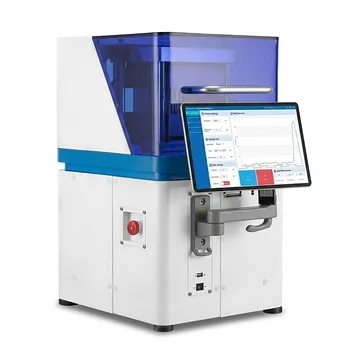
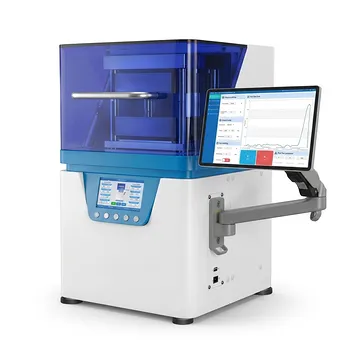
Precise temperature control is the cornerstone of high-performance polymer composite manufacturing.
In a heated hydraulic press, temperature precision directly dictates the melting behavior, viscosity changes, and cross-linking kinetics of the polymer matrix. By maintaining an exact thermal environment, manufacturers ensure that thermoplastic materials fully infiltrate reinforcement phases and that thermosetting resins achieve synchronous curing throughout the mold cavity. This level of control is necessary to eliminate internal defects like micro-voids, thereby maximizing the interfacial bonding strength and the final mechanical properties of the composite.
Core Takeaway: Temperature precision is not merely a setting but a critical process variable that balances material fluidity against thermal degradation. It ensures the physical transition from raw material to a dense, defect-free structure while preserving the chemical integrity of the polymer.
Managing Fluidity and Matrix Infiltration
Optimizing Viscosity for Complex Geometries
The fluidity of a polymer is highly sensitive to temperature fluctuations. Precise control ensures the melt reaches a specific viscosity window, allowing it to flow into the deepest sections of a mold to form complex microstructures or high-aspect-ratio features.
Enhancing Reinforcement Wetting
For composites reinforced with fibers or nanoparticles, the polymer must thoroughly "wet" the reinforcement phase. Accurate heating reduces viscosity enough to drive the molten polymer into porous networks, ensuring a transition from a porous interface to a dense, high-strength surface.
Maintaining Consistent Flow Rates
Inconsistent temperatures lead to localized variations in flow, which can cause incomplete microstructure formation. Precision regulation prevents these "cold spots," ensuring the material fills the mold uniformly and maintains dimensional stability across the entire part.
Governing Chemical Reactions and Stability
Synchronizing Cross-Linking and Curing
In thermosetting polymers, temperature precision governs the rate of cross-linking kinetics. Synchronous curing across the mold prevents internal stresses and ensures that the entire component reaches its peak mechanical strength simultaneously.
Preventing Thermal Degradation
Many high-performance polymers, such as Polycaprolactone (PCL) or Polyimide (PI), have narrow windows between their melting points and their degradation temperatures. Precision control prevents the thermal breakdown of polymer chain segments, which would otherwise weaken the material's chemical and mechanical profile.
Preserving Sensitive Additives
Modern composites often include functional additives, such as mechanochromic molecules or sensor particles. Strict thermal regulation is vital to prevent the thermal failure of these molecules, ensuring that properties like fluorescence or electrical conductivity remain intact after the molding process.
Eliminating Internal Defects and Voids
Reducing Micro-Voids and Porosity
When temperature and pressure are synchronized, the polymer melt flows to eliminate air bubbles and internal pores. Precise heating ensures the material remains in a molten state long enough for high pressure to compact the particles and polymer chains into a void-free solid.
Improving Interfacial Bonding Strength
The strength of a composite depends on how well the polymer matrix bonds to the reinforcement. Accurate temperature compensation allows for tight interfacial bonding, creating a unified structure that can effectively transfer mechanical loads.
Ensuring Uniform Density and Thickness
A stable thermal environment is required to produce substrates with uniform thickness. By preventing premature solidification, the hydraulic press can apply even pressure across the mold, resulting in high-quality sheets free of internal irregularities.
Understanding the Trade-offs
Precision vs. Cycle Time
While high-precision heating ensures quality, it often requires slower ramp rates to avoid thermal overshoot. This can increase cycle times, requiring a balance between the need for perfect structural integrity and the demands of high-volume production.
Thermal Lag in Large Molds
In larger hydraulic presses, there is a natural thermal lag between the heating element and the center of the mold. Relying solely on sensor data without accounting for this delay can lead to a core that is under-cured while the surface risks thermal degradation.
How to Apply This to Your Project
When configuring your heated hydraulic press, your temperature strategy should align with your specific material requirements:
- If your primary focus is Thermoset Curing: Prioritize a control system that offers staged heating profiles to manage the exothermic nature of cross-linking and ensure synchronous curing.
- If your primary focus is Micro-molding: Focus on high-precision sensors and rapid response heaters to maintain the exact viscosity needed for filling complex, high-aspect-ratio cavities.
- If your primary focus is Bio-polymers or Sensors: Invest in systems with minimal thermal overshoot to protect delicate chemical structures from permanent thermal degradation.
Mastering temperature precision transforms the molding process from a mechanical shape-forming task into a controlled scientific synthesis of high-performance materials.
Summary Table:
| Key Process Factor | Role of Temperature Precision | Final Material Benefit |
|---|---|---|
| Matrix Fluidity | Optimizes viscosity for mold infiltration | Eliminates voids and ensures dense structures |
| Curing Kinetics | Synchronizes chemical cross-linking | Prevents internal stress and maximizes strength |
| Thermal Stability | Prevents polymer chain degradation | Preserves chemical integrity and functionality |
| Interfacial Bonding | Enhances wetting of reinforcement phases | Maximizes load transfer and mechanical durability |
Elevate Your Composite Manufacturing with KINTEK Precision
Achieving the perfect balance of viscosity and curing requires world-class thermal control. KINTEK specializes in comprehensive laboratory pressing solutions designed to meet the rigorous demands of material science and battery research.
Our extensive range includes:
- Heated & Multifunctional Presses: Delivering the precise thermal profiles required for advanced polymer thermal molding.
- Manual & Automatic Models: Scalable solutions tailored for laboratory throughput and operational ease.
- Cold & Warm Isostatic Presses: High-performance systems critical for high-density battery research and advanced ceramics.
- Glovebox-Compatible Systems: Specialized designs for processing sensitive materials in inert environments.
Ready to eliminate micro-voids and optimize your thermal molding process? Contact KINTEK today to discuss your specific application and discover how our precision pressing solutions can transform your lab's productivity.
References
- Abdullah Alotaibi, Katabathini Narasimharao. Iron Phosphate Nanomaterials for Photocatalytic Degradation of Tetracycline Hydrochloride. DOI: 10.1002/slct.202501231
This article is also based on technical information from Kintek Solution Knowledge Base .
Related Products
- Heated Hydraulic Press Machine with Heated Plates for Vacuum Box Laboratory Hot Press
- Automatic High Temperature Heated Hydraulic Press Machine with Heated Plates for Lab
- Automatic Heated Hydraulic Lab Press with Programmable Touch Screen Controls and Precision Temperature Regulation
- Automatic Hydraulic Heat Press Machine with Multi Stage Programmable Control and Integrated Water Cooling Plate Size 180x180mm
- Automatic Hydraulic Hot Press with Large Plate and Precision Temperature Control for Advanced Material Sample Preparation and Industrial Research
People Also Ask
- How does a laboratory heated hydraulic press facilitate PBN sample prep for WAXS? Achieve Precise X-Ray Scattering
- What are the requirements for electrode pressing with high-viscosity ionic liquids like EMIM TFSI? Optimize Performance
- What are the industrial applications of heated hydraulic presses? Master Heat & Force for Precision Manufacturing
- Function of a Laboratory Hydraulic Press with Heated Platens in SSE? Enhance Battery Density & Conductivity
- How are heated hydraulic presses utilized in the preparation of thin films? Key Mechanisms and Applications