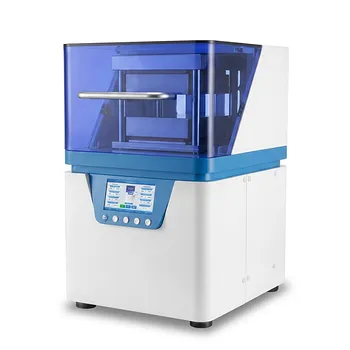
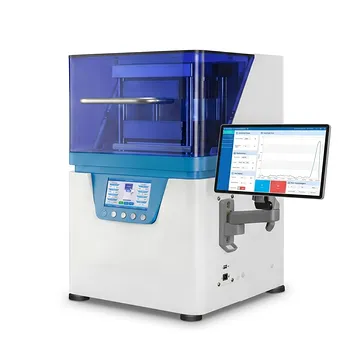
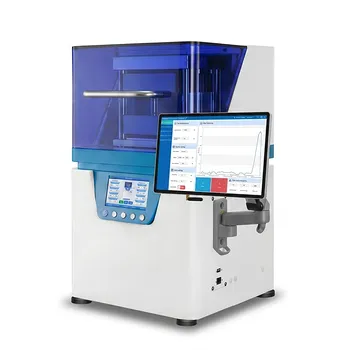
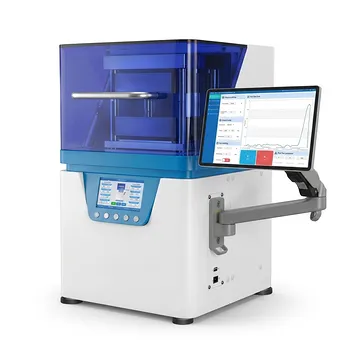
Laboratory hydraulic presses are the primary tools used to transform raw fungal chitosan into standardized formats suitable for high-resolution structural analysis. By applying controlled, high-pressure loads, these devices compress chitosan powder into translucent potassium bromide (KBr) pellets or thin films. This preparation is essential for techniques like Fourier Transform Infrared (FTIR) spectroscopy, as it ensures the sample is thin and uniform enough for light to pass through, allowing for the precise identification of molecular functional groups.
The core value of a hydraulic press in chitosan characterization lies in its ability to eliminate atmospheric interference and light scattering. By creating a homogeneous sample, the press ensures that the resulting data accurately reflects the material’s molecular structure rather than preparation artifacts.
Enhancing Spectroscopic Clarity for Molecular Identification
KBr Pellet Formation for FTIR
The most frequent application is the creation of potassium bromide (KBr) pellets. A small amount of fungal chitosan is mixed with KBr powder and compressed under high pressure to create a transparent disk.
Ensuring Light Transmittance
Structural characterization depends on light transmittance. The hydraulic press provides a stable, high-pressure output that forces the mixture into a high-density state, allowing infrared beams to penetrate the sample and yield clear absorption peaks.
Minimizing Signal Noise
Without sufficient pressure, air pockets and powder particles cause light scattering. This scattering creates background interference that can obscure the delicate spectral "fingerprints" used to identify the degree of deacetylation in fungal chitosan.
Expanding Characterization Beyond Molecular Fingerprinting
Elemental Analysis via XRF
Hydraulic presses are also used to prepare samples for X-ray Fluorescence (XRF). By compressing the chitosan into high-density disks, researchers can achieve a uniform surface that allows for the accurate detection of elemental composition and potential impurities.
Surface Micro-structuring and Hot Embossing
Beyond chemical analysis, presses are used for hot embossing to study physical characteristics. In this process, the press drives a metal mold into a heated chitosan film to create micro-channel patterns, which are then used to evaluate the material's structural integrity at the micron scale.
Preparation for Mechanical Tension Testing
To characterize the physical strength of fungal-derived materials, presses are used to create uniform thin films. These films provide a consistent baseline for tension testing, ensuring that measurements of durability and tensile strength are reproducible.
Understanding the Trade-offs
Manual vs. Automatic Precision
While manual presses are cost-effective, they rely on the operator to maintain consistent pressure. Automatic hydraulic presses provide a more repeatable environment, which is critical for comparative studies where slight variations in pellet density could skew FTIR results.
The Risk of Over-Compression
Applying excessive pressure can occasionally alter the crystalline structure of the polymer or cause the KBr pellet to become brittle and crack. Achieving the optimal pressure set-point is a delicate balance between sample transparency and structural preservation.
Moisture Sensitivity
Chitosan is hygroscopic, meaning it absorbs moisture from the air. If the pressing process is not performed quickly or in a controlled environment, water vapor can be trapped in the pellet, leading to broad "O-H" peaks that interfere with the structural analysis of the chitosan itself.
How to Apply This to Your Research
If you are preparing fungal chitosan for structural characterization, your choice of pressing technique should align with your specific analytical goals:
- If your primary focus is molecular identification (FTIR): Use an automatic press to ensure consistent KBr pellet thickness and maximum transparency for clear peak resolution.
- If your primary focus is elemental purity (XRF): Prioritize high-density disk compression to eliminate voids that could lead to inaccurate elemental readings.
- If your primary focus is surface morphology or micro-fluidics: Utilize a press with integrated heating elements (hot embossing) to precisely transfer mold patterns into the chitosan matrix.
Mastering the precision of the hydraulic press ensures that the resulting structural data is a true reflection of the material's properties rather than a result of inconsistent sample preparation.
Summary Table:
| Application | Preparation Method | Key Benefit for Characterization |
|---|---|---|
| FTIR Spectroscopy | KBr Pellet formation | Maximizes light transmittance and eliminates signal noise |
| XRF Analysis | High-density disk compression | Ensures a uniform surface for accurate elemental detection |
| Hot Embossing | Heated film compression | Transfers precise micro-channel patterns for structural study |
| Tension Testing | Uniform thin film creation | Provides a consistent baseline for reproducible strength data |
Achieve High-Resolution Results with KINTEK Pressing Solutions
Precision in sample preparation is the foundation of accurate structural characterization. KINTEK specializes in comprehensive laboratory pressing solutions designed to meet the rigorous demands of fungal chitosan research and material science.
Our extensive range includes manual, automatic, heated, multifunctional, and glovebox-compatible models, as well as cold and warm isostatic presses widely applied in advanced battery research. Whether you need to eliminate atmospheric interference in FTIR or ensure elemental purity in XRF, KINTEK provides the reliability and precision your lab requires.
Ready to enhance your lab's efficiency and data accuracy? Contact KINTEK today to find your perfect solution!
References
- D. Layten Davis, Timo Kikas. Extraction of Fungal Chitosan by Leveraging Pineapple Peel Substrate for Sustainable Biopolymer Production. DOI: 10.3390/polym16172455
This article is also based on technical information from Kintek Solution Knowledge Base .
Related Products
- Automatic Hydraulic Hot Press with Large Plate and Precision Temperature Control for Advanced Material Sample Preparation and Industrial Research
- Automatic Hydraulic Heat Press Machine with Multi Stage Programmable Control and Integrated Water Cooling Plate Size 180x180mm
- Automatic High Temperature Heated Hydraulic Press Machine with Heated Plates for Lab
- Automatic Heated Hydraulic Lab Press with Programmable Touch Screen Controls and Precision Temperature Regulation
- Manual Heated Hydraulic Lab Press with Integrated Hot Plates Hydraulic Press Machine
People Also Ask
- What are the specific features and applications of hydraulic hot press machines? Precision Solutions for Modern Labs
- How does an automatic hydraulic press operate? Achieve Precision and Consistency in Lab Pelleting
- What are the advantages and common applications of an automatic hydraulic press? Elevate Your Lab's Precision
- What is the technical significance of setting a precise dwell time? Achieve Peak Material Density and Stability
- When is an automatic hydraulic press more suitable than a manual press? Scale Your Lab with Precision & Speed