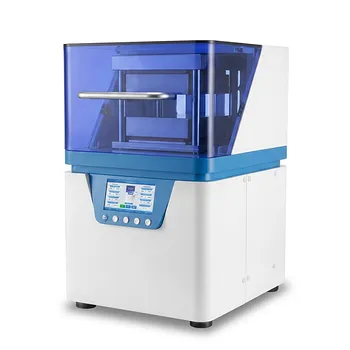
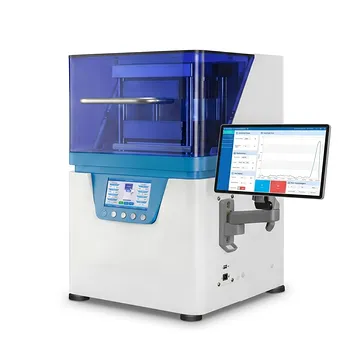
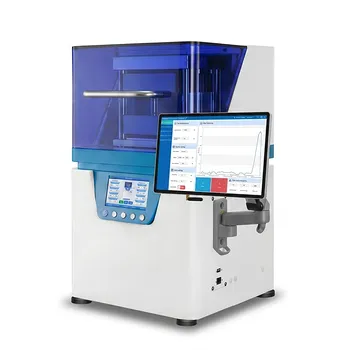
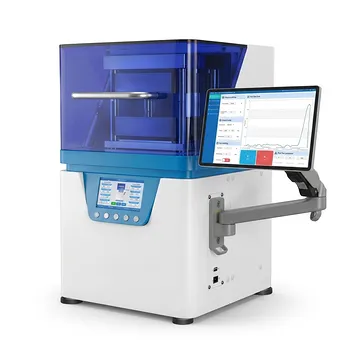
Hydraulic presses are the essential bridge between raw oral film components and actionable spectral data. They compress a mixture of the drug sample and Potassium Bromide (KBr) powder into thin, transparent pellets. This high-pressure environment forces the particles to bond and excludes air, allowing an infrared beam to pass through the sample for precise molecular analysis.
By transforming opaque pharmaceutical powders into infrared-transparent pellets, hydraulic presses enable researchers to identify chemical interactions and ensure the long-term stability of oral film formulations.
The Mechanics of Pellet Preparation
Dilution and the KBr Matrix
In FT-IR analysis, oral film components are typically too opaque to be analyzed in their raw state. To solve this, the sample is diluted in KBr powder, a material that is transparent to infrared light.
Achieving Uniform Density
The hydraulic press applies a stable, uniform force—often reaching 5 tons or more—to the mixture inside a specialized die. This high pressure creates a translucent tablet with a uniform density, which is critical for consistent light transmission.
Manual vs. Automatic Systems
Manual presses require physical effort to pump the hydraulic fluid, making them suitable for low-volume testing. Automatic presses provide programmable pressure settings, ensuring higher repeatability and reducing user fatigue during large-scale formulation studies.
Enhancing Spectral Quality
Eliminating Light Scattering
Raw powder particles cause infrared light to scatter, resulting in "noisy" or unusable data. The hydraulic press eliminates these air voids, ensuring the infrared beam penetrates the sample uniformly without interference.
Optimizing Signal-to-Noise Ratio
By creating an extremely thin and highly transparent pellet, the press maximizes the signal-to-noise ratio. This results in clear, sharp characteristic peaks that allow for the accurate characterization of the chemical structure.
Evaluating Oral Film Stability
Detecting Drug-Polymer Interactions
Oral films rely on the compatibility between the active pharmaceutical ingredient (API) and various polymers. FT-IR analysis of these pellets reveals whether chemical bonding or degradation is occurring between these components.
Predicting Formulation Longevity
If the spectra show unexpected shifts in functional groups, it indicates a potential instability in the oral film. The precision provided by the hydraulic press allows researchers to make data-driven decisions about the shelf-life and safety of the drug delivery system.
Understanding Technical Trade-offs
Consistency vs. Throughput
Manual presses are cost-effective but can introduce human error in the amount of pressure applied. Automatic presses eliminate this variance but require a higher initial investment and periodic calibration.
Pressure Sensitivity
Applying excessive pressure can occasionally alter the polymorphic state of certain drug molecules. It is vital to find the "sweet spot" where the pellet is transparent but the physical integrity of the oral film components remains unchanged.
Moisture Interference
KBr is highly hygroscopic, meaning it absorbs moisture from the air quickly. If the pressing process is too slow or the environment is humid, the resulting pellet will show water interference peaks that can mask important oral film data.
How to Apply This to Your Project
When selecting or using a hydraulic press for oral film FT-IR analysis, consider your specific analytical goals:
- If your primary focus is high-resolution research: Use an automatic hydraulic press with a vacuum-capable die to ensure the complete removal of air and maximum pellet clarity.
- If your primary focus is routine quality control: A manual press is often sufficient, provided the operator follows a strict protocol for tonnage and dwell time to maintain consistency.
- If your primary focus is sensitive drug-polymer stability: Opt for lower, sustained pressure settings to avoid inducing mechanical stress that could artificially trigger chemical changes in the sample.
Mastering the application of hydraulic pressure ensures your oral film analysis is built on a foundation of precise, reproducible molecular data.
Summary Table:
| Feature | Manual Hydraulic Press | Automatic Hydraulic Press |
|---|---|---|
| Primary Application | Low-volume testing & routine QC | High-throughput research & R&D |
| Pressure Control | Manual pumping (physical effort) | Programmable digital settings |
| Repeatability | Variable (user-dependent) | High (consistent precision) |
| Key Advantage | Cost-effective and portable | Reduces human error & fatigue |
| Pellet Quality | Standard transparency | Maximum clarity with vacuum options |
Elevate Your Pharmaceutical Research with KINTEK Precision
Achieving accurate FT-IR results for oral films starts with perfect pellet preparation. KINTEK specializes in comprehensive laboratory pressing solutions designed to meet the rigorous demands of modern formulation science. Our diverse range includes:
- Manual & Automatic Models: For everything from routine QC to high-reproducibility research.
- Specialized Solutions: Heated, multifunctional, and glovebox-compatible models for sensitive environments.
- Advanced Engineering: Cold and warm isostatic presses widely applied in battery research and pharmaceutical stability studies.
Don't let poor sample preparation compromise your spectral data. Contact KINTEK today to discover how our pressing solutions can enhance your lab's efficiency and ensure the integrity of your drug delivery systems.
References
- Kusum Dhankar, Rajesh Choudhary. Oral fast dissolving film: Pharmaceutical development and approaches. DOI: 10.33545/26646862.2025.v7.i2a.157
This article is also based on technical information from Kintek Solution Knowledge Base .
Related Products
- Automatic Hydraulic Hot Press with Large Plate and Precision Temperature Control for Advanced Material Sample Preparation and Industrial Research
- Automatic Hydraulic Heat Press Machine with Multi Stage Programmable Control and Integrated Water Cooling Plate Size 180x180mm
- Automatic High Temperature Heated Hydraulic Press Machine with Heated Plates for Lab
- Automatic Heated Hydraulic Lab Press with Programmable Touch Screen Controls and Precision Temperature Regulation
- Manual Heated Hydraulic Lab Press with Integrated Hot Plates Hydraulic Press Machine
People Also Ask
- What are the specific features and applications of hydraulic hot press machines? Precision Solutions for Modern Labs
- How does an automatic hydraulic press operate? Achieve Precision and Consistency in Lab Pelleting
- What are the advantages and common applications of an automatic hydraulic press? Elevate Your Lab's Precision
- What is the technical significance of setting a precise dwell time? Achieve Peak Material Density and Stability
- When is an automatic hydraulic press more suitable than a manual press? Scale Your Lab with Precision & Speed