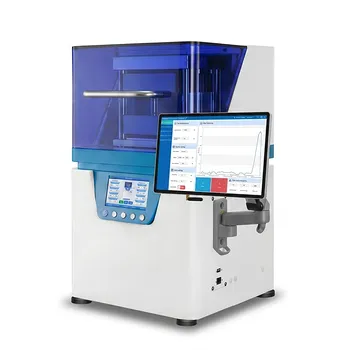
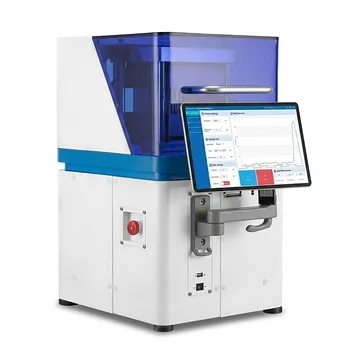
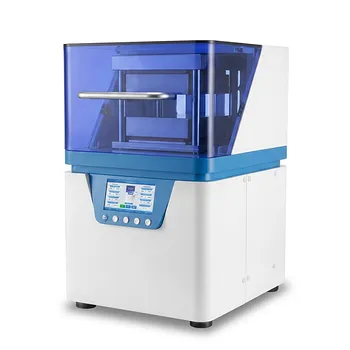
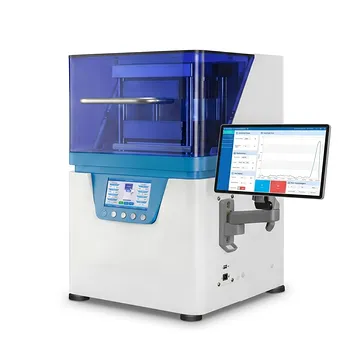
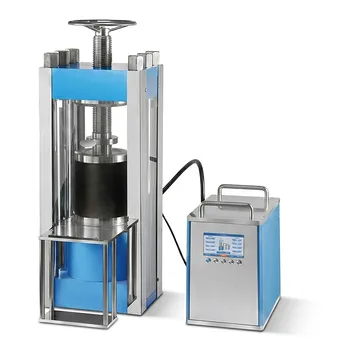
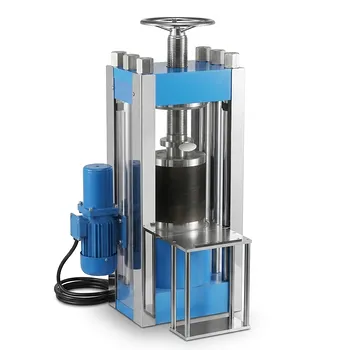
Laboratory-grade electric heating presses are the essential catalyst for structural transformation because they provide the high-precision environment necessary to convert loose wood particles into a rigid, load-bearing composite. By applying simultaneous pressure (typically around 25 kg/cm²) and heat (near 150°C), these machines force particles into intimate contact while triggering the chemical reaction required for adhesive curing. This dual-action process ensures the final board achieves its target density and internal bond strength.
The core value of a laboratory heating press lies in its ability to synchronize physical densification with chemical cross-linking. This precision ensures that the resulting particleboard possesses a stable thickness and the mechanical properties required for structural applications.
The Mechanics of Physical Consolidation
Achieving Target Density through Compression
The primary role of the press is to reduce the volume of a loose particle mat into a dense structural board. By applying a specific pressure, such as 25 kg/cm², the press eliminates voids between particles to reach a predetermined density.
Facilitating Wood Fiber Reorganization
Under high pressure, wood fibers undergo a physical reorganization that allows them to interlock and settle. This structural alignment is critical for ensuring that the final board can resist mechanical stresses and maintain its shape over time.
Ensuring Close Particle Contact
Effective bonding cannot occur if there are gaps between the raw materials. The electric heating press forces particles into intimate contact, which is a prerequisite for the adhesive to bridge the gaps between individual wood elements.
Driving Chemical Bond Formation
Accelerating Adhesive Cross-linking
Temperature is the key driver for the chemical curing of adhesives, such as protein-based or synthetic resins. A steady heat of 150°C provides the thermal energy required to trigger cross-linking, turning a liquid or powder adhesive into a permanent, solid bond.
Maximizing the Bonding Force
The press allows for the fine-tuning of the hot-pressing duration, which is vital for maximizing the bond between the adhesive and wood fibers. Proper timing ensures the heat penetrates the core of the mat without over-curing the surface layers.
Managing Adhesive Transitions
Laboratory-grade presses offer the precision needed to manage the transition of adhesives (like rapeseed protein) from a raw state to a fully cured matrix. Consistent heat distribution across the plates prevents "weak spots" within the structural board.
Navigating the Trade-offs of Precision Pressing
The Risk of Thermal Degradation
While high temperatures are necessary for curing, excessive heat or prolonged exposure can lead to the thermal degradation of wood fibers. This can result in a brittle board with reduced structural integrity.
Balancing Pressure and Internal Stress
Applying too much pressure can crush the wood cells rather than just consolidating them, leading to internal stresses. These stresses may cause the board to warp or "spring back" once the pressure is released.
Moisture Management Challenges
Rapid heating can cause moisture within the wood particles to turn into steam. If the press is opened too quickly or the temperature is too high, this trapped steam can cause internal delamination or "blowouts."
How to Apply This to Your Research
Effective use of a laboratory heating press requires balancing mechanical force with chemical requirements.
- If your primary focus is Maximizing Mechanical Strength: Prioritize precise pressure control (e.g., 25 kg/cm²) to ensure maximum fiber contact and density.
- If your primary focus is Adhesive Performance: Focus on optimizing the temperature-to-time ratio to ensure the adhesive achieves a full chemical cure without degrading the wood.
- If your primary focus is Dimensional Stability: Focus on the cooling phase and consistent pressure application to prevent post-press warping or thickness swelling.
By mastering the intersection of heat and pressure, you can consistently produce high-performance composites that meet rigorous structural standards.
Summary Table:
| Function | Process Mechanism | Impact on Final Board |
|---|---|---|
| Physical Consolidation | High-pressure compression (25 kg/cm²) | Reaches target density and reduces voids |
| Structural Alignment | Wood fiber reorganization | Increases mechanical resistance and stability |
| Chemical Curing | Thermal cross-linking (approx. 150°C) | Transforms raw adhesive into a solid structural bond |
| Moisture Control | Managed thermal penetration | Prevents internal delamination and steam blowouts |
Elevate Your Material Research with KINTEK Precision
Achieve uncompromising accuracy in your composite and battery research with KINTEK. As specialists in comprehensive laboratory pressing solutions, we offer a versatile range of equipment designed to meet the most rigorous structural standards.
Whether you need manual, automatic, heated, or multifunctional models, or specialized glovebox-compatible and isostatic presses (cold and warm), KINTEK provides the precise control over heat and pressure necessary for high-performance material formation.
Why choose KINTEK?
- Synchronized Heat/Pressure: Perfect for sensitive adhesive curing and fiber reorganization.
- Versatile Applications: Expertly engineered for both wood composites and advanced battery research.
- Customizable Solutions: Models tailored to your specific lab environment and research goals.
Contact our experts today to discover how our pressing solutions can enhance your lab's efficiency and output!
References
- Selahattin Bardak, Sebahattin Tiryaki. INFLUENCE OF RESIDUE TYPE ON QUALITY PROPERTIES OF PARTICLEBOARD MANUFACTURED FROM FAST-GROWN TREE OF HEAVEN (Ailanthus altissima (Mill.) Swingle). DOI: 10.12841/wood.1644-3985.216.08
This article is also based on technical information from Kintek Solution Knowledge Base .
Related Products
- Automatic Hydraulic Hot Press with Large Plate and Precision Temperature Control for Advanced Material Sample Preparation and Industrial Research
- Automatic High Temperature Heated Hydraulic Press Machine with Heated Plates for Lab
- Automatic Heated Hydraulic Press Machine with Hot Plates for Laboratory
- Warm Isostatic Press for Solid State Battery Research Warm Isostatic Press
- Automatic Heated Hydraulic Lab Press 120x120mm Plate Fully Automated Material Research Press
People Also Ask
- What are the specific features and applications of hydraulic hot press machines? Precision Solutions for Modern Labs
- How does an automatic hydraulic press operate? Achieve Precision and Consistency in Lab Pelleting
- What are the advantages and common applications of an automatic hydraulic press? Elevate Your Lab's Precision
- What is the technical significance of setting a precise dwell time? Achieve Peak Material Density and Stability
- When is an automatic hydraulic press more suitable than a manual press? Scale Your Lab with Precision & Speed