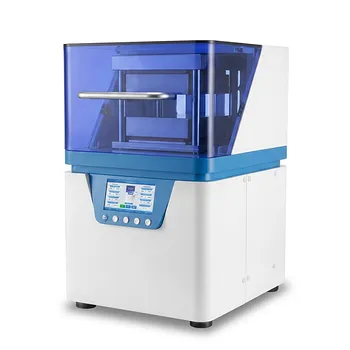
High-performance hydraulic molding is the critical mechanical stage used to consolidate Cellulose Tribenzoate (CTBe) thin films initially formed through solvent casting. This process applies precise pressure to the cast material, creating a uniform substrate that can then undergo drawing orientation. By combining these methods, researchers produce films with highly ordered crystalline structures necessary for advanced chiral recognition and structural analysis.
The integration of hydraulic molding with subsequent drawing processes allows for the creation of oriented CTBe films that yield clear X-ray fiber diffraction patterns. This structural clarity is essential for determining molecular chain orientation and maximizing the efficiency of chromatographic separations.
The Role of Hydraulic Molding in Film Fabrication
Integrating with Solvent Casting
The process begins with solvent casting, where CTBe is dissolved and cast into a preliminary film. High-performance hydraulic molding is then applied to these cast films to ensure a consistent thickness and density across the material. This step provides the mechanical stability required for further processing.
Preparing for Molecular Alignment
Hydraulic molding acts as the bridge between a raw polymer cast and a functional optical tool. By applying controlled force, it eliminates structural irregularities that could lead to tearing or uneven stretching during the next phase. This uniformity is vital for achieving repeatable results in chiral selector applications.
Achieving Structural Precision through Orientation
The Drawing Orientation Process
Once the hydraulic molding has finalized the film's initial state, the material undergoes drawing orientation. This involves stretching the film under specific conditions to align the polymer chains along a single axis. The result is an oriented film that exhibits distinct physical and optical properties compared to its unaligned state.
Establishing Chain Models
The orientation process allows researchers to study the spatial arrangement of the chiral selectors. Specifically, it enables the differentiation between parallel and anti-parallel models of chain orientation. Understanding these models is key to predicting how the CTBe surface will interact with different enantiomers.
Analytical Significance and Chiral Recognition
Enabling High-Resolution X-ray Diffraction
The primary benefit of utilizing hydraulic molding and drawing is the production of clear X-ray fiber diffraction patterns. These patterns provide a "roadmap" of the atomic and molecular structure of the CTBe. Without the high degree of orientation provided by these technologies, the diffraction patterns would be too blurred for meaningful analysis.
Optimizing Chromatographic Efficiency
By understanding the exact spatial arrangement of the CTBe molecules, scientists can optimize chromatographic separation efficiency. The oriented films serve as a model for how the stationary phase in a column will perform. This allows for the fine-tuning of separation parameters to achieve higher purity in chiral drugs and chemicals.
Understanding the Trade-offs and Challenges
Precision vs. Material Stress
While hydraulic molding ensures uniformity, excessive pressure can induce unwanted stresses that cause the film to become brittle. Finding the balance between compaction and flexibility is a primary challenge in the fabrication of CTBe films.
Maintaining Orientation Stability
Oriented films are inherently in a higher energy state than their disordered counterparts. Over time or under thermal stress, these films may undergo relaxation, where the chains return to a random orientation. This loss of alignment directly degrades the quality of the X-ray diffraction patterns and the accuracy of chiral recognition.
Applying These Insights to Your Material Research
Making the Right Choice for Your Goal
To successfully prepare CTBe films for chiral recognition, your processing strategy must align with your ultimate analytical objective.
- If your primary focus is structural determination: Prioritize the drawing orientation phase to ensure the sharpest possible X-ray fiber diffraction patterns.
- If your primary focus is chromatographic modeling: Focus on the consistency of the hydraulic molding to ensure the film's surface properties accurately mimic a stable stationary phase.
- If your primary focus is optimizing separation speed: Use the parallel and anti-parallel chain models to predict enantiomer interaction times and adjust your solvent system accordingly.
Mastering the synergy between hydraulic molding and drawing orientation is the definitive path to unlocking the full analytical potential of Cellulose Tribenzoate in chiral science.
Summary Table:
| Stage | Primary Purpose | Key Benefit for CTBe Films |
|---|---|---|
| Solvent Casting | Initial film formation | Creates the preliminary material substrate. |
| Hydraulic Molding | Consolidation & Uniformity | Ensures consistent thickness and mechanical stability. |
| Drawing Orientation | Molecular Alignment | Aligns polymer chains for crystalline structure. |
| X-ray Diffraction | Structural Analysis | Provides clear patterns for molecular chain modeling. |
| Chiral Recognition | Functional Application | Optimizes chromatographic separation efficiency. |
Elevate Your Material Research with KINTEK Precision
Achieving the perfect molecular alignment in CTBe films requires uncompromising pressure control. KINTEK specializes in comprehensive laboratory pressing solutions designed to meet the rigorous demands of advanced material science and battery research.
Our diverse range includes:
- Manual & Automatic Presses for versatile laboratory tasks.
- Heated & Multifunctional Models for precise thermal-mechanical processing.
- Glovebox-Compatible & Isostatic Presses (Cold/Warm) for specialized environments and uniform compaction.
Whether you are modeling chiral selectors or developing next-generation battery components, KINTEK provides the reliability and precision your research deserves. Contact us today to find your ideal pressing solution!
References
- P. Zugenmaier. Materials of cellulose derivatives and fiber-reinforced cellulose-polypropylene composites: Characterization and application. DOI: 10.1351/pac200678101843
This article is also based on technical information from Kintek Solution Knowledge Base .
Related Products
- Automatic Hydraulic Hot Press with Large Plate and Precision Temperature Control for Advanced Material Sample Preparation and Industrial Research
- Automatic Laboratory Hydraulic Press Lab Pellet Press Machine
- Laboratory Hydraulic Press Lab Pellet Press Machine for Glove Box
- Automatic High Temperature Heated Hydraulic Press Machine with Heated Plates for Lab
- Manual Laboratory Hydraulic Press Lab Pellet Press
People Also Ask
- What are the specific features and applications of hydraulic hot press machines? Precision Solutions for Modern Labs
- How does an automatic hydraulic press operate? Achieve Precision and Consistency in Lab Pelleting
- What are the advantages and common applications of an automatic hydraulic press? Elevate Your Lab's Precision
- What is the technical significance of setting a precise dwell time? Achieve Peak Material Density and Stability
- When is an automatic hydraulic press more suitable than a manual press? Scale Your Lab with Precision & Speed