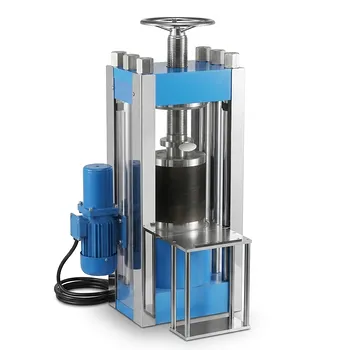
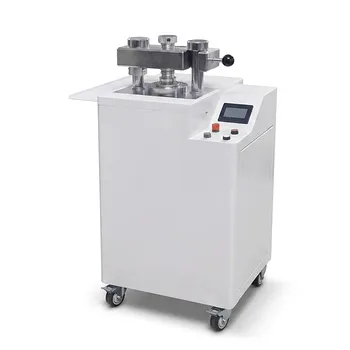
The primary advantages of using a KBr press for sample preparation are optical transparency, analytical versatility, and high reproducibility. By applying precise, uniform force, these presses transform a mixture of potassium bromide (KBr) and sample material into a glass-like pellet that allows infrared radiation to pass through with minimal interference, ensuring accurate spectral analysis.
Core Insight A KBr press is not merely a crushing tool; it is a precision instrument designed to eliminate optical noise. Its main value lies in standardizing the physical state of a sample, ensuring that the resulting data reflects the chemical composition of the material rather than artifacts of the preparation process.
The Physics of Optical Transparency
Minimizing Signal Interference
The most critical advantage of a KBr press is its ability to create a pellet that is transparent to Infrared (IR) radiation. KBr is chosen because it does not absorb IR light in the standard analysis region (4000–400 cm⁻¹).
Creating a Homogeneous Matrix
To achieve this transparency, the press must fuse the powdered KBr and the sample into a solid, glass-like disk. The high pressure eliminates air voids and scatters, which would otherwise distort the light path.
Ensuring Clear Spectral Peaks
Because the pellet allows IR light to pass through unhindered, the detector only measures the absorbance of your specific sample. This results in sharp, distinct spectral peaks that are free from background noise caused by the matrix itself.
Precision and Reproducibility
The Necessity of Controlled Pressure
Hydraulic KBr presses allow for the precise and controlled application of pressure. This is essential because different materials require specific force levels to form stable pellets without altering their chemical structure.
Consistency Across Batches
Sample preparation is often the largest source of error in analytical chemistry. A KBr press mitigates this by mechanizing the compaction process, ensuring that pellets have uniform thickness and density every time.
Quantitative Reliability
This high degree of reproducibility is vital for quantitative studies. When the path length (pellet thickness) and particle distribution are consistent, researchers can confidently compare absorbance values across multiple samples.
Versatility and Efficiency
Handling Diverse Solid Samples
KBr presses are highly versatile tools capable of processing a wide range of solid materials, from pharmaceuticals to polymers. As long as the sample can be ground into a fine powder, it can generally be analyzed using this method.
Improving Laboratory Throughput
Modern hydraulic presses significantly increase efficiency and speed. They are designed for quick sample switching, allowing laboratories to handle high-volume workflows without the fatigue associated with manual preparation methods.
Operational Flexibility
Many presses offer adjustable parameters, such as force limits and dwell times. This allows the user to tailor the physical environment to the specific needs of fragile or difficult-to-press samples.
Understanding the Trade-offs
The Moisture Challenge
While KBr is optically ideal, it is hygroscopic (absorbs moisture from the air). Even with a perfect press, if the environment is humid or the press is not evacuable, water bands may appear in the spectrum, obscuring data around the 3300 cm⁻¹ and 1640 cm⁻¹ regions.
Equipment Limitations (Hand vs. Hydraulic)
Hand presses are portable and space-saving, but they often lack the ability to be evacuated (vacuum sealed) during pressing. This can result in cloudy pellets or trapped air. Hydraulic presses offer better quality pellets and vacuum capabilities but require more bench space and a higher initial investment.
Making the Right Choice for Your Goal
To maximize the benefits of a KBr press, align your equipment choice with your specific analytical requirements:
- If your primary focus is quantitative precision: Prioritize a hydraulic press with a pressure gauge, as this ensures the exact same force is applied to every sample for reproducible results.
- If your primary focus is field work or occasional checking: A hand press provides sufficient quality for qualitative identification without the need for heavy machinery or power.
- If your primary focus is high-throughput screening: Look for a hydraulic press with automated features to reduce operator fatigue and cycle time between samples.
Success in KBr pellet preparation ultimately relies on balancing the mechanical precision of the press with careful handling of the hygroscopic materials.
Summary Table:
| Feature | Advantage | Impact on Analysis |
|---|---|---|
| Optical Transparency | Minimizes IR signal interference | Sharp, distinct spectral peaks |
| Controlled Pressure | Ensures uniform pellet density | Highly reproducible & quantitative data |
| Vacuum Capability | Eliminates air voids and moisture | Clearer spectra with reduced background noise |
| Versatility | Compatible with diverse solid samples | Efficient processing for powders & polymers |
| Efficiency | High-throughput hydraulic systems | Reduced operator fatigue and faster workflows |
Elevate Your Spectroscopic Accuracy with KBr Solutions
Unlock the full potential of your analytical research with KINTEK. As specialists in comprehensive laboratory pressing solutions, we provide the precision tools necessary to eliminate optical noise and ensure reproducible data.
Whether your work involves pharmaceutical testing, polymer analysis, or battery research, our range of manual, automatic, heated, and glovebox-compatible models—including advanced cold and warm isostatic presses—is designed to meet the most rigorous laboratory standards.
Ready to standardize your sample preparation? Contact KINTEK today to find the perfect press for your lab's specific needs and maximize your research efficiency.
Related Products
- Laboratory Hydraulic Press 2T Lab Pellet Press for KBR FTIR
- Laboratory Hydraulic Pellet Press for XRF KBR FTIR Lab Press
- Automatic Laboratory Hydraulic Press for XRF and KBR Pellet Pressing
- Lab Infrared Press Mold for No Demolding
- Button Battery Sealing Press Machine for Lab
People Also Ask
- What is the role of a laboratory pressure machine and KBr in FTIR? Master Sample Preparation for Flame Retardants
- What is the role of a laboratory hydraulic press in high-loading NCM811 cathode prep for solid-state batteries?
- What role does a laboratory hydraulic press play in reaction pellets? Optimizing Lunar Soil and Metal Fuel Density
- Why is a laboratory hydraulic press necessary for sample preparation? Precise Pelleting for Spiro Heterocyclic Analysis
- How does a laboratory hydraulic press ensure repair performance? Master Self-Healing CFRP Molding with Precision