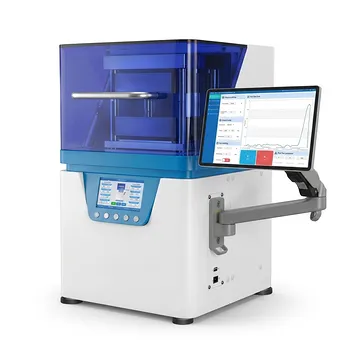
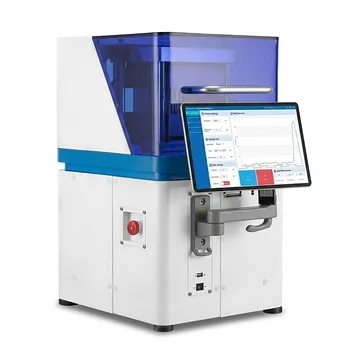
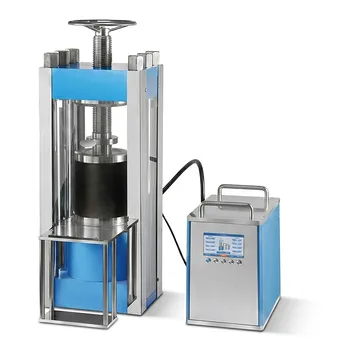
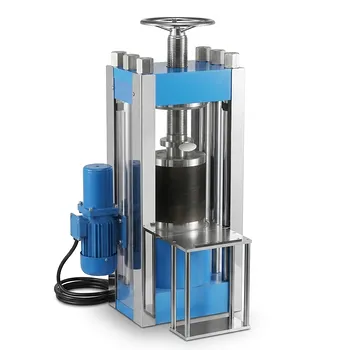
In the production of thermoplastic syntactic core materials, a laboratory heated press serves as the critical instrument for controlled thermal consolidation and structural stabilization. This specialized equipment enables the precise melting of the polymer matrix and the subsequent bonding of material layers while carefully protecting the integrity of fragile filler components, such as expanded glass granules.
The laboratory heated press facilitates a delicate balance between high-temperature matrix melting and low-impact pressure application to ensure the creation of a stable, defect-free sandwich structure without crushing the lightweight syntactic fillers.
Preservation of Syntactic Integrity
Protecting Fragile Glass Granules
The primary function of the press during the initial phase of manufacturing is the protection of expanded glass granules. Unlike standard composite molding, which often requires immediate high pressure, this process begins with zero applied pressure to prevent the mechanical crushing of the delicate, hollow fillers that give syntactic foams their low-density properties.
Managing Thermal Expansion for Pressure
Once the thermoplastic matrix reaches its melting point, the press utilizes the thermal expansion of both the tooling and the polymer itself to generate a controlled internal pressure. This specific pressure, typically around 10 N/cm², is sufficient to consolidate the layers without exceeding the crush strength of the glass granules.
Precision Thermal Management
High-Rate Heating Control
The press is equipped with independently adjustable heating plates capable of reaching temperatures up to 300°C. For thermoplastic matrices, the ability to control heating rates at speeds such as 15 K/min is essential for ensuring the polymer reaches a flowable state quickly and uniformly.
Achieving Interfacial Bonding
By maintaining a stable, high-temperature environment, the press ensures the thermoplastic matrix fully wets the surfaces of the reinforcement phase. This interfacial adhesion is vital for eliminating internal air pockets and ensuring the final core material behaves as a single, cohesive unit rather than a collection of loose layers.
Structural Standardization and Quality
Eliminating Internal Defects
The combination of heat and controlled expansion pressure works to evacuate residual air bubbles from the melt. This results in a high-density, standardized material that is free from internal voids, which are common points of failure in composite structures.
Ensuring Geometric Uniformity
The press locks the material into a fixed volume, ensuring that the final thermoplastic sheets have a uniform thickness and smooth surface finish. This geometric precision is mandatory for materials intended for standardized mechanical testing, such as density and hardness characterization.
Understanding the Trade-offs
Pressure Sensitivity vs. Consolidation
The most significant challenge in this process is the pressure-sensitivity of the syntactic filler. While high pressure (often used in standard polymer molding, such as 10 MPa) improves matrix flow and removes voids, it can catastrophically increase the density of a syntactic core by crushing the hollow granules.
Thermal Gradients and Cooling Rates
Rapid heating rates are efficient but can introduce thermal gradients within thick samples, leading to uneven melting. Similarly, if the cooling phase is not managed within the press, internal stresses can develop, causing the thermoplastic core to warp or delaminate after removal from the tool.
Applying Press Parameters to Your Project
Recommendations for Material Development
To achieve the best results when manufacturing thermoplastic syntactic cores, the operational parameters must be tuned to the specific matrix and filler combination.
- If your primary focus is weight reduction: Prioritize a "zero-pressure" initial heating phase and rely strictly on thermal expansion to prevent the crushing of low-density fillers.
- If your primary focus is mechanical strength: Ensure the temperature is held slightly above the melting point for a "dwell period" to maximize the wetting of the glass granules by the polymer matrix.
- If your primary focus is high-volume consistency: Use a press with independently controlled plates to ensure a uniform temperature profile across the entire surface of the mold.
Precise control over the transition from heating to consolidation allows for the production of lightweight, high-strength core materials that meet rigorous industrial standards.
Summary Table:
| Key Function | Technical Mechanism | Primary Benefit |
|---|---|---|
| Thermal Consolidation | Precise heating up to 300°C | Ensures uniform polymer matrix melting |
| Filler Protection | Zero-pressure initial phase | Prevents crushing of fragile glass granules |
| Structural Bonding | Controlled thermal expansion | High interfacial adhesion & void elimination |
| Geometric Precision | Fixed-volume molding | Uniform thickness for standardized testing |
| Quality Control | Adjustable cooling/heating rates | Prevents warping and internal delamination |
Optimize Your Composite Manufacturing with KINTEK Precision
Achieving the perfect balance between high-temperature melting and low-impact pressure is critical for high-performance syntactic cores. KINTEK specializes in comprehensive laboratory pressing solutions designed to meet these exact needs. From protecting fragile fillers to ensuring defect-free consolidation, our equipment provides the precision your research demands.
Our laboratory solutions include:
- Advanced Heated Presses: Manual, automatic, and multifunctional models with independent plate control.
- Specialized Equipment: Glovebox-compatible designs and cold/warm isostatic presses.
- Application Expertise: Widely used in battery research and advanced thermoplastic composite development.
Ready to enhance your lab's efficiency and material quality? Contact KINTEK today to find the perfect pressing solution for your project!
References
- Alexander Hackert, Lothar Kroll. Syntactic core composite sandwich (SCCS) with thermoplastic foam and expanded glass granulate core. DOI: 10.1051/matecconf/201926402002
This article is also based on technical information from Kintek Solution Knowledge Base .
Related Products
- Automatic Large Format Laboratory Heated Hydraulic Press 400x400mm Plate Capacity
- 24T 30T 60T Heated Hydraulic Lab Press Machine with Hot Plates for Laboratory
- Laboratory Split Manual Heated Hydraulic Press Machine with Hot Plates
- Automatic Heated Hydraulic Lab Press 120x120mm Plate Fully Automated Material Research Press
- Heated Hydraulic Press Machine with Heated Plates for Vacuum Box Laboratory Hot Press
People Also Ask
- Why is a laboratory heated hydraulic press required? Ensure Precise Vulcanization for NBR/EPDM Nanocomposites
- What role does a Laboratory Heated Hydraulic Press play in rubber vulcanization? Master Precision Specimen Molding
- How does a laboratory heated hydraulic press improve the performance of dried composite solid-state membranes? Guide
- What role does a laboratory heated hydraulic press play in PLA/MCC molding? Achieve superior composite density.
- Role of Laboratory Heated Hydraulic Presses in Solid Electrolyte Fabrication: Enhance Density & Ionic Conductivity