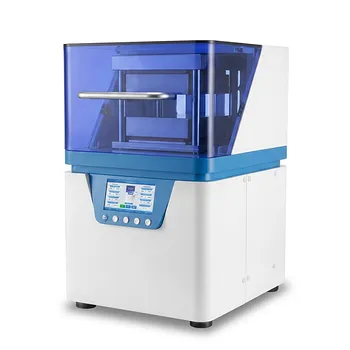
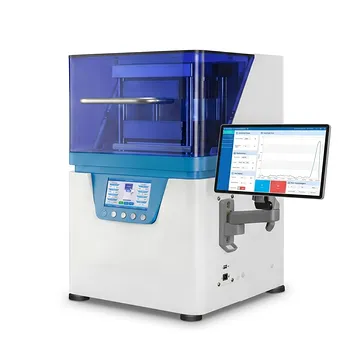
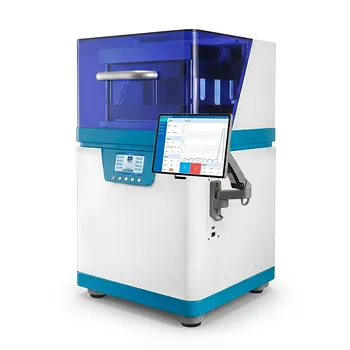
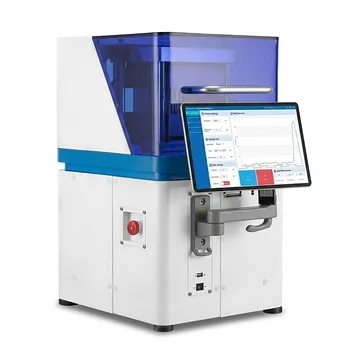
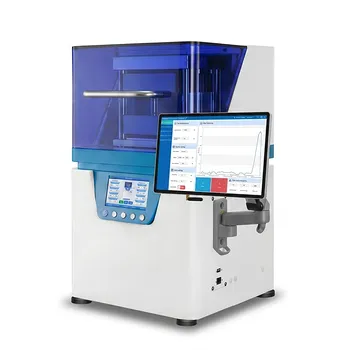
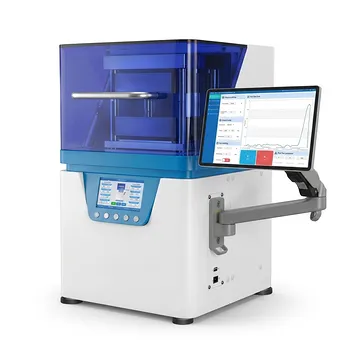
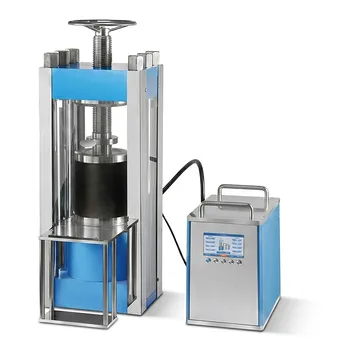
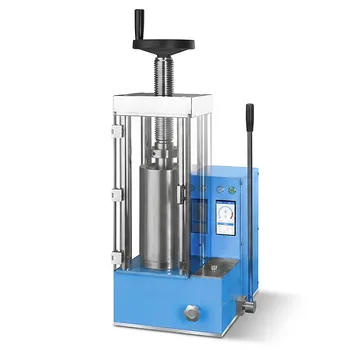
The primary role of an electrically heated press in natural rubber vulcanization is to provide a controlled environment of high temperature and uniform pressure. This equipment facilitates the chemical cross-linking reaction that transforms plastic raw rubber into a durable, elastic three-dimensional network.
Core Takeaway: The electrically heated press provides the critical kinetic energy and mechanical force necessary to activate vulcanizing agents, ensuring a uniform cross-linked molecular structure that defines the finished rubber's mechanical strength and stability.
The Dual Function of Heat and Pressure
Thermal Activation of Vulcanizing Agents
The press maintains a constant high temperature, typically ranging from 140°C to 160°C, to trigger the vulcanization reaction. This heat provides the kinetic energy required for accelerators such as CBS, TMTD, and ZDC to react within the rubber matrix.
Structural Transformation via Pressure
Simultaneously, the hydraulic system applies uniform pressure, often reaching 4.5 kg/cm² or higher, to the rubber compound. This force ensures the rubber fully fills the mold cavity and excludes trapped air, preventing internal voids or surface defects.
Creation of the Three-Dimensional Network
Under these specific conditions, linear rubber molecular chains undergo chemical bonding via vulcanizing agents. This process converts the material from a "plastic" state into a vulcanized elastomer characterized by high elasticity and dimensional stability.
Ensuring Material Quality and Uniformity
Achieving Optimal Cross-Link Density
Precise temperature control is essential for determining the cross-link density of the final product. An even distribution of heat ensures that the entire rubber sheet reaches the intended state of cure, directly impacting its modulus and tensile strength.
Eliminating Internal Defects
High-pressure application, sometimes reaching 200 kg/cm² in specialized industrial setups, is vital for material density. By forcing the compound into every corner of the mold, the press produces dense, dimensionally stable specimens free from bubbles.
Consistency in Laboratory Testing
In a laboratory setting, the press ensures repeatability across multiple test batches. This precision allows engineers to accurately measure physical properties like hardness and thermal resistance without interference from processing variables.
Understanding the Trade-offs
Temperature Precision vs. Energy Consumption
While higher temperatures can reduce the curing time, they increase the risk of "scorching" or uneven curing if the press plates are not perfectly calibrated. Maintaining a lower, more stable temperature like 140°C provides better control but requires longer cycle times.
Pressure Distribution and Mold Wear
Using extreme hydraulic pressure ensures a defect-free part but accelerates the wear and tear on steel molds. Over-pressurization can also lead to "flash" (excess material leaking from the mold), necessitating additional trimming and material waste.
Manual vs. Automated Compensation
Standard presses may experience slight pressure drops as the rubber softens and flows. Higher-end units utilize pressure compensation to maintain constant force, though these systems come with increased mechanical complexity and maintenance requirements.
How to Apply This to Your Project
When selecting or operating an electrically heated press for rubber vulcanization, your primary objective should dictate your technical settings.
- If your primary focus is mechanical strength: Prioritize precise temperature maintenance at the levels specified for your specific accelerators (e.g., 140°C for CBS/TMTD blends) to ensure a full, uniform cure.
- If your primary focus is dimensional accuracy: Focus on the hydraulic pressure stability and air exclusion to ensure the compound perfectly replicates the mold geometry without internal porosity.
- If your primary focus is laboratory repeatability: Implement a standardized heating duration (e.g., 15 minutes) and utilize a press with documented thermal uniformity across the entire plate surface.
By mastering the balance of thermal energy and mechanical force, you ensure the transition from raw compound to high-performance elastomer is both efficient and reliable.
Summary Table:
| Parameter | Role in Vulcanization | Key Benefit |
|---|---|---|
| Thermal Energy | Activates vulcanizing agents (140°C–160°C) | Ensures uniform chemical cross-linking |
| Hydraulic Pressure | Compresses compound & excludes air | Prevents internal defects and ensures density |
| Time Control | Manages curing cycle duration | Optimizes modulus and tensile strength |
| Consistency | Maintains repeatable test conditions | Guaranteed reliability in laboratory R&D |
Elevate Your Laboratory Precision with KINTEK
Unlock the full potential of your material research with KINTEK’s advanced laboratory pressing solutions. Whether you are conducting critical battery research or developing high-performance elastomers, our range of equipment—including manual, automatic, heated, multifunctional, and glovebox-compatible models, as well as cold and warm isostatic presses—is designed to deliver the precise thermal and mechanical control your project demands.
Why choose KINTEK?
- Unmatched Thermal Uniformity: Ensure consistent cross-link density across every specimen.
- Precision Pressure Control: Eliminate internal defects and achieve superior material density.
- Versatile Applications: Tailored solutions for rubber vulcanization, battery components, and beyond.
Ready to enhance your lab's efficiency and repeatability? Contact us today to find the perfect press for your application!
References
- B. B. Konar. Studies on the effects of cyclohexylbenzthiazyl sulfenamide accelerated sulfur vulcanization of natural rubber. Part-II. Load-deformation characteristics. DOI: 10.5281/zenodo.5833075
This article is also based on technical information from Kintek Solution Knowledge Base .
Related Products
- Cylindrical Lab Electric Heating Press Mold for Laboratory Use
- Automatic Hydraulic Heat Press Machine with Multi Stage Programmable Control and Integrated Water Cooling Plate Size 180x180mm
- Automatic Heated Hydraulic Press Machine with Heated Plates for Laboratory
- Heated Hydraulic Press Machine with Heated Plates for Vacuum Box Laboratory Hot Press
- Heated Hydraulic Press Machine With Heated Plates For Vacuum Box Laboratory Hot Press
People Also Ask
- How does a laboratory electric heated press ensure sample quality? Optimize SiR-EPDM vulcanization and molding.
- What role does a laboratory electric heated press play in polymer composite fabrication? Key for Standardized Specimens
- What role does a laboratory electric heating press play in NBR molding? Master Vulcanization & Material Density
- Why is a laboratory electric heating press required for PP/EPDM molding? Achieve Superior Specimen Integrity
- What is the purpose of incorporating cartridge heaters into a lab press mold for MLCC block compression? Optimize Results