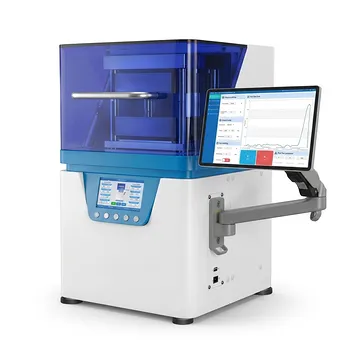
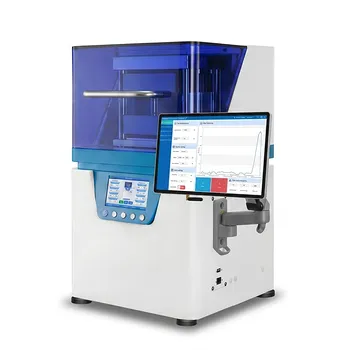
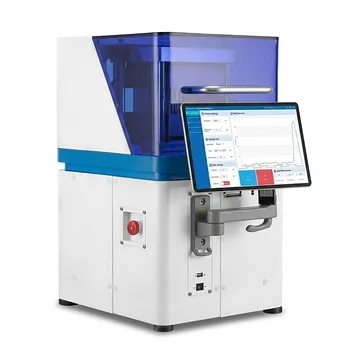
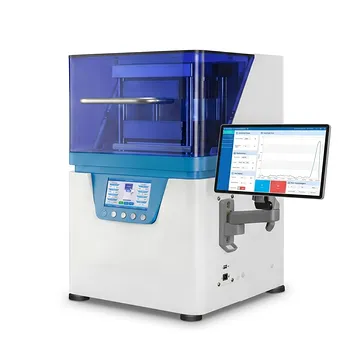
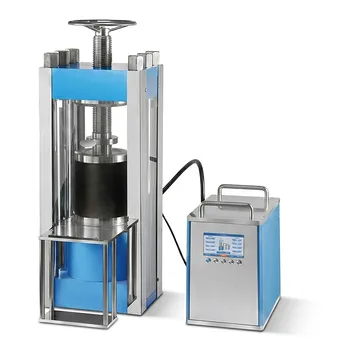
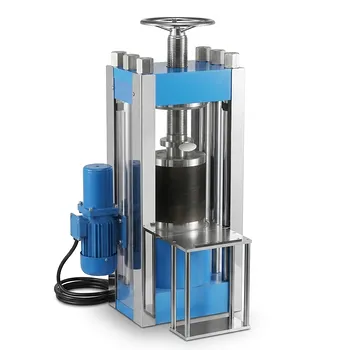
The primary purpose of a laboratory heated press during the pre-pressing stage is to force the composite mixture into the mold cavity while simultaneously expelling residual air. This process is critical for high-fill PDMS (Polydimethylsiloxane) composites, as it significantly increases material density and eliminates porosity defects. By applying constant, uniform pressure, the press ensures that the final cured samples achieve the precise mechanical properties and density required by design specifications.
The laboratory heated press serves as the foundation for structural integrity in composite molding by eliminating internal voids and ensuring uniform material distribution. This "pre-treatment" phase is essential for transforming a raw mixture into a dense, standardized material suitable for high-performance testing.
Achieving Structural Homogeneity and Density
Elimination of Internal Porosity
The most critical function of the pre-pressing stage is the removal of trapped air. Even small amounts of residual air can create internal pores, which act as stress concentrators and lead to premature failure during mechanical testing.
Maximizing Material Density
For high-fill composites, manual packing is often insufficient to reach the theoretical density. The press applies static pressure to pack the filler and matrix tightly, ensuring the material meets specific density targets.
Ensuring Uniform Thickness and Surface Quality
A laboratory press compresses reaction-blended materials into sheets with highly uniform thickness. This geometric precision is vital for subsequent testing, such as surface roughness analysis or interlaminar sliding characterization.
Facilitating Material Flow and Impregnation
Overcoming High Viscosity via Heat
By precisely controlling the temperature, the press reduces the viscosity of the polymer matrix, allowing it to flow fully into complex mold geometries. This is especially important once the material exceeds its glass transition temperature or melting point, enabling plastic deformation.
Enhancing Filler-Matrix Bonding
The combination of high temperature and pressure facilitates the initial penetration of the polymer into fiber bundles or filler gaps. This ensures a tight bond between the reinforcement material and the matrix, which is the "technological foundation" for a reliable composite.
Phase and Morphology Control
Advanced heated presses allow researchers to adjust cooling rates and temperature distribution. This level of control is used to influence the crystallization behavior and microscopic morphology of the PDMS composite, directly impacting its final performance.
Understanding the Trade-offs and Risks
Thermal Degradation vs. Flow
While heat is necessary to ensure material flow, excessive temperatures can lead to premature curing or thermal degradation of the PDMS. Finding the balance between "flowability" and material stability is a primary challenge in protocol design.
Pressure Management and Flash
Applying too much pressure can force the PDMS mixture out of the mold (creating "flash") or even damage the mold itself. Conversely, insufficient pressure fails to expel air bubbles, leaving the sample prone to structural defects.
Dwell Time and Production Speed
The "dwell time"—the duration the material remains under pressure—must be long enough for air to escape and for the polymer to stabilize. Short-cutting this stage to save time often results in inconsistent sample quality across a single batch.
Making the Right Choice for Your Goal
To achieve the best results with a laboratory heated press, align your parameters with your specific research or production objectives:
- If your primary focus is mechanical strength testing: Prioritize the elimination of porosity by using higher unit pressures and longer dwell times to ensure maximum density.
- If your primary focus is optical or surface clarity: Focus on precise temperature control and polished mold surfaces to ensure a smooth, uniform finish and minimal internal scattering from bubbles.
- If your primary focus is high-fill conductive composites: Use the heated press to ensure that filler particles are in close contact, as the high-pressure environment facilitates the tight packing required for effective percolation networks.
A properly executed pre-pressing stage transforms a chaotic mixture into a high-performance material, ensuring that your experimental results are a true reflection of the composite's potential rather than a consequence of processing flaws.
Summary Table:
| Feature | Primary Function | Research Benefit |
|---|---|---|
| Pre-Pressing | Air expulsion & cavity filling | Eliminates internal porosity and defects |
| Thermal Control | Reduces polymer viscosity | Ensures full material flow and impregnation |
| Static Pressure | Material compaction | Achieves maximum density and uniform thickness |
| Dwell Time | Structural stabilization | Guarantees consistent sample quality |
Precision Pressing Solutions with KINTEK
Standardize your composite molding process and achieve superior structural integrity with KINTEK. We specialize in comprehensive laboratory pressing solutions, offering a versatile range of manual, automatic, heated, multifunctional, and glovebox-compatible models, as well as cold and warm isostatic presses widely applied in battery research and high-performance material science.
Our equipment is designed to help you:
- Eliminate Porosity: Ensure dense, void-free samples for reliable mechanical testing.
- Optimize Flow: Precisely control temperature to handle high-viscosity PDMS mixtures.
- Improve Consistency: Maintain uniform thickness and surface quality across every batch.
Don't let processing flaws compromise your experimental results. Contact KINTEK today to find the perfect pressing solution for your laboratory!
References
- Ingyu Bak, Kwan‐Soo Lee. Compression Response of Silicone-Based Composites with Integrated Multifunctional Fillers. DOI: 10.3390/polym17040500
This article is also based on technical information from Kintek Solution Knowledge Base .
Related Products
- Automatic Large Format Laboratory Heated Hydraulic Press 400x400mm Plate Capacity
- 24T 30T 60T Heated Hydraulic Lab Press Machine with Hot Plates for Laboratory
- Laboratory Split Manual Heated Hydraulic Press Machine with Hot Plates
- Automatic Heated Hydraulic Lab Press 120x120mm Plate Fully Automated Material Research Press
- Heated Hydraulic Press Machine with Heated Plates for Vacuum Box Laboratory Hot Press
People Also Ask
- Why is a laboratory heated hydraulic press required? Ensure Precise Vulcanization for NBR/EPDM Nanocomposites
- What role does a Laboratory Heated Hydraulic Press play in rubber vulcanization? Master Precision Specimen Molding
- How does a laboratory heated hydraulic press improve the performance of dried composite solid-state membranes? Guide
- What role does a laboratory heated hydraulic press play in PLA/MCC molding? Achieve superior composite density.
- Role of Laboratory Heated Hydraulic Presses in Solid Electrolyte Fabrication: Enhance Density & Ionic Conductivity