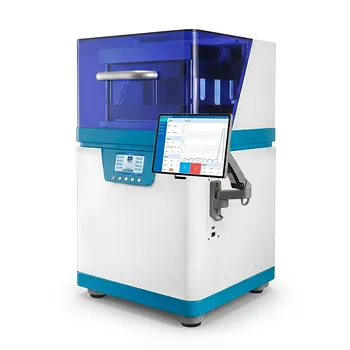
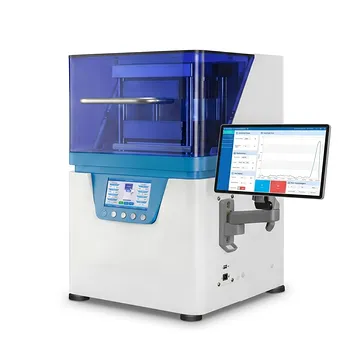
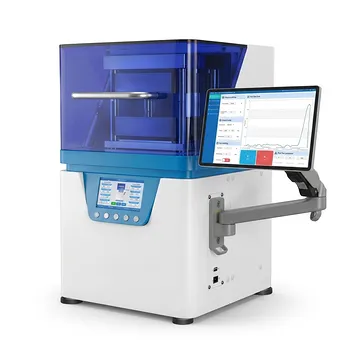
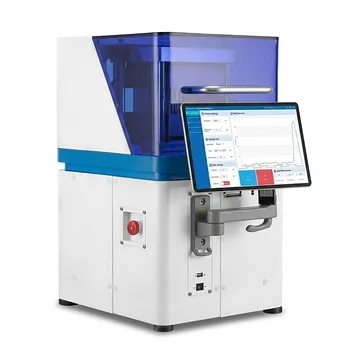
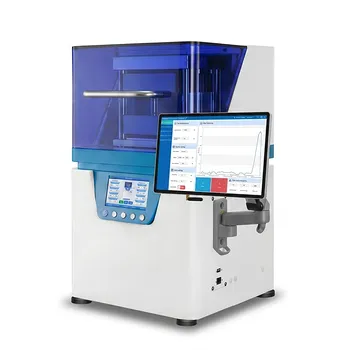
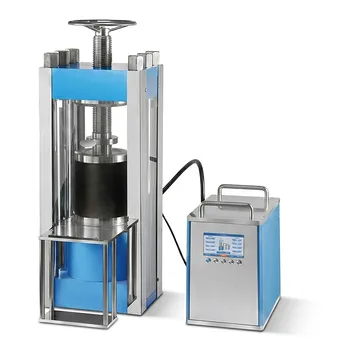
The role of a high-precision laboratory hot press in GDL preparation is to facilitate critical structural shaping by consolidating carbon-based components and binders into a unified, functional composite. This equipment applies precisely programmed temperature, pressure, and time to control the electrode's final thickness, porosity, and mechanical stability. By inducing controlled thermoplastic deformation in binders like polytetrafluoroethylene (PTFE), the hot press ensures optimal gas transport, liquid permeability, and electrical contact within the gas diffusion electrode.
The laboratory hot press is the primary tool for transforming loose carbon fiber and polymer layers into a high-performance electrode by regulating the internal micro-structure and interfacial contact. It balances the need for high electrical conductivity with the specific mass transport properties required for efficient electrochemical reactions.
The Role of Controlled Thermoplastic Deformation
Inducing PTFE Fibrillation
High-precision hot presses provide the multi-stage heating necessary to guide polytetrafluoroethylene (PTFE) through its transition from a dough-like state into a fibrillated network. This network acts as a robust physical binder that interlocks carbon particles and fibers.
Regulating Hydrophobicity and Flooding
By precisely controlling the temperature and pressure during the press cycle, the machine regulates the material's hydrophobicity. This is essential for preventing electrolyte flooding, as the hot press ensures the PTFE is distributed correctly to maintain open gas pathways during electrolysis.
Achieving Structural Cohesion and Low Resistance
Minimizing Interfacial Contact Resistance
The hot press applies uniform pressure to eliminate microscopic gaps between the active catalyst layer, the micro-porous layer (MPL), and the current collector. This high-pressure molding significantly reduces interfacial resistance, ensuring that current distribution remains uniform across the entire electrode surface.
Creating the Micro-Porous Layer (MPL) Bond
The equipment ensures a robust physical bond between the MPL and the carbon fiber fabric support layer. This integration is vital for maintaining structural stability even under high current densities or during long-term operation in flow cells and fuel cells.
Defining Mass Transport Pathways
Controlling Porosity and Thickness
A high-precision press allows for the exact regulation of the final product's porosity and volumetric energy density. By adjusting the linear pressure, researchers can achieve a specific compaction density that dictates how effectively gases and liquids move through the GDL.
Preventing Material Damage During Compaction
Precision control prevents common manufacturing defects such as secondary particle breakage or electrode delamination. The ability to apply uniform, controllable pressure ensures that the active material is compacted without compromising the integrity of the carbon fibers or the catalyst structure.
Understanding Critical Trade-offs in Hot Pressing
Porosity vs. Electrical Conductivity
Increasing the pressure in a hot press typically improves electrical conductivity by creating tighter contact between particles. However, excessive pressure can over-compact the layer, reducing the pore volume and hindering the diffusion of reactant gases.
Processing Speed vs. Structural Homogeneity
Rapid heating and pressing cycles may increase throughput but often lead to non-uniform thermal expansion or incomplete PTFE fibrillation. Multi-stage programs are necessary to ensure the material reaches thermal equilibrium, though they extend the total preparation time.
Optimizing Your Hot Pressing Protocol
How to Apply This to Your Project
To achieve the best results in gas diffusion electrode preparation, your hot pressing strategy should be tailored to your specific material composition and performance targets.
- If your primary focus is Maximizing Power Density: Use high-precision pressure control to minimize thickness and interfacial resistance while maintaining just enough porosity for gas transport.
- If your primary focus is Long-Term Durability: Prioritize multi-stage heating programs that ensure complete PTFE fibrillation and a robust physical bond between the MPL and the substrate.
- If your primary focus is Experimental Accuracy: Ensure the hot press applies perfectly uniform pressure across the entire surface area to eliminate microscopic gaps that could skew impedance and conductivity data.
Mastering the precision of the hot pressing process allows you to engineer a gas diffusion layer that serves as a reliable and high-performing interface for electrochemical energy conversion.
Summary Table:
| Function | Key Mechanism | Impact on GDL Performance |
|---|---|---|
| Structural Shaping | Thermoplastic deformation | Consolidates carbon fibers & binders into a stable composite |
| PTFE Fibrillation | Multi-stage heating | Creates a robust physical network to interlock particles |
| Resistance Control | Uniform pressure molding | Minimizes interfacial contact resistance & improves conductivity |
| Porosity Regulation | Linear pressure control | Balances gas transport pathways with volumetric energy density |
| Bonding | Thermal equilibrium | Ensures structural integrity between MPL and carbon support |
Elevate Your Battery Research with KINTEK Precision
Achieving the perfect balance of porosity and electrical conductivity requires hardware that delivers absolute control. KINTEK specializes in comprehensive laboratory pressing solutions tailored for advanced material science.
Our range includes:
- Manual & Automatic Hot Presses for versatile lab applications.
- Heated & Multifunctional Models for complex thermoplastic deformation.
- Glovebox-Compatible Systems for air-sensitive battery research.
- Cold & Warm Isostatic Presses for high-density material compaction.
Ready to optimize your GDL fabrication and enhance electrode durability? Contact KINTEK today to find the ideal pressing solution for your specific research needs.
References
- Matthew F. Philips, Klaas Jan P. Schouten. Electrochemical CO<sub>2</sub> Reduction on Gas Diffusion Electrodes: Enhanced Selectivity of In–Bi Bimetallic Particles and Catalyst Layer Optimization through a Design of Experiment Approach. DOI: 10.1021/acsaem.1c03156
This article is also based on technical information from Kintek Solution Knowledge Base .
Related Products
- Automatic Hydraulic Hot Press with Large Plate and Precision Temperature Control for Advanced Material Sample Preparation and Industrial Research
- Automatic High Temperature Heated Hydraulic Press Machine with Heated Plates for Lab
- Automatic Heated Hydraulic Lab Press with Programmable Touch Screen Controls and Precision Temperature Regulation
- Automatic Heated Hydraulic Press Machine with Heated Plates for Laboratory
- Automatic Heated Hydraulic Press Machine with Hot Plates for Laboratory
People Also Ask
- What are the specific features and applications of hydraulic hot press machines? Precision Solutions for Modern Labs
- How does an automatic hydraulic press operate? Achieve Precision and Consistency in Lab Pelleting
- What are the advantages and common applications of an automatic hydraulic press? Elevate Your Lab's Precision
- What is the technical significance of setting a precise dwell time? Achieve Peak Material Density and Stability
- When is an automatic hydraulic press more suitable than a manual press? Scale Your Lab with Precision & Speed