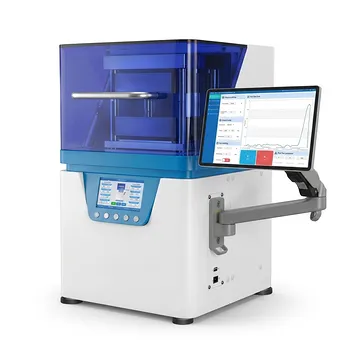
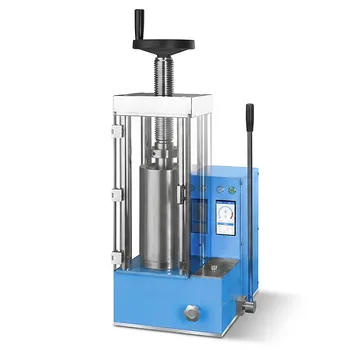
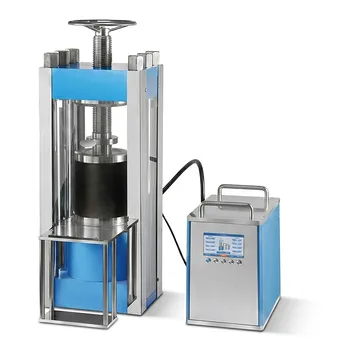
The electric heating press is the critical facilitator of the vulcanization process. It provides a synchronized environment of high temperature (typically 140°C to 160°C) and sustained pressure (ranging from 14 MPa to 200 kg/cm²) to trigger chemical cross-linking within the rubber compound. By maintaining these precise conditions, the press transforms raw, plastic natural rubber into a stable, three-dimensional molecular network with high mechanical strength and elasticity.
The electric heating press acts as both a thermal catalyst and a structural mold, ensuring that natural rubber achieves the specific cross-link density and material density required for industrial and laboratory standards.
The Thermal Mechanism of Vulcanization
Activating Chemical Cross-Linking
The primary role of the press is to supply the thermal energy needed to initiate reactions between rubber macromolecular chains and vulcanizing agents. High-precision electric heating elements maintain a constant temperature that allows accelerators like CBS, TMTD, or ZDC to react fully within the matrix.
Creating the Three-Dimensional Network
Under steady heat, the rubber’s internal structure shifts from a linear arrangement of chains to a three-dimensional cross-linked network. This fundamental change is what gives the final vulcanized sheet its characteristic thermal resistance and high modulus.
Ensuring Chemical Uniformity
Precise temperature control prevents localized areas of incomplete reaction, which would otherwise lead to weak spots in the rubber. A stable thermal environment ensures the cross-link density is consistent throughout the entire thickness of the specimen.
The Role of Mechanical Pressure
Eliminating Internal Voids and Bubbles
High hydraulic pressure is applied to the mold to force out trapped air and internal gases generated during the chemical reaction. This process of degassing is essential to prevent internal bubbles, which would compromise the structural integrity and appearance of the rubber.
Achieving Dimensional Stability
The press ensures that the softened rubber compound completely fills every cavity of the steel mold. This result is a dense, dimensionally stable specimen that matches the exact geometric requirements for standardized physical testing or product assembly.
Optimizing Material Density
By providing continuous pressure compensation, the press compacts the rubber molecules as they bond. This compression results in a material with superior tensile strength and hardness, qualities that are non-negotiable for high-performance applications.
Understanding the Trade-offs and Pitfalls
The Risk of Thermal Degradation
If the electric heating press is set to a temperature that is too high or if the cycle lasts too long, the rubber may undergo over-vulcanization. This leads to a reversal of properties, where the material becomes brittle or loses its elastic memory due to chain scission.
Challenges of Pressure Non-Uniformity
If the hydraulic system fails to distribute pressure evenly across the plates, the resulting rubber sheet will have uneven thickness. This variation makes the material unsuitable for precision testing, as the mechanical properties will fluctuate across the surface of the specimen.
Balancing Energy and Time
While higher temperatures can accelerate the vulcanization process, they often require more complex cooling cycles to prevent warping. Finding the "sweet spot" between cycle time and energy consumption is a constant challenge in high-volume production environments.
How to Optimize Press Usage for Your Goals
Proper utilization of an electric heating press depends entirely on the intended application of the natural rubber.
- If your primary focus is Laboratory Testing: Prioritize high-precision temperature control (±1°C) to ensure the repeatability of tensile and hardness results across different batches.
- If your primary focus is Industrial Durability: Focus on pressure compensation systems that maintain high force (e.g., 200 kg/cm²) throughout the cooling phase to maximize material density.
- If your primary focus is Complex Geometry: Utilize a press with multi-stage pressure settings to ensure the compound flows into intricate mold details without trapping air.
Mastering the balance of heat and force within the press is the only way to guarantee a high-quality, high-strength vulcanized product.
Summary Table:
| Process Phase | Primary Mechanism | Key Benefit |
|---|---|---|
| Thermal Activation | Constant Heat (140°C-160°C) | Triggers chemical cross-linking and 3D network formation |
| Mechanical Compression | High Pressure (Up to 200 kg/cm²) | Eliminates internal voids, bubbles, and ensures dimensional stability |
| Precision Control | Uniform Heat Distribution | Prevents over-vulcanization and ensures material density consistency |
Elevate Your Material Research with KINTEK Precision Pressing
Achieving the perfect vulcanization balance requires absolute control over temperature and force. KINTEK specializes in comprehensive laboratory pressing solutions tailored for high-performance applications like battery research and material science.
Our extensive range includes:
- Manual & Automatic Models for flexible lab workflows.
- Heated & Multifunctional Presses for precise thermal cross-linking.
- Glovebox-Compatible Systems for sensitive research environments.
- Cold & Warm Isostatic Presses (CIP/WIP) for advanced material density.
Don't settle for uneven results or material degradation. Let our experts help you find the ideal press to ensure repeatability and mechanical excellence. Contact KINTEK today to discuss your specific laboratory needs!
References
- Chang Su Woo, Wan Doo Kim. Heat-Aging Effects on the Material Properties and Fatigue Life Prediction of Vulcanized Natural Rubber. DOI: 10.2324/ejsm.2.7
This article is also based on technical information from Kintek Solution Knowledge Base .
Related Products
- Cylindrical Lab Electric Heating Press Mold for Laboratory Use
- Automatic Hydraulic Heat Press Machine with Multi Stage Programmable Control and Integrated Water Cooling Plate Size 180x180mm
- Automatic Heated Hydraulic Press Machine with Heated Plates for Laboratory
- Automatic Heated Hydraulic Press Machine with Hot Plates for Laboratory
- Automatic Heated Hydraulic Lab Press with Programmable Touch Screen Controls and Precision Temperature Regulation
People Also Ask
- How does a laboratory electric heated press ensure sample quality? Optimize SiR-EPDM vulcanization and molding.
- What role does a laboratory electric heated press play in polymer composite fabrication? Key for Standardized Specimens
- What role does a laboratory electric heating press play in NBR molding? Master Vulcanization & Material Density
- Why is a laboratory electric heating press required for PP/EPDM molding? Achieve Superior Specimen Integrity
- What is the purpose of incorporating cartridge heaters into a lab press mold for MLCC block compression? Optimize Results