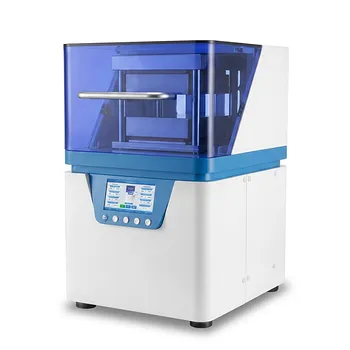
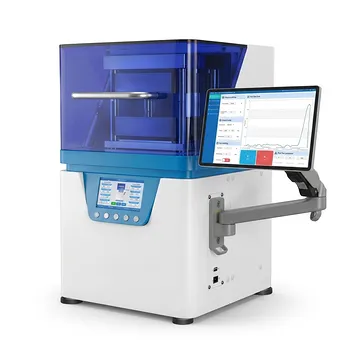
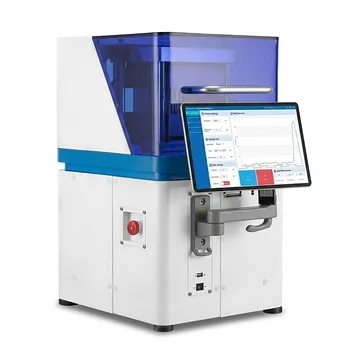
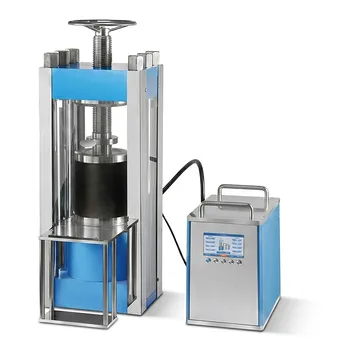
A high-precision laboratory heating press provides the simultaneous application of uniform heat and pressure required to transform raw biocomposite blends into consolidated, high-density sheets. It ensures adequate material flow to fill mold cavities while precisely regulating sample thickness and density. This process is fundamental for eliminating internal voids and ensuring a tight bond between the natural fibers and the polymer matrix.
Core Takeaway: The heating press acts as the critical bridge between raw biocomposite materials and standardized test specimens. By synchronizing thermal and mechanical energy, it eliminates defects and ensures the material achieves the structural integrity necessary for accurate performance evaluation.
Achieving Material Homogeneity and Structural Integrity
Eliminating Voids and Entrapped Air
The primary role of a heating press is to apply steady, high pressure to expel air bubbles and volatile gases trapped within the resin or fiber interface. This compaction is essential for producing dense structural composites with extremely low porosity. Without this vacuum-like consolidation, internal voids become stress concentrators that lead to premature material failure during mechanical testing.
Optimizing Fiber-Matrix Adhesion
By maintaining a temperature above the melting point or glass transition point, the press ensures the polymer matrix flows adequately to wet out bio-fillers like weight-blended fibers or lignin. This high-temperature environment facilitates diffusion bonding and tight packing at the molecular level. The result is a biocomposite sheet with uniform physical properties and a strong interfacial bond that maximizes load transfer between components.
Managing Complex Chemical Reactions
For biocomposites utilizing thermosetting resins, the heating press provides the precise thermal environment required for complete cross-linking reactions. Accurate temperature control (typically ranging from 130°C to 180°C) triggers the curing process while the pressure ensures the resin remains in a molten state long enough to fill every crevice of the mold. This synchronized control directly determines the final hardness and structural integrity of the composite.
Precision Control for Standardized Testing
Dimensional Accuracy and Density Regulation
A high-precision press allows researchers to produce plates with uniform thickness and smooth surfaces by controlling the displacement and pressure (often measured in tons or MPa). This precision is vital for creating standardized base materials for interlaminar sliding, friction characterization, and tensile testing. Consistent thickness ensures that variations in test results are due to material composition rather than geometric inconsistencies.
Facilitating Molecular Reorganization
In advanced materials like vitrimers, the press facilitates dynamic covalent bond exchange by heating the material above its topology freezing transition temperature. The application of stable pressure allows for chain segment reorganization, which is the core mechanism behind self-healing and damage recovery in smart biocomposites. This capability transforms a rigid polymer into a rubbery state where cracks can be closed and structural performance restored.
Understanding the Trade-offs
- Thermal Sensitivity of Bio-fillers: While high heat is necessary for matrix flow, excessive temperatures can lead to the thermal degradation of natural fibers (like wood or feather powder), weakening the final composite.
- Pressure vs. Fiber Damage: High pressure is required for density, but excessive force can crush delicate bio-fibers or cause non-uniform fiber distribution, leading to anisotropic properties where they are not desired.
- Dwell Time Management: Longer dwell times ensure complete curing but increase processing internal stresses, which may cause the biocomposite sheets to warp once they are removed from the press and cooled.
Applying the Right Parameters for Your Goal
How to Apply This to Your Project
To achieve the best results with a laboratory heating press, you must align your press settings with your specific material objectives:
- If your primary focus is Maximum Density: Prioritize high unit pressure (e.g., 10 MPa) and a longer dwell time to ensure all internal air and volatiles are completely expelled before the matrix solidifies.
- If your primary focus is Thermal Stability: Use the lowest possible temperature that still allows for full polymer flow to prevent the scorching or chemical breakdown of sensitive natural fibers.
- If your primary focus is Standardized Mechanical Testing: Utilize precision spacers or depth-stop controls on the press to maintain rigorous sample thickness across multiple batches.
- If your primary focus is Self-Healing/Recycling: Ensure the press can maintain a constant temperature above the topology freezing transition (Tv) while applying light, steady pressure to facilitate bond exchange.
The high-precision heating press is the definitive tool for converting inconsistent biocomposite blends into high-performance, standardized materials through the rigid control of the thermal and mechanical environment.
Summary Table:
| Role of Heating Press | Impact on Biocomposite | Research Outcome |
|---|---|---|
| Thermal Regulation | Facilitates polymer flow & curing | Stronger fiber-matrix bonding |
| Pressure Application | Eliminates voids & internal gases | High-density, defect-free samples |
| Precision Control | Ensures uniform sample thickness | Standardized mechanical testing |
| Molecular Reorg | Enables bond exchange (vitrimers) | Enhanced self-healing properties |
Elevate Your Biocomposite Research with KINTEK Precision
Achieving the perfect balance of heat and pressure is critical for developing high-performance materials. KINTEK specializes in comprehensive laboratory pressing solutions tailored to your specific research needs. Whether you are working on advanced battery research or sustainable biocomposites, our range includes:
- Manual & Automatic Heated Presses: For precise thermal and mechanical synchronization.
- Multifunctional & Glovebox-Compatible Models: Optimized for sensitive material processing.
- Cold & Warm Isostatic Presses: Ensuring maximum density for complex material applications.
Ready to transform your raw blends into high-integrity, standardized test specimens? Contact us today to discover how our pressing solutions can drive your innovation forward!
References
- Ramengmawii Siakeng, Suchart Siengchin. Accelerated Weathering and Soil Burial Effect on Biodegradability, Colour and Textureof Coir/Pineapple Leaf Fibres/PLA Biocomposites. DOI: 10.3390/polym12020458
This article is also based on technical information from Kintek Solution Knowledge Base .
Related Products
- Automatic Hydraulic Heat Press Machine with Multi Stage Programmable Control and Integrated Water Cooling Plate Size 180x180mm
- Heated Hydraulic Press Machine with Heated Plates for Vacuum Box Laboratory Hot Press
- Automatic High Temperature Heated Hydraulic Press Machine with Heated Plates for Lab
- Heated Hydraulic Press Machine With Heated Plates For Vacuum Box Laboratory Hot Press
- Automatic Heated Hydraulic Press Machine with Heated Plates for Laboratory
People Also Ask
- What are the specific features and applications of hydraulic hot press machines? Precision Solutions for Modern Labs
- What are the industrial applications of a hydraulic heat press? Powering Lamination, Bonding, and R&D Efficiency
- What role does a heated hydraulic press play in preparing test specimens using the compression molding (CM) process?
- What are the primary functions of a hydraulic press with heated platens in TP-RTM? Master Composite Manufacturing
- What is a hydraulic heat press? Discover Precision Material Bonding and Sample Preparation