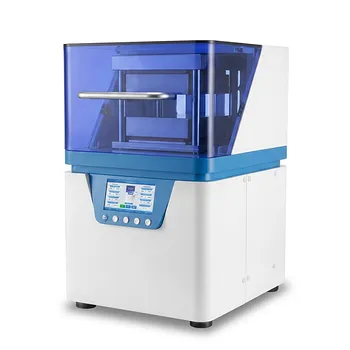
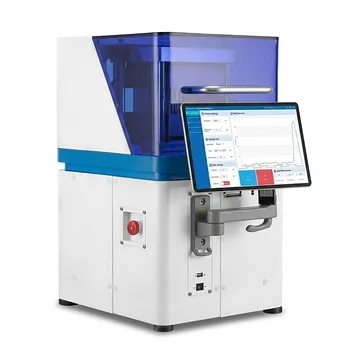
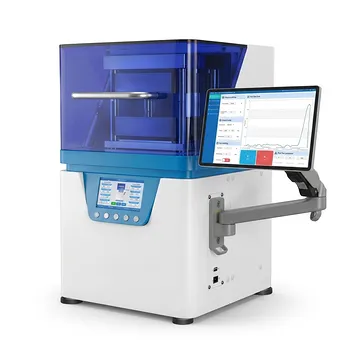
A laboratory hydraulic heat press facilitates cellulose composite molding by applying precise, simultaneous heat and uniaxial pressure to consolidate raw materials into dense, standardized specimens. This process transforms extruded pellets or powder mixtures into uniform thin films—typically around 0.3 mm—by eliminating internal pores and ensuring a consistent density throughout the material. It is a foundational step for preparing high-quality samples for rigorous mechanical characterization, such as tensile testing and Dynamic Mechanical Thermal Analysis (DMTA).
The hydraulic heat press serves as a critical bridge between raw composite material and standardized testing by using controlled thermal energy and pressure to remove structural defects. By eliminating air bubbles and managing the material's micro-scale orientation, the press ensures that experimental data reflects the material's inherent properties rather than processing inconsistencies.
The Role of Simultaneous Heat and Pressure
Facilitating Plastic Flow and Softening
The application of heat, often reaching temperatures like 190°C to 220°C, allows polymer-based cellulose composites to reach their melting point or exceed their glass transition temperature. This thermal energy softens the material, promoting plastic flow and allowing the polymer matrix to move around the cellulose fibers. In some protocols, a pre-heating phase is used without pressure to ensure the material is sufficiently softened before the consolidation begins.
Eliminating Internal Pores and Voids
High uniaxial pressure, which can range from 15 MPa to 30 MPa (or up to 400 bar), forces out entrapped air and gases. This compaction is vital for removing microscopic pores that would otherwise act as stress concentrators during mechanical testing. The result is a dense, "green body" or finished film with significantly higher structural integrity than specimens produced via additive manufacturing.
Enhancing Particle Rearrangement
In powder-based composites, the press applies a precise load that encourages particles to rearrange into a tightly packed configuration. This rearrangement is often assisted by organic binders that flow when heated, filling the gaps between cellulose and other components. This ensures a uniform distribution of the reinforcement phase within the matrix, leading to isotropic or specifically pre-oriented material properties.
Ensuring Structural Integrity and Standardization
Achieving Dimensional Stability and Uniformity
The use of precision-machined stainless steel molds within the press ensures that every specimen has a standardized thickness and surface finish. This level of dimensional stability is essential for calculating accurate stress and strain values during characterization. Consistency across multiple samples allows researchers to produce reproducible data that can be compared across different studies.
Controlling Morphology and Crystallization
By accurately adjusting the heating plate temperature and the subsequent cooling rate, researchers can influence the microscopic morphology of the composite. The press environment allows for the fine-tuning of crystallization behavior and phase separation. This capability is vital for "strain-engineering" materials, where the micro-scale orientation determines the final electromechanical performance.
Improving Mechanical Interlocking
The combination of heat and high pressure promotes mechanical interlocking between the cellulose fibers and the polymer precursors. In processes involving coated powders, the heat softens the coating, allowing it to flow and uniformly encapsulate the reinforcement particles. This creates a stronger interface, which is the primary factor in determining the tensile strength and durability of the composite.
Understanding the Trade-offs
Risks of Thermal Degradation
While heat is necessary for flow, cellulose is sensitive to prolonged exposure to high temperatures. If the press temperature is set too high or the dwell time is too long, the cellulose fibers may degrade, leading to a loss of mechanical properties and discoloration. Finding the "thermal window" between polymer melting and cellulose degradation is a common challenge for researchers.
Pressure Distribution and Defect Formation
Uneven pressure distribution across the mold surface can lead to internal density gradients. This can cause the specimen to warp, delaminate, or crack during the cooling phase or subsequent sintering stages. Maintaining parallelism between the platens and ensuring even material distribution within the mold is required to avoid these structural failures.
How to Apply This to Your Project
Guidelines for Molding Parameters
When utilizing a laboratory hydraulic press for cellulose composites, your settings should be dictated by the specific matrix material and the desired final test.
- If your primary focus is mechanical characterization (Tensile/DMTA): Prioritize thickness uniformity and pore elimination by using standardized molds and high pressure (e.g., 30 MPa) to ensure specimen density.
- If your primary focus is studying morphology or crystallization: Focus on the cooling rate and precise temperature control of the heating plates to manipulate the material's internal structure.
- If your primary focus is preventing material degradation: Utilize a pre-heating phase to soften the matrix at the lowest possible temperature before applying full pressure to minimize the thermal load on the cellulose.
By mastering the balance of thermal flow and mechanical compaction, you can produce cellulose composite specimens that yield highly accurate and reproducible experimental results.
Summary Table:
| Feature | Physical Process | Key Research Benefit |
|---|---|---|
| Simultaneous Heat/Pressure | Facilitates plastic flow & matrix softening | Consolidates material into dense, 0.3mm films |
| Uniaxial Pressure | Eliminates microscopic pores & air bubbles | Removes stress concentrators for accurate testing |
| Precision Temp Control | Manages crystallization & morphology | Enables reproducible DMTA and tensile data |
| Standardized Molds | Ensures dimensional stability | Produces uniform specimens for comparative studies |
Elevate Your Material Research with KINTEK
Achieve unparalleled precision in your specimen preparation with KINTEK’s comprehensive laboratory pressing solutions. Whether you are working on cellulose composites or cutting-edge battery research, our range of manual, automatic, heated, and multifunctional presses ensures consistent density and pore-free results every time.
Our specialized equipment includes:
- Glovebox-compatible models for sensitive environments.
- Heated and cooling platens for precise morphology control.
- Cold and warm isostatic presses for advanced material characterization.
Don't let processing inconsistencies compromise your data. Contact KINTEK today to find the perfect pressing solution for your laboratory needs!
References
- P. Zugenmaier. Materials of cellulose derivatives and fiber-reinforced cellulose-polypropylene composites: Characterization and application. DOI: 10.1351/pac200678101843
This article is also based on technical information from Kintek Solution Knowledge Base .
Related Products
- Automatic Hydraulic Heat Press Machine with Multi Stage Programmable Control and Integrated Water Cooling Plate Size 180x180mm
- Automatic Hydraulic Hot Press with Large Plate and Precision Temperature Control for Advanced Material Sample Preparation and Industrial Research
- Automatic Heated Hydraulic Lab Press with Programmable Touch Screen Controls and Precision Temperature Regulation
- Heated Hydraulic Press Machine with Heated Plates for Vacuum Box Laboratory Hot Press
- Automatic Heated Hydraulic Press Machine with Hot Plates for Laboratory
People Also Ask
- How is a hydraulic heat press used for sample preparation? Achieve Uniform, Void-Free Samples for Lab Analysis
- What is the role of a hydraulic heat press in material testing? Unlock Superior Data for Research & QC
- What is a hydraulic heat press? Discover Precision Material Bonding and Sample Preparation
- What are the industrial applications of a hydraulic heat press? Powering Lamination, Bonding, and R&D Efficiency
- What is a hydraulic hot press machine? Master Material Bonding with Precise Thermal Pressure Control