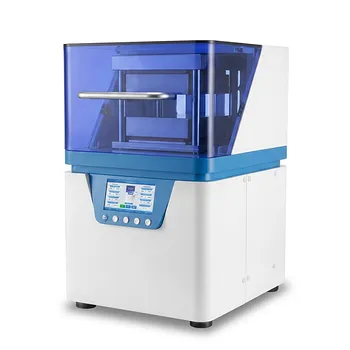
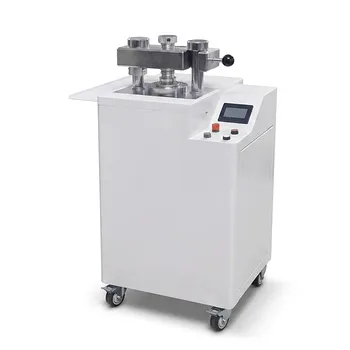
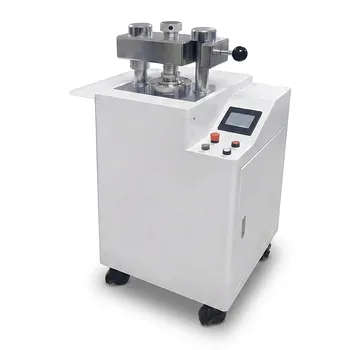
Precision through systematic automation. Fully automatic program-controlled hydraulic presses provide a standardized environment that eliminates the inherent variability of manual operation. By utilizing preset pressure curves and precise dwell parameters, these systems ensure that every sample in a high-throughput workflow is identical in density, thickness, and microstructural integrity.
Core Takeaway: The transition to automated hydraulic pressing replaces subjective manual force with objective, programmable control. This shift is essential for generating the highly reproducible data required to build reliable research databases and validate theoretical material models.
Eliminating Human-Induced Variability
Removing Operator-Dependent Errors
Manual pressing relies on the physical strength and consistency of a technician, which naturally fluctuates over time. Automated systems remove this variable by executing the exact same mechanical sequence for every batch, regardless of the operator.
Standardizing Pressurization Rates
The speed at which pressure is applied can significantly alter a material's final properties. Programmable controls allow researchers to define specific pressurization rates, ensuring that the material reaches its target load under controlled, repeatable conditions.
Closed-Loop Load Control
Advanced automatic presses utilize closed-loop systems to monitor and adjust pressure in real-time. This system corrects for minor mechanical fluctuations instantly, maintaining a level of precision that manual equipment simply cannot achieve.
Enhancing Material and Scientific Integrity
Eliminating Internal Density Gradients
Uneven pressure application often creates internal density variations that ruin experimental results. Smooth, automated pressurization ensures a uniform "green body" density, which is critical for advanced functional materials sensitive to physical structure.
Preventing Microscopic Defects
Rapid manual decompression can lead to microscopic cracks or structural failure in brittle samples. Programmed decompression allows for a controlled release of energy, significantly increasing the yield rate for fragile or pressure-sensitive materials.
Aligning Experiments with Theoretical Models
In fields like lithium-ion research, physical density directly impacts diffusion coefficients. Precision control ensures that experimental samples possess the exact physical characteristics required to make data comparable to first-principles theoretical calculations.
Driving High-Throughput Efficiency
Enabling Autonomous Operation
Once a program is initiated, the press operates independently, requiring no human intervention. This allows researchers to focus on data analysis and other critical tasks, effectively increasing the total output of the laboratory.
Managing Complex Multi-Stage Processes
Certain materials require complex cycles involving heating, specific dwell times at multiple pressures, and controlled cooling. Integrated cycle management handles these multi-stage parameters automatically, ensuring that complex synthesis paths are followed perfectly every time.
Understanding the Trade-offs
Initial Capital Investment
The most significant barrier to automation is the higher upfront cost compared to manual equipment. While the long-term ROI is found in data reliability and labor savings, the initial expenditure requires a clear budgetary commitment.
Programming and Maintenance Requirements
Automated systems require a degree of technical expertise to program and calibrate correctly. Furthermore, the increased complexity of the electronics and sensors means that maintenance must be more rigorous than the simple mechanical upkeep of a manual press.
Setup Time for Variable Samples
For labs that frequently change materials or sample sizes, the initial programming time can be a bottleneck. While automation excels at repetitive tasks, manual equipment remains slightly more "nimble" for one-off, highly exploratory trials where parameters are unknown.
Applying This Technology to Your Research Goals
Implementing High-Performance Standards
Evaluating your specific research needs will dictate how heavily you should lean into automation features versus cost-saving manual options.
- If your primary focus is high-throughput data sets: Invest in fully automatic presses with closed-loop control to ensure every data point in your database is built on a consistent physical foundation.
- If your primary focus is pressure-sensitive functional materials: Prioritize systems with programmable decompression and dwell times to prevent micro-cracks and ensure structural integrity.
- If your primary focus is comparative performance studies: Utilize stored pressure curves to guarantee that different batches of samples are processed under identical conditions for valid scientific comparison.
True scientific progress in materials research is built upon the foundation of experimental reproducibility.
Summary Table:
| Feature | Manual Hydraulic Press | Fully Automatic Press |
|---|---|---|
| Consistency | Operator-dependent | High reproducibility (stored programs) |
| Pressure Control | Subjective manual force | Precise closed-loop system |
| Decompression | Rapid/Uncontrolled | Programmable (prevents micro-cracks) |
| Efficiency | Labor-intensive | Autonomous operation |
| Ideal Use | Simple exploratory trials | High-throughput material databases |
Optimize Your Research with KINTEK Precision
Ensure absolute reproducibility in your laboratory with KINTEK’s comprehensive pressing solutions. From manual and automatic models to heated, multifunctional, and glovebox-compatible systems, we provide the tools needed for advanced battery research and materials science. Whether you require cold/warm isostatic presses or high-throughput automation, our equipment is designed to align your experiments with the highest theoretical standards.
Ready to upgrade your lab's performance? Contact KINTEK today to find your solution!
References
- Abdullah Alotaibi, Katabathini Narasimharao. Iron Phosphate Nanomaterials for Photocatalytic Degradation of Tetracycline Hydrochloride. DOI: 10.1002/slct.202501231
This article is also based on technical information from Kintek Solution Knowledge Base .
Related Products
- Automatic Heated Hydraulic Lab Press with Programmable Touch Screen Controls and Precision Temperature Regulation
- Automatic Heated Hydraulic Lab Press 120x120mm Plate Fully Automated Material Research Press
- Automatic Hydraulic Heat Press Machine with Multi Stage Programmable Control and Integrated Water Cooling Plate Size 180x180mm
- Automatic Heated Hydraulic Press Machine with Hot Plates for Laboratory
- Automatic Hydraulic Hot Press with Large Plate and Precision Temperature Control for Advanced Material Sample Preparation and Industrial Research
People Also Ask
- Why is a laboratory heated hydraulic press required? Ensure Precise Vulcanization for NBR/EPDM Nanocomposites
- What are the industrial applications of heated hydraulic presses? Master Heat & Force for Precision Manufacturing
- Why is an automatic heated lab press preferred for PEEK & CNT laminates? Achieve Precise Crystallization Control
- What is the necessity of a laboratory hydraulic press with heating functions? Master Rubber Vulcanization Precision
- How does a heated laboratory hydraulic press contribute to the formation of dense mycelium-based materials? Expert Tips