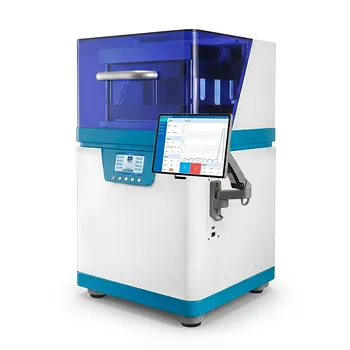
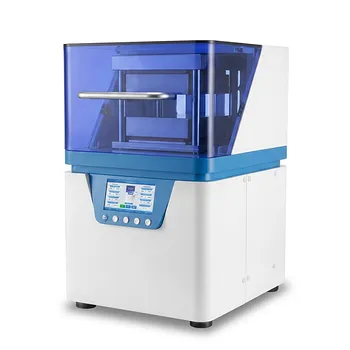
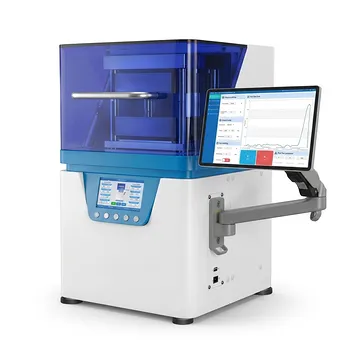
The precise measurement of ionic conductivity hinges on the physical integrity of the test material. For fast ion conductors like $Li_8SiSe_6$, laboratory hydraulic presses are essential because they condense loose powder into high-density pellets, minimizing the air gaps and grain boundary resistance that otherwise obscure the material’s intrinsic electrochemical properties. This ensures the data generated reflects the actual movement of ions through the crystal lattice rather than physical obstructions between particles.
Core Takeaway: Laboratory hydraulic presses transform synthesized powders into dense, high-performance ceramic pellets to ensure maximum particle-to-particle contact. By drastically reducing grain boundary resistance and porosity, these tools allow researchers to measure a material’s intrinsic ionic conductivity and validate results against theoretical models.
Maximizing Particle-to-Particle Contact
The efficiency of ion transport in solid-state electrolytes is entirely dependent on how well the individual particles "touch."
Minimizing Grain Boundary Resistance
In a loose powder, ions must jump across large physical gaps, which creates massive electrical resistance. High-pressure compaction forces particles together, significantly reducing this grain boundary resistance and allowing ions to flow more freely across interface boundaries.
Eliminating Macro-Physical Voids
Air pockets and internal porosity act as insulators that block ion diffusion. By applying pressures—often reaching up to 347 MPa—hydraulic presses eliminate these voids, ensuring the density of the sample approaches its theoretical limit.
Optimizing Electrode Interface
Accurate Electrochemical Impedance Spectroscopy (EIS) requires a perfect interface between the electrolyte and the electrodes (often gold). The hydraulic press ensures the pellet surface is uniform and flat, providing superior contact quality that is essential for reliable data.
Ensuring Scientific Accuracy and Validation
Experimental data is only valuable if it can be compared to theoretical predictions and repeated by other researchers.
Validation Against Simulation Results
Researchers use ab initio molecular dynamics (AIMD) simulations to predict how ions should move through a material. By using a hydraulic press to create a high-density "green pellet," researchers can obtain experimental data that accurately reflects intrinsic properties, facilitating a direct and effective comparison with these simulations.
Consistency in Sample Geometry
Precise control of pressure output ensures that every sample produced has consistent dimensions. This uniformity is critical because the final conductivity calculation depends on the pellet’s thickness and surface area; any variance here would lead to incorrect results.
Establishing Material Baselines
Without dense compaction, measured conductivity would reflect the "bulk" data of the voids rather than the material itself. Using a press ensures that the measured lithium-ion migration energy barrier is a characteristic of the material's chemistry, not its physical preparation state.
Understanding the Trade-offs and Pitfalls
While high pressure is necessary, it must be applied with technical precision to avoid compromising the sample.
Pressure Sensitivity
Applying too little pressure results in "green bodies" that are too fragile to handle or too porous to test. Conversely, excessive pressure can cause micro-fractures or phase changes in sensitive thio-selenide materials like $Li_8SiSe_6$, which can skew conductivity readings downwards.
Uniaxial vs. Isostatic Compaction
Standard hydraulic presses apply uniaxial pressure, which may lead to density gradients within the pellet. Isostatic presses, while more complex, apply pressure from all directions, resulting in superior uniformity and even lower internal porosity.
The Role of Sintering
Compaction is often just the first step; these "green pellets" usually require subsequent high-temperature sintering. If the initial pressing is inconsistent, the sintering process will likely result in a warped or cracked ceramic, rendering the sample useless for EIS testing.
How to Apply Compaction to Your Research
Choosing the right pressing strategy depends on your material's sensitivity and your required data precision.
- If your primary focus is initial screening of new materials: Use an automatic uniaxial hydraulic press to quickly produce uniform pellets at standardized pressures (e.g., 250–350 MPa) for rapid EIS benchmarking.
- If your primary focus is validating theoretical AIMD models: Utilize an isostatic press to ensure the highest possible density and eliminate geometric variables, ensuring the measurement reflects intrinsic bulk transport.
- If your primary focus is mechanical stability during sintering: Ensure the press allows for a slow "dwell time" at peak pressure to allow air to escape, preventing the formation of internal cracks during the heating phase.
By mastering the densification of fast ion conductors, researchers bridge the gap between theoretical chemistry and functional solid-state battery technology.
Summary Table:
| Key Feature | Impact on Ionic Conductivity Testing | Recommended Press Type |
|---|---|---|
| High-Pressure Compaction | Reduces grain boundary resistance by forcing particles together. | Automatic Uniaxial Press |
| Void Elimination | Removes air pockets (insulators) to reach theoretical density. | Isostatic Press |
| Surface Uniformity | Ensures a flat interface for accurate EIS (Impedance Spectroscopy). | Automatic/Heated Press |
| Geometric Precision | Guarantees consistent pellet dimensions for reliable calculations. | Automatic Pellet Press |
| Density Gradient Control | Minimizes internal porosity and prevents micro-fractures. | Isostatic/Slow-Dwell Press |
Elevate Your Battery Research with KINTEK Precision
To achieve reliable ionic conductivity measurements in materials like $Li_8SiSe_6$, sample integrity is non-negotiable. KINTEK specializes in comprehensive laboratory pressing solutions designed for the rigorous demands of battery research.
Our range includes:
- Manual & Automatic Pellet Presses for rapid screening.
- Heated & Multifunctional Models for advanced material synthesis.
- Glovebox-Compatible Designs for air-sensitive solid-state electrolytes.
- Cold & Warm Isostatic Presses to eliminate density gradients and maximize bulk transport.
Don't let physical voids skew your electrochemical data. Contact KINTEK today to discover how our high-performance pressing equipment can bridge the gap between your theoretical models and experimental validation!
References
- Qifan Yang, Hong Li. New fast ion conductors discovered through the structural characteristic involving isolated anions. DOI: 10.1038/s41524-025-01559-9
This article is also based on technical information from Kintek Solution Knowledge Base .
Related Products
- Automatic Hydraulic Hot Press with Large Plate and Precision Temperature Control for Advanced Material Sample Preparation and Industrial Research
- Automatic Hydraulic Heat Press Machine with Multi Stage Programmable Control and Integrated Water Cooling Plate Size 180x180mm
- Automatic High Temperature Heated Hydraulic Press Machine with Heated Plates for Lab
- Automatic Heated Hydraulic Lab Press with Programmable Touch Screen Controls and Precision Temperature Regulation
- Manual Heated Hydraulic Lab Press with Integrated Hot Plates Hydraulic Press Machine
People Also Ask
- What are the specific features and applications of hydraulic hot press machines? Precision Solutions for Modern Labs
- How does an automatic hydraulic press operate? Achieve Precision and Consistency in Lab Pelleting
- What are the advantages and common applications of an automatic hydraulic press? Elevate Your Lab's Precision
- What is the technical significance of setting a precise dwell time? Achieve Peak Material Density and Stability
- When is an automatic hydraulic press more suitable than a manual press? Scale Your Lab with Precision & Speed