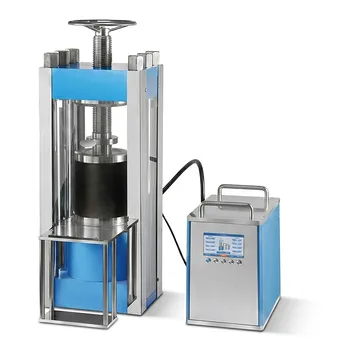
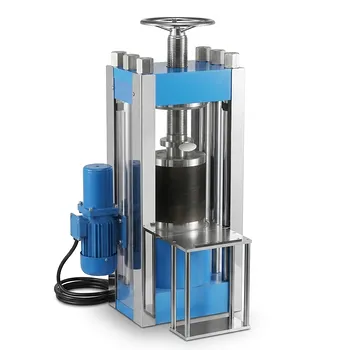
The necessity of a high-precision laboratory heated press stems from its ability to provide the exact thermodynamic conditions required to activate the molecular mechanisms of self-repair. In intrinsic self-healing polyurethanes, repair is driven by the reversible breaking and recombination of dynamic covalent bonds or supramolecular interactions, processes that require precisely controlled thermal energy and pressure to accelerate molecular chain diffusion. Without this high-precision control, researchers cannot accurately quantify healing efficiency or ensure the structural integrity of the material specimens.
Core Takeaway: A heated laboratory press acts as both a catalyst for molecular reorganization and a tool for rigorous specimen standardization, making it indispensable for evaluating how external stimuli trigger the "healing" properties of advanced polyurethanes.
Triggering Molecular Reorganization and Chain Diffusion
Activation of Dynamic Reversible Bonds
Intrinsic self-healing polyurethanes rely on dynamic covalent bonds (such as Diels-Alder reactions or disulfide bridges) or supramolecular interactions that break and reform. A high-precision press provides the specific, uniform thermal field required to reach the activation energy of these bonds without degrading the polymer backbone.
Facilitating Molecular Mobility
Healing occurs when polymer chains migrate across a fracture interface, a process known as chain diffusion. The press applies constant, controlled pressure that ensures intimate contact between surfaces, allowing heat to effectively lower the material's viscosity and promote chain entanglement.
Achieving Optimal Cross-linking Density
The synchronization of temperature and pressure is critical for ensuring that the polymer achieves its optimal cross-linking density. This environment promotes the thorough rearrangement of functional groups, which is essential for the material to regain its original mechanical strength after damage.
Ensuring Specimen Integrity and Standardization
Elimination of Internal Defects
During the R&D process, air bubbles and internal voids can act as stress concentrators, leading to premature failure during testing. The high-pressure capabilities of a laboratory press force the molten polymer to flow into every corner of a mold, purging air and ensuring a dense, homogeneous sample.
Controlling Thermal History and Crystallinity
Polymers "remember" how they were cooled and heated; this thermal history significantly impacts their crystallinity and mechanical behavior. A high-precision press allows for repeatable cooling and heating rates, ensuring that every specimen tested has a uniform crystalline structure and standardized physical properties.
Precision in Sample Geometry
For research to be valid, test specimens must have exact dimensions for tensile or bending tests. The press allows for precise control over thickness and surface flatness, minimizing variables that could skew the data when measuring the recovery of mechanical properties.
Understanding the Trade-offs and Pitfalls
The Risk of Thermal Degradation
While heat is necessary for healing, excessive temperatures can lead to the permanent breakdown of polymer chains. High-precision systems are required to prevent thermal overshoot, which could turn a reversible bond into an irreversible decomposition of the material.
Balancing Flow and Microstructure
Applying too much pressure can cause "flash" (excess material leaking from the mold) or crush the delicate microstructure of composite polyurethanes. Conversely, insufficient pressure leads to poor interfacial adhesion, making it impossible to distinguish between a failure of the healing chemistry and a failure of the specimen's physical structure.
How to Apply High-Precision Pressing to Your Research
Successful R&D requires matching the pressing parameters to the specific chemistry of your polyurethane.
- If your primary focus is quantifying healing efficiency: Prioritize a press with high-precision pressure stability to ensure that the contact between fractured surfaces is identical across all test cycles.
- If your primary focus is processing heat-sensitive polymers: Invest in a system with advanced PID temperature controllers to maintain a tight thermal window, preventing accidental degradation of dynamic functional groups.
- If your primary focus is developing high-performance films: Select a press that offers ultra-flat heated platens to ensure uniform thickness and consistent ion transport or mechanical properties across the entire surface area.
By precisely controlling the external environment, the heated laboratory press transforms the theoretical potential of self-healing chemistry into measurable, repeatable material performance.
Summary Table:
| Key Feature | Research Benefit | Impact on Material |
|---|---|---|
| Precise Thermal Control | Activates dynamic covalent bonds | Enables molecular self-repair mechanism |
| Uniform Pressure | Promotes polymer chain diffusion | Ensures molecular entanglement & strength |
| Specimen Molding | Eliminates air bubbles & voids | Guarantees dense, defect-free samples |
| Thermal History Mgt. | Standardizes cooling/heating rates | Ensures repeatable crystallinity & data |
| Geometric Precision | Consistent sample thickness | Minimizes variables in mechanical testing |
Elevate Your Material Research with KINTEK Precision
In the world of advanced polymers and self-healing materials, precision is the boundary between a breakthrough and a failure. KINTEK specializes in comprehensive laboratory pressing solutions designed to give researchers total control over their thermodynamic environments.
Whether you are quantifying the healing efficiency of new polyurethanes or pioneering next-generation energy storage, our equipment provides the reliability and accuracy your data deserves. Our extensive range includes:
- Manual & Automatic Presses: Versatile options for every lab scale.
- Heated & Multifunctional Models: Engineered for precise bond activation and molding.
- Glovebox-Compatible Presses: Ideal for sensitive material synthesis in controlled environments.
- Cold & Warm Isostatic Presses: Widely applied in high-performance battery research and advanced ceramics.
Ready to standardize your specimens and achieve repeatable, publication-quality results?
Contact KINTEK Today for a Tailored Solution
References
- Mahesh Yadlapati. Self-Healing Materials: A Breakthrough in Material Science. DOI: 10.37745/ejcsit.2013/vol13n125261
This article is also based on technical information from Kintek Solution Knowledge Base .
Related Products
- Automatic Large Format Laboratory Heated Hydraulic Press 400x400mm Plate Capacity
- 24T 30T 60T Heated Hydraulic Lab Press Machine with Hot Plates for Laboratory
- Laboratory Split Manual Heated Hydraulic Press Machine with Hot Plates
- Automatic Heated Hydraulic Lab Press 120x120mm Plate Fully Automated Material Research Press
- Heated Hydraulic Press Machine with Heated Plates for Vacuum Box Laboratory Hot Press
People Also Ask
- Why is a laboratory heated hydraulic press required? Ensure Precise Vulcanization for NBR/EPDM Nanocomposites
- What role does a Laboratory Heated Hydraulic Press play in rubber vulcanization? Master Precision Specimen Molding
- How does a laboratory heated hydraulic press improve the performance of dried composite solid-state membranes? Guide
- What role does a laboratory heated hydraulic press play in PLA/MCC molding? Achieve superior composite density.
- Role of Laboratory Heated Hydraulic Presses in Solid Electrolyte Fabrication: Enhance Density & Ionic Conductivity