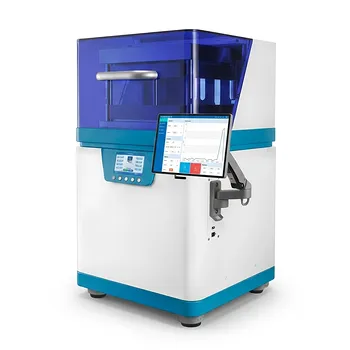
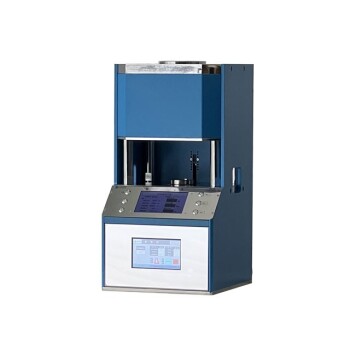
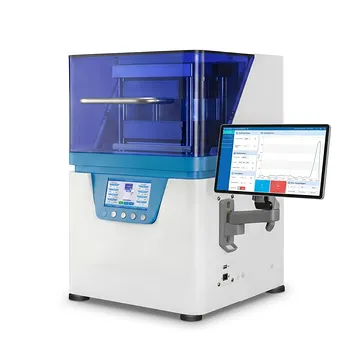
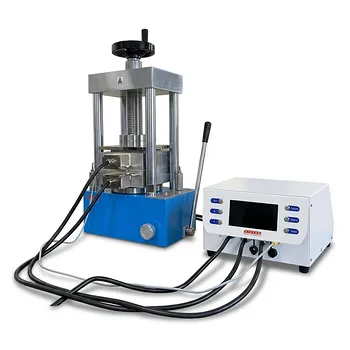
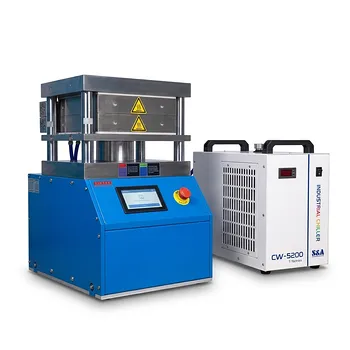
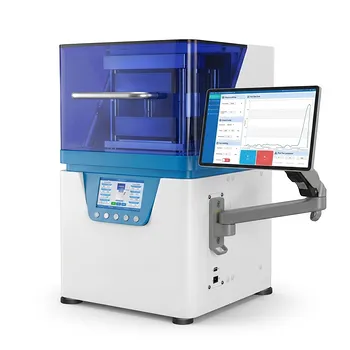
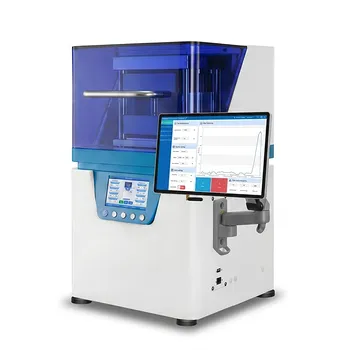
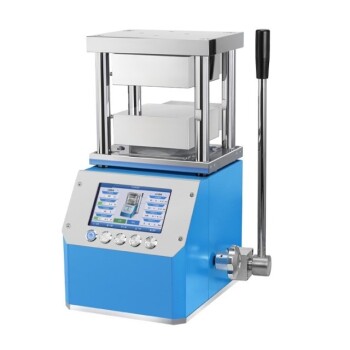
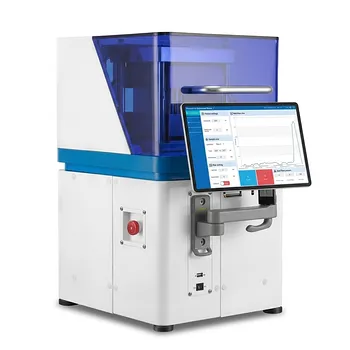
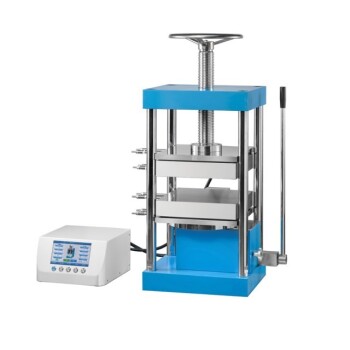
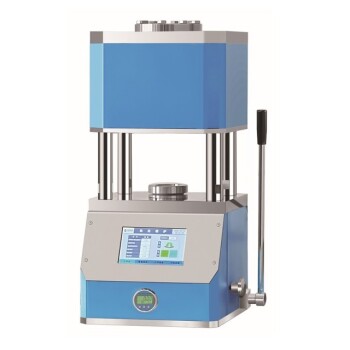
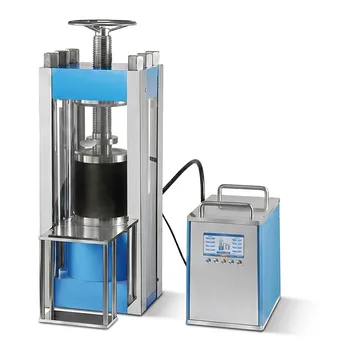
A high-precision laboratory hot press is required to eliminate internal voids and standardize the thermal history of LDPE/PET blends. By applying precise temperatures (such as 270 °C) and constant pressure (typically 4.8 MPa), the equipment ensures that the specimens reach a uniform thickness and a dense internal structure. This level of control is fundamental for obtaining reliable, repeatable data in subsequent rheological and mechanical evaluations.
The core function of a precision hot press is to transform a raw polymer blend into a defect-free, standardized specimen with a representative microstructure. Without this precise control, internal air bubbles and inconsistent thermal exposure would lead to inaccurate data that fails to reflect the material's true properties.
Eliminating Structural Defects and Internal Voids
The Role of Constant High Pressure
A precision hot press applies a constant, high pressure—often around 4.8 MPa—to force the molten LDPE/PET blend into every corner of the mold. This force is necessary to drive out micropores and air bubbles that are naturally trapped during the initial mixing or pelletizing stages.
Ensuring Internal Density
High-pressure molding ensures the material achieves a dense final structure with no internal gaps. In mechanical testing, even a tiny internal void acts as a stress concentrator, which would cause the specimen to fail prematurely and provide a false reading of the material's actual strength.
Surface and Dimensional Accuracy
Precise control over the press plates ensures high consistency in specimen thickness, typically targeted at 1 mm or 100 µm depending on the test. For rheological analysis, where results are highly sensitive to the gap between the plates, any variation in thickness would render the viscosity and modulus data incomparable.
Standardizing Morphology and Thermal History
Managing Multi-Phase Interfacial States
LDPE and PET are typically immiscible, meaning they form a multi-phase system with complex interfaces. A laboratory press allows for the precise control of holding time and temperature needed to accurately represent the material’s inherent microstructure and interfacial state.
Controlling Thermal Memory
Polymers have "memory" of how they were heated and cooled, known as thermal history. High-precision equipment ensures that every specimen undergoes the exact same heating cycle (e.g., 270 °C), which prevents orientation effects and ensures that the data reflects the material properties rather than processing artifacts.
Achieving Full Material Flow
PET requires high temperatures (often exceeding 250 °C) to flow properly. The precision hot press maintains these high temperatures with minimal fluctuation, ensuring the PET phase is fully molten and blended with the LDPE, resulting in a homogeneous distribution within the test plate.
Understanding the Trade-offs
Thermal Degradation vs. Proper Consolidation
While high temperatures and long holding times are required to eliminate voids, they increase the risk of thermal degradation, especially for the LDPE phase. A high-precision press mitigates this by allowing for staged pressure increases and rapid, controlled cooling to lock in the structure without over-exposing the polymer to heat.
Equipment Precision vs. Sample Throughput
Manual presses often lack the consistency of automated high-precision units, leading to specimen-to-specimen variability. While high-precision units may require more rigorous setup and calibration, this investment is necessary to avoid the much higher cost of unreliable or non-reproducible research data.
How to Optimize Specimen Preparation for Your Goals
To ensure your LDPE/PET specimens meet the strict requirements of standardized testing, consider the following recommendations:
- If your primary focus is Rheological Analysis: Prioritize thickness precision and the elimination of micro-bubbles, as rheological data is extremely sensitive to geometry and internal gaps.
- If your primary focus is Mechanical Testing: Focus on maintaining a constant pressure of at least 4.8 MPa to ensure maximum material density and the removal of stress-concentrating defects.
- If your primary focus is Morphology/Interfacial Studies: Use the press to strictly control the cooling rate, which directly influences the phase separation and crystalline structure of the PET within the LDPE matrix.
Mastering the precision of the hot-pressing process is the single most critical step in bridging the gap between raw material blending and accurate performance characterization.
Summary Table:
| Key Parameter | Requirement | Impact on Analysis |
|---|---|---|
| Applied Pressure | ~4.8 MPa | Eliminates internal voids and stress concentrators |
| Processing Temp | ~270 °C | Ensures PET phase flow and homogeneous blending |
| Thickness Control | 100 µm - 1 mm | Critical for consistent rheological viscosity data |
| Thermal History | Standardized Cycle | Prevents processing artifacts and orientation effects |
| Cooling Rate | Controlled | Determines phase morphology and crystallinity |
Optimize Your Specimen Preparation with KINTEK
Precision is the foundation of reliable material science. KINTEK specializes in comprehensive laboratory pressing solutions tailored for high-stakes research, including battery development and polymer analysis.
Our extensive range includes:
- Manual & Automatic Hot Presses for repeatable thermal cycles.
- Heated & Multifunctional Models for complex material blends.
- Glovebox-Compatible & Isostatic Presses (Cold/Warm) for specialized environments.
Ensure your LDPE/PET blends and battery materials meet the highest standards of structural integrity. Contact KINTEK today to find the perfect pressing solution for your lab!
References
- Pedro V. Rodrigues, A. V. Machado. New Strategy for Upcycling Marine Plastic Waste Through the Development of a Diamine-Functionalized Poly(ethylene terephthalate) Compatibilizer. DOI: 10.3390/recycling10030082
This article is also based on technical information from Kintek Solution Knowledge Base .
Related Products
- Automatic Hydraulic Hot Press with Large Plate and Precision Temperature Control for Advanced Material Sample Preparation and Industrial Research
- Automatic High Temperature Heated Hydraulic Press Machine with Heated Plates for Lab
- Automatic Heated Hydraulic Lab Press with Programmable Touch Screen Controls and Precision Temperature Regulation
- 24T 30T 60T Heated Hydraulic Lab Press Machine with Hot Plates for Laboratory
- Automatic Heated Hydraulic Press Machine with Hot Plates for Laboratory
People Also Ask
- What are the specific features and applications of hydraulic hot press machines? Precision Solutions for Modern Labs
- How does an automatic hydraulic press operate? Achieve Precision and Consistency in Lab Pelleting
- What are the advantages and common applications of an automatic hydraulic press? Elevate Your Lab's Precision
- What is the technical significance of setting a precise dwell time? Achieve Peak Material Density and Stability
- When is an automatic hydraulic press more suitable than a manual press? Scale Your Lab with Precision & Speed