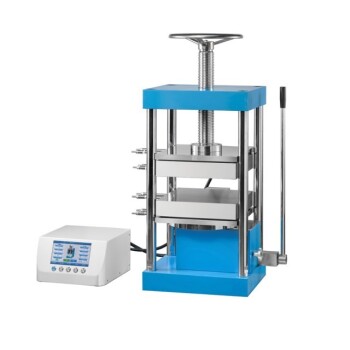
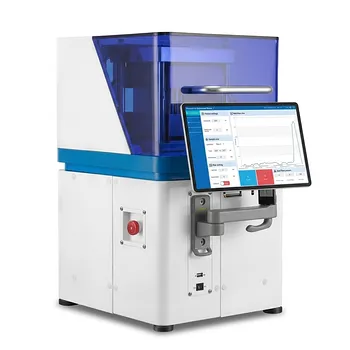
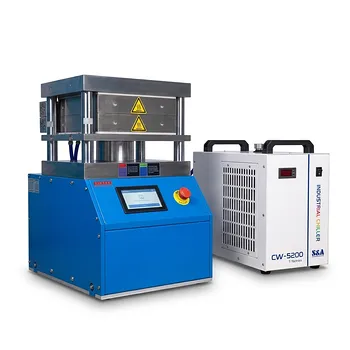
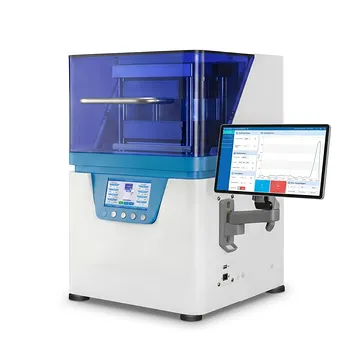
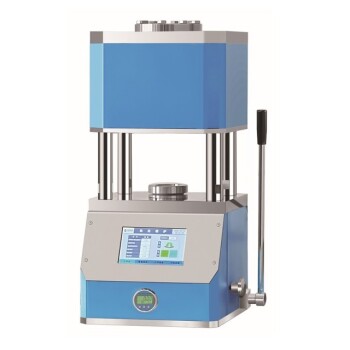
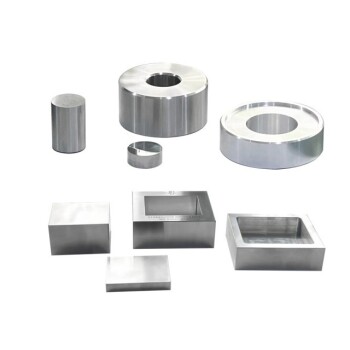
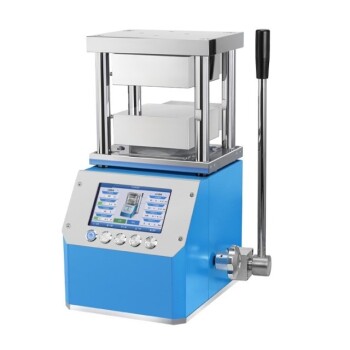
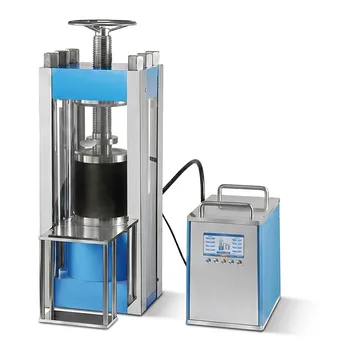
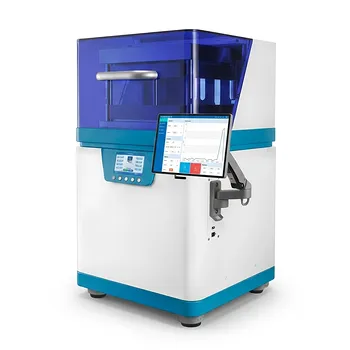
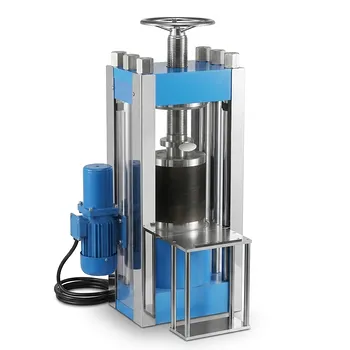
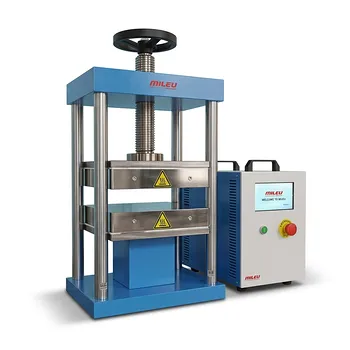
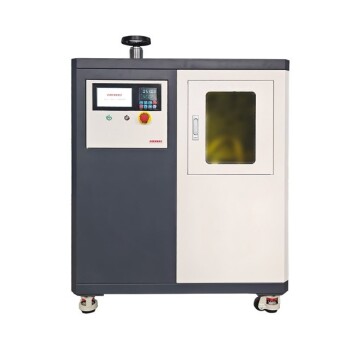
The laboratory heated press is the indispensable bridge between raw Polylactic Acid (PLA) resin and a successful foam structure. By simultaneously applying precise thermal energy and high mechanical pressure, the press transforms loose granules and blowing agents into a dense, monolithic "preform" that serves as the essential substrate for controlled expansion.
A laboratory heated press is essential because it compresses PLA and blowing agent mixtures into dense, uniform plates, ensuring the blowing agent is tightly encapsulated within the polymer matrix to create a uniform cellular structure during expansion.
Achieving Structural Homogeneity
The primary role of the heated press in foaming is the elimination of physical inconsistencies that would otherwise ruin the foaming process.
Eliminating Gaps and Voids
Raw PLA granules and blowing agent powders naturally contain air gaps and microscopic voids between particles. Applying high pressure, often reaching 5 tons or more, forces these particles together while the heat melts the resin, effectively purging internal air bubbles and creating a bubble-free, high-density sheet.
Ensuring Uniform Density
A consistent cellular structure in the final foam depends entirely on the uniform thickness and density of the initial preform. The press ensures that the polymer spreads evenly within the mold, resulting in a flat specimen with stable mechanical properties that can withstand the subsequent stresses of gas saturation.
Managing the Blowing Agent
For PLA to foam correctly, the blowing agent must be distributed perfectly and "locked" into the material.
Critical Encapsulation
The press creates a high-pressure environment that tightly encapsulates the blowing agent within the polymer matrix. This prevents the premature escape of gases and ensures that when the material is later heated for free expansion, the gas is released evenly throughout the entire volume of the plastic.
Thermodynamic Precision
Precision heating platens allow researchers to reach a fluid state—often around 180°C to 210°C—without degrading the polymer. This exact temperature control is vital for physical cross-linking and flow between components, which is necessary for the blowing agent to integrate fully with the PLA.
Controlling Material Properties
Beyond simple shaping, the heated press allows for the manipulation of the PLA’s internal state before foaming occurs.
Managing Crystallization
PLA is a semi-crystalline polymer, and its crystallinity significantly impacts its foaming behavior. By using the press in combination with rapid quenching, researchers can inhibit static crystallization, producing standardized amorphous specimens that are far more predictable during the foaming stage.
Dimensional Consistency
Precise control over the thickness of the preform—often down to 0.2 mm to 250 µm—is fundamental for subsequent processes. This accuracy allows for the consistent adsorption of gases like supercritical carbon dioxide (scCO2), ensuring that every test sample reacts identically.
Understanding the Trade-offs
While the heated press is essential, it requires careful calibration to avoid compromising the material.
The Risk of Thermal Degradation
If the dwell time is too long or the temperature is set too high, the PLA chains can begin to break down, leading to a loss in molecular weight. This weakens the melt strength, making it impossible for the material to hold a cellular structure during foaming.
Dealing with Pressure Limits
Insufficient pressure during the molding phase will leave residual microscopic bubbles. These bubbles act as "nucleation sites" during the expansion phase, leading to large, irregular holes rather than the desired fine-celled foam structure.
How to Apply Product Training to Your Project
Selecting the right parameters for your laboratory press depends on your specific research objectives.
- If your primary focus is Fine Cellular Structure: Focus on high mechanical pressure (5+ tons) to ensure maximum encapsulation of the blowing agent and the total elimination of pre-existing voids.
- If your primary focus is Reproducible Research Data: Prioritize precision dwelling and temperature control (e.g., 150°C to 180°C) to ensure uniform thickness and consistent density across all test specimens.
- If your primary focus is Rapid Prototyping: Utilize manual presses with integrated venting cycles to quickly clear air and re-solidify 2D sheets for immediate subsequent laser microstructuring or testing.
By mastering the balance of heat and pressure, you ensure that your PLA preforms provide the perfect foundation for high-performance foam development.
Summary Table:
| Key Feature | Benefit for PLA Preforms | Process Impact |
|---|---|---|
| High Pressure (5+ Tons) | Eliminates air gaps and microscopic voids | Creates dense, monolithic bubble-free sheets |
| Precise Thermal Control | Melts resin (180°C–210°C) without degradation | Ensures blowing agent is perfectly encapsulated |
| Dimensional Accuracy | Precise thickness (0.2 mm to 250 µm) | Consistent gas adsorption (scCO2) for testing |
| Rapid Quenching Capability | Blocks static crystallization | Produces predictable amorphous specimens |
| Uniform Density | Stable mechanical properties | Prevents cell collapse during expansion phase |
Unlock High-Performance Material Synthesis with KINTEK
Precise preform preparation is the foundation of breakthrough foam research. KINTEK specializes in comprehensive laboratory pressing solutions, offering the versatility and control required for advanced polymer science and battery research.
Whether you need manual, automatic, heated, multifunctional, or glovebox-compatible models, or require high-pressure cold and warm isostatic presses, our equipment is engineered for maximum repeatability and precision. From ensuring uniform PLA density to facilitating complex material transformations, KINTEK provides the tools to elevate your lab's output.
Ready to optimize your pressing process? Contact KINTEK today to find your ideal solution!
References
- Matheus Vinícius Gregory Zimmermann, Ademir J. Zattera. Observations of the effects of different chemical blowing agents on the degradation of poly(lactic acid) foams in simulated soil. DOI: 10.1590/s1516-14392013005000133
This article is also based on technical information from Kintek Solution Knowledge Base .
Related Products
- Automatic Large Format Laboratory Heated Hydraulic Press 400x400mm Plate Capacity
- 24T 30T 60T Heated Hydraulic Lab Press Machine with Hot Plates for Laboratory
- Heated Hydraulic Press Machine with Heated Plates for Vacuum Box Laboratory Hot Press
- Automatic Heated Hydraulic Lab Press 120x120mm Plate Fully Automated Material Research Press
- Laboratory Split Manual Heated Hydraulic Press Machine with Hot Plates
People Also Ask
- Why is a laboratory heated hydraulic press required? Ensure Precise Vulcanization for NBR/EPDM Nanocomposites
- What role does a Laboratory Heated Hydraulic Press play in rubber vulcanization? Master Precision Specimen Molding
- How does a laboratory heated hydraulic press improve the performance of dried composite solid-state membranes? Guide
- What role does a laboratory heated hydraulic press play in PLA/MCC molding? Achieve superior composite density.
- Role of Laboratory Heated Hydraulic Presses in Solid Electrolyte Fabrication: Enhance Density & Ionic Conductivity