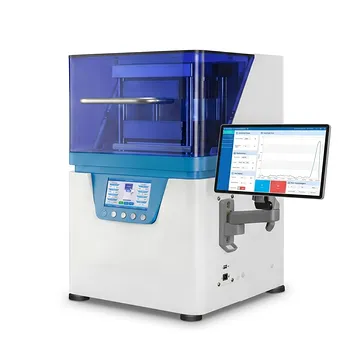
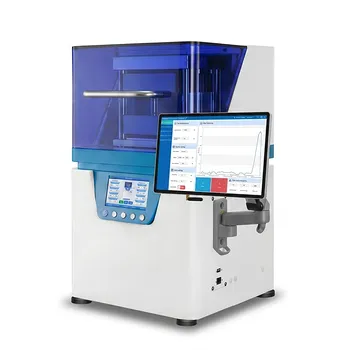
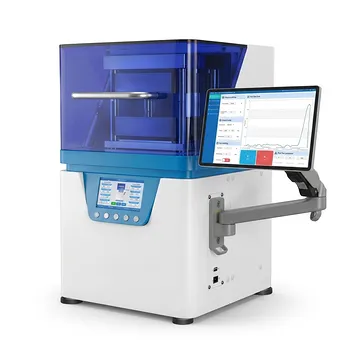
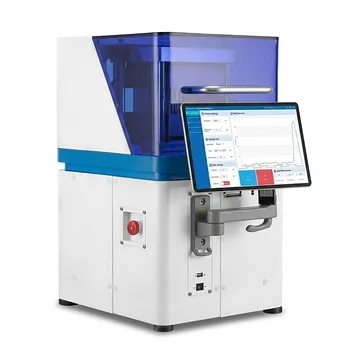
A precision laboratory hydraulic press is the critical driver of initial densification by applying controlled mechanical loads that rearrange powder particles and reduce inter-particle voids. In water-assisted cold sintering, this system generates localized stress at contact points, triggering a dissolution-precipitation mechanism. This chemical-mechanical synergy allows the ceramic green body to reach high density at temperatures far below traditional sintering thresholds.
Core Takeaway: The laboratory hydraulic press facilitates densification by converting axial pressure into localized contact stress, which, when combined with a liquid medium, lowers the activation energy required for atomic diffusion and particle bonding.
The Role of Mechanical Force in Initial Densification
Particle Rearrangement and Void Reduction
The primary function of the hydraulic press is to apply significant axial pressure—often up to 70 MPa in cold sintering contexts—to the ceramic powder. This force physically pushes particles into the empty spaces between them, leading to an immediate increase in packing density. By expelling trapped air and forcing particles to interlock, the press converts loose powder into a cohesive green body.
Inducing the Dissolution-Precipitation Process
In a water-assisted environment, the pressure from the hydraulic system does not just move particles; it creates extreme stress concentrations at the points where particles touch. This high pressure works with the liquid medium to dissolve the material at high-stress contact points. The dissolved matter then precipitates into the low-stress pores, filling gaps and creating solid bridges between particles.
Enhancing Material Properties at Low Temperatures
Lowering Activation Energy for Diffusion
Traditional sintering requires massive thermal energy to move atoms; however, the hydraulic press provides a mechanical substitute for some of that heat. The combined effect of high pressure and the liquid phase lowers the activation energy required for atomic diffusion. This enables researchers to achieve preliminary densification at significantly lower temperatures than conventional methods.
Establishing Interfacial Bonding
The precision control of the press ensures that the powder and liquid are in constant, intimate contact under load. This environment promotes tight interfacial bonding, which is essential for the structural integrity of the ceramic. Without the sustained pressure of the hydraulic system, the liquid phase would not be effectively utilized to "glue" the particles together during the early stages of sintering.
Understanding Technical Trade-offs and Risks
The Threshold for Overpressure Defects
While higher pressure generally increases density, there is a critical limit for alumina ceramics. Exceeding a pressure range of 150–250 MPa can lead to internal stresses that cause diagonal cracks or delamination (layer separation). A precision system is required to stay within the "sweet spot" where density is maximized without compromising the structural integrity of the sample.
Consistency and Experimental Control
The primary trade-off in manual versus precision systems is repeatability. High-precision electromechanical or hydraulic presses allow for exact pressure holding times, ensuring that porosity remains the only variable in an experiment. Inconsistent pressure application can lead to varied shrinkage rates, making it difficult to establish accurate correlations between processing parameters and material strength.
How to Apply This to Your Project
To successfully utilize a hydraulic press for water-assisted alumina densification, your approach should vary based on your specific material requirements.
- If your primary focus is maximizing initial green density: Apply a steady axial pressure between 70 MPa and 150 MPa to ensure optimal particle packing without inducing structural cracks.
- If your primary focus is leveraging the dissolution-precipitation process: Ensure the press can maintain a constant, precise load for a specific holding time to allow the liquid medium to redistribute dissolved material effectively.
- If your primary focus is producing standardized laboratory samples: Utilize a precision press with digital controls to guarantee that every sample starts with the same geometric dimensions and initial density baseline.
The precise application of mechanical pressure is the fundamental catalyst that allows cold-sintered alumina to transition from a loose powder to a high-performance ceramic.
Summary Table:
| Factor | Role in Cold Sintering | Impact on Alumina Ceramics |
|---|---|---|
| Mechanical Load | Rearranges powder particles | Increases green body packing density |
| Localized Stress | Drives dissolution-precipitation | Fills gaps with solid bridges at low temp |
| Precision Control | Maintains optimal pressure (70-150MPa) | Prevents diagonal cracks & delamination |
| Thermal Synergy | Lowers activation energy | Achieves high performance without extreme heat |
Precision Pressing for Next-Gen Materials
Achieve superior densification and structural integrity in your ceramic and battery research with KINTEK. We specialize in comprehensive laboratory pressing solutions, offering manual, automatic, heated, multifunctional, and glovebox-compatible models, as well as cold and warm isostatic presses. Our precision systems ensure consistent, repeatable results, helping you overcome challenges like internal stress and delamination.
Contact KINTEK experts today to optimize your laboratory workflow!
References
- Anastasia A. Kholodkova, Yu. D. Ivakin. Water-Assisted Cold Sintering of Alumina Ceramics in SPS Conditions. DOI: 10.3390/ceramics6020066
This article is also based on technical information from Kintek Solution Knowledge Base .
Related Products
- Automatic Heated Hydraulic Lab Press with Programmable Touch Screen Controls and Precision Temperature Regulation
- Automatic Hydraulic Hot Press with Large Plate and Precision Temperature Control for Advanced Material Sample Preparation and Industrial Research
- 24T 30T 60T Heated Hydraulic Lab Press Machine with Hot Plates for Laboratory
- Laboratory Hydraulic Press 2T Lab Pellet Press for KBR FTIR
- Laboratory Hydraulic Press Lab Pellet Press Machine for Glove Box
People Also Ask
- Why is a laboratory heated hydraulic press required? Ensure Precise Vulcanization for NBR/EPDM Nanocomposites
- What are the industrial applications of heated hydraulic presses? Master Heat & Force for Precision Manufacturing
- Why is an automatic heated lab press preferred for PEEK & CNT laminates? Achieve Precise Crystallization Control
- What is the necessity of a laboratory hydraulic press with heating functions? Master Rubber Vulcanization Precision
- How does a heated laboratory hydraulic press contribute to the formation of dense mycelium-based materials? Expert Tips