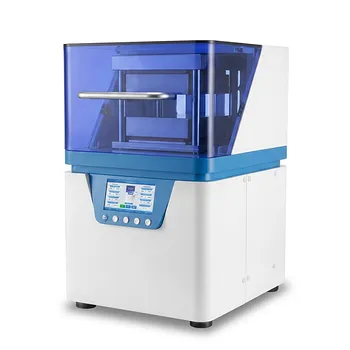
Industrial-grade laboratory hydraulic forming equipment enables precise sample preparation by converting loose oil sand powders into solid specimens that replicate specific reservoir conditions. This equipment applies controlled, uniform pressure to achieve the exact density and stress states found in deep geological formations, allowing researchers to study how varying levels of bitumen and clay influence rock mechanics. By standardizing these physical properties, it ensures that subsequent reservoir simulations are based on consistent, high-fidelity data.
Laboratory hydraulic presses bridge the gap between raw geological materials and stable experimental specimens by eliminating internal inconsistencies. This precision allows researchers to isolate the effects of chemical and mineralogical variables without the interference of density gradients or porosity fluctuations.
Replicating In-Situ Reservoir Conditions
Achieving Precise Geological Density
Industrial-grade hydraulic equipment utilizes fine pressure control to compress raw oil sand powders into "green bodies" with specific densities. This process ensures the specimen matches the density and stress characteristics of the specific geological formation being studied. By mimicking the overburden pressure of the earth, the equipment creates a realistic physical foundation for reservoir modeling.
Managing Complex Material Compositions
Oil sands are heterogeneous mixtures, often containing bitumen levels of 6-14% and clay levels of 5-22%. The hydraulic forming process allows researchers to investigate the non-linear impacts of these components on the rock’s brittleness and mechanical strength. Precision forming ensures that these variations in composition are the only variables affecting the test results.
Establishing Stable Stress States
Before samples are placed into high-temperature or high-pressure displacement devices, they must be in a stable stress state. The laboratory press provides the necessary load control to encapsulate natural cores or form artificial ones that won't fail prematurely. This stability is critical for obtaining accurate data during chemical displacement or wax plugging experiments.
Enhancing Data Repeatability and Accuracy
Eliminating Internal Porosity Variations
One of the primary functions of a hydraulic press is to reduce microscopic porosity and internal stress gradients. By applying highly controlled and uniform pressure, the equipment removes air pockets and structural weak points that could skew results. This creates a consistent physical baseline, allowing for a direct comparison of how different fracturing fluids affect the rock.
The Importance of Controlled Dwell Times
Beyond simple pressure application, these machines allow for the precise control of dwell times—the duration the pressure is held. Proper dwell time ensures the raw materials are fully compacted and that the internal structure is uniform throughout the specimen. This eliminates density gradients, which are a common source of error in laboratory reservoir simulations.
Transforming Loose Materials into Experimental Specimens
The equipment effectively transforms loose, unworkable raw materials into high-quality solid samples. This transformation is essential for subsequent sintering processes or mechanical performance testing. Without this standardized forming process, the "green bodies" would lack the structural integrity required for rigorous laboratory analysis.
Understanding the Trade-offs
Artificial vs. Natural Core Limitations
While hydraulic forming produces highly consistent artificial cores, these samples may lack some of the complex micro-structures found in natural formations. Researchers must balance the benefit of perfect repeatability in artificial cores against the messy, non-uniform reality of natural geological samples.
Calibration and Maintenance Demands
The high level of precision required for reservoir simulation means that hydraulic equipment is sensitive to calibration drift. Even minor deviations in pressure delivery can lead to inconsistent sample densities, which may result in misleading data regarding rock expansion or fluid flow.
Sample Size and Geometry Constraints
Hydraulic forming is often limited by the mold dimensions and the maximum tonnage of the press. Creating very large specimens or complex geometries can introduce non-uniform pressure distribution, potentially re-introducing the very density gradients the process is intended to eliminate.
How to Apply This to Your Project
Recommendations for Sample Preparation
To get the most out of your hydraulic forming equipment, align your preparation strategy with your specific research objectives:
- If your primary focus is mechanical strength testing: Prioritize the precise matching of formation stress states and density to ensure the brittleness data is geologically relevant.
- If your primary focus is fluid displacement or wax plugging: Focus on eliminating internal porosity and stress gradients to ensure that fluid flow is not influenced by preparation artifacts.
- If your primary focus is testing new fracturing fluids: Use standardized dwell times and pressure settings to create a consistent physical baseline for comparing fluid expansion characteristics.
By mastering the precision of hydraulic forming, you transform unpredictable raw materials into the reliable, high-fidelity specimens required for definitive reservoir simulation.
Summary Table:
| Feature | Function in Sample Preparation | Impact on Reservoir Simulation |
|---|---|---|
| Fine Pressure Control | Compresses powders into specific densities | Replicates geological overburden & stress states |
| Dwell Time Control | Ensures uniform material compaction | Eliminates density gradients & internal inconsistencies |
| Porosity Reduction | Removes air pockets & structural weak points | Provides a consistent baseline for fluid flow analysis |
| Stress Stabilization | Encapsulates cores for high-pressure testing | Prevents sample failure during displacement experiments |
Precision Solutions for Your Geological Research
Elevate the accuracy of your reservoir simulations with KINTEK’s comprehensive laboratory pressing solutions. Whether you require manual, automatic, heated, or multifunctional models, or advanced cold and warm isostatic presses, our equipment is engineered to deliver the precise density and stress control your oil sand and battery research demands.
Ready to transform your sample preparation workflow? Contact KINTEK today to find your perfect pressing solution!
References
- Shao Hao Wang, Yanfang Gao. Impact of Reservoir Properties on Micro-Fracturing Stimulation Efficiency and Operational Design Optimization. DOI: 10.3390/pr13072137
This article is also based on technical information from Kintek Solution Knowledge Base .
Related Products
- Automatic Hydraulic Hot Press with Large Plate and Precision Temperature Control for Advanced Material Sample Preparation and Industrial Research
- Laboratory Hydraulic Press 2T Lab Pellet Press for KBR FTIR
- Laboratory Hydraulic Press Lab Pellet Press Machine for Glove Box
- Automatic Laboratory Hydraulic Press Lab Pellet Press Machine
- Automatic Large Format Laboratory Heated Hydraulic Press 400x400mm Plate Capacity
People Also Ask
- What are the specific features and applications of hydraulic hot press machines? Precision Solutions for Modern Labs
- How does an automatic hydraulic press operate? Achieve Precision and Consistency in Lab Pelleting
- What are the advantages and common applications of an automatic hydraulic press? Elevate Your Lab's Precision
- What is the technical significance of setting a precise dwell time? Achieve Peak Material Density and Stability
- When is an automatic hydraulic press more suitable than a manual press? Scale Your Lab with Precision & Speed