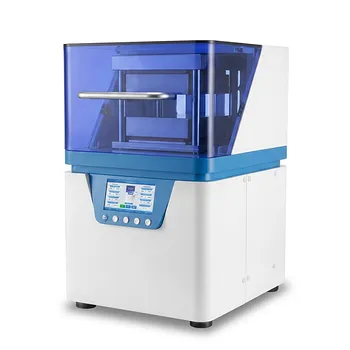
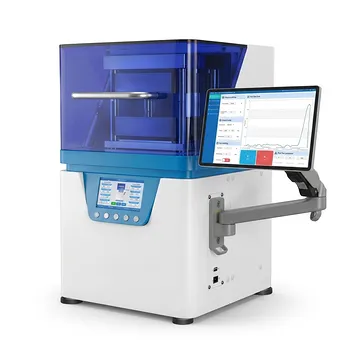
A laboratory hydraulic press with heating and cooling functions is the critical instrument for transforming raw polypropylene and bio-fillers into standardized, high-performance test specimens. It provides the precise thermal and mechanical environment necessary to melt the polymer matrix, ensure complete infiltration of fibers, and solidify the material without internal defects. This controlled process is the only way to guarantee the structural integrity and repeatability required for valid scientific analysis.
The necessity of this equipment stems from its ability to simultaneously manage resin viscosity, material density, and dimensional stability. By integrating heating, high-pressure compression, and rapid cooling, the press eliminates air voids and thermal warping, ensuring that the resulting biocomposite accurately reflects its intended mechanical properties.
Facilitating Resin Flow and Fiber Infiltration
Achieving Complete Polymer Melting
Polypropylene requires stable, high temperatures—often ranging from 160°C to 220°C—to transition from a solid to a flowable melt. The heated platens of a hydraulic press provide the uniform thermal energy needed to reach this melting point, allowing the resin to act as a liquid vehicle for the reinforcement phase.
Ensuring Effective Wetting of Reinforcements
In biocomposites, the molten polypropylene must fully encapsulate reinforcements like wood fibers or wollastonite particles. Without the precise heat provided by the press, the resin viscosity remains too high, leading to "dry" fibers and weak interfacial bonding that would compromise the specimen's strength.
Maximizing Density Through High-Pressure Compression
Elimination of Internal Air Voids
As the material is compressed, the hydraulic system applies significant force—often up to 300 kN—to drive out entrapped air. This high-pressure environment is vital for removing internal voids and air pockets, which act as stress concentrators and can cause premature failure during mechanical testing.
Standardizing Geometry and Thickness
Precision pressure control ensures that the composite granules are pressed into dense films or blocks of uniform thickness. This creates standardized geometric dimensions and flat surfaces, which are essential for the accuracy of subsequent flexural strength, XRD, and DSC evaluations.
Removing Density Gradients
A hydraulic press applies force evenly across the surface of the mold, preventing the formation of density gradients. This uniformity ensures that every section of the test plate possesses the same physical characteristics, allowing for repeatable and reliable data collection across multiple samples.
Managing Solidification and Dimensional Stability
Preventing Thermal Warping
The cooling function is just as critical as the heating phase, as it manages the uniform solidification of the specimen. By controlling the rate of temperature reduction, the press prevents the internal thermal stresses that typically cause thin biocomposite plates to warp or deform.
Locking the Microstructure
Integrated water-cooling systems allow for the rapid stabilization of the material’s microstructure. This "locking" process ensures that the crystalline structure of the polypropylene is consistent across all specimens, which is a prerequisite for accurate thermal and chemical performance testing.
Understanding the Trade-offs
Thermal Degradation Risks
While high heat is necessary for flow, excessive residence time at peak temperatures can lead to the thermal degradation of the polypropylene or the organic bio-fillers. Wood fibers, in particular, are sensitive to heat and may char if the press temperature is not precisely calibrated and monitored.
Pressure Sensitivity
Applying pressure too rapidly can cause flash (excess material leaking from the mold) or result in an uneven distribution of fibers. Conversely, insufficient pressure will fail to eliminate voids, leading to a porous structure that does not represent the true potential of the biocomposite material.
How to Apply This to Your Project
Selecting the Right Parameters for Your Goal
To achieve the best results with your hydraulic press, your operational settings must align with your specific testing objectives.
- If your primary focus is mechanical strength testing: Prioritize high-pressure holding stages (e.g., 150 bar) to ensure maximum densification and the total elimination of structural voids.
- If your primary focus is aesthetic or dimensional accuracy: Focus on the cooling gradient to ensure the specimens remain perfectly flat and free from surface sink marks or warping.
- If your primary focus is chemical or thermal analysis (XRD/DSC): Ensure precise temperature calibration of the platens to maintain a consistent crystalline structure across your entire sample set.
By mastering the transition between controlled heating and rapid cooling under pressure, you ensure that your biocomposite specimens are free from the defects that undermine scientific research.
Summary Table:
| Stage | Function | Scientific Benefit |
|---|---|---|
| Heating (160°C-220°C) | Transitions polymer to flowable melt | Ensures complete fiber wetting and infiltration |
| High-Pressure (Up to 300kN) | Compresses material and drives out air | Eliminates internal voids and standardizes thickness |
| Controlled Cooling | Manages uniform solidification | Prevents thermal warping and stabilizes microstructure |
| Precision Control | Calibrates heat and pressure timing | Prevents thermal degradation and density gradients |
Elevate Your Material Research with KINTEK Precision
Don't let internal defects compromise your scientific data. KINTEK specializes in comprehensive laboratory pressing solutions designed to meet the rigorous demands of biocomposite and battery research. Whether you need manual, automatic, heated, multifunctional, or glovebox-compatible models, our equipment provides the precise thermal and mechanical control required for high-performance specimen molding. We also offer advanced cold and warm isostatic presses for specialized applications.
Ready to achieve superior specimen integrity? Contact KINTEK Experts Today to find the perfect pressing solution for your laboratory.
References
- Mustafa Öncül, Kutlay Sever. Improvement of Mechanical and Viscoelastic Properties of Polypropylene with Wood and Wollastonite Fillers. DOI: 10.18466/cbayarfbe.1565156
This article is also based on technical information from Kintek Solution Knowledge Base .
Related Products
- Automatic Hydraulic Heat Press Machine with Multi Stage Programmable Control and Integrated Water Cooling Plate Size 180x180mm
- Heated Hydraulic Press Machine with Heated Plates for Vacuum Box Laboratory Hot Press
- Heated Hydraulic Press Machine With Heated Plates For Vacuum Box Laboratory Hot Press
- Automatic Heated Hydraulic Lab Press with Programmable Touch Screen Controls and Precision Temperature Regulation
- 24T 30T 60T Heated Hydraulic Lab Press Machine with Hot Plates for Laboratory
People Also Ask
- How does a laboratory hydraulic heat press facilitate the molding of cellulose composite specimens? Precision Molding
- How is a hydraulic heat press used for sample preparation? Achieve Uniform, Void-Free Samples for Lab Analysis
- What is the role of a hydraulic heat press in material testing? Unlock Superior Data for Research & QC
- What is a hydraulic heat press? Discover Precision Material Bonding and Sample Preparation
- What are the industrial applications of a hydraulic heat press? Powering Lamination, Bonding, and R&D Efficiency