The Invisible Transition
Raw rubber is a paradox. In its natural state, it is both versatile and useless. It is a "plastic" substance—deformable, unstable, and prone to permanent distortion under the slightest stress.
To become a high-performance elastomer, it must undergo a rite of passage. It requires a specific, controlled environment where thermal energy meets mechanical force.
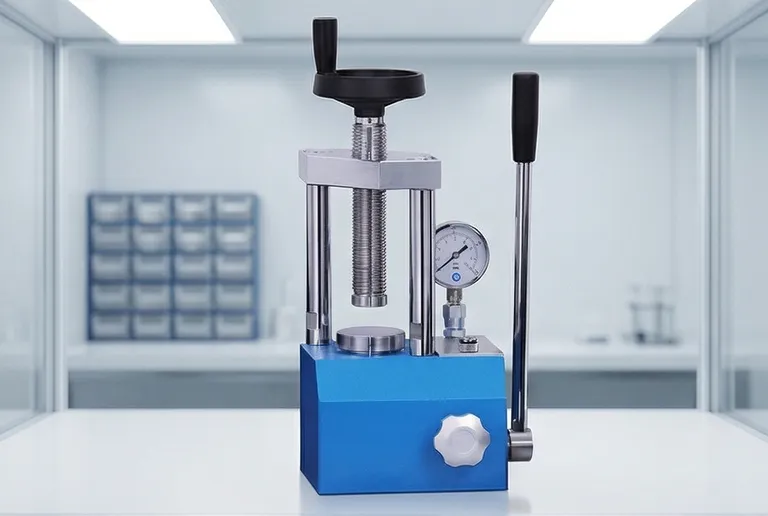
This is not merely a manufacturing step; it is a molecular metamorphosis driven by the electric heating plate vulcanizing press.
The Chemistry of Constraint
At the heart of butadiene-based rubber preparation lies the "cross-link." Imagine a tangled mess of long, linear polymer chains. Without a press, these chains slide past each other like wet noodles.
When the press delivers heat—precisely calibrated, often to 160°C—it activates vulcanizing agents like sulfur. These agents act as molecular bridges, snapping the chains together into a stable, three-dimensional spatial network.
- From Linear to Network: The material transitions from a flowable plastic to a resilient elastomer.
- The Probability of Strength: Precision in temperature dictates "cross-link density." Too low, and the material is soft. Too high, and it becomes brittle.
- The Catalyst of Energy: The press provides the exact activation energy required to trigger these chemical bonds without destroying the polymer itself.
Pressure: The Architect of Density
Heat provides the chemistry, but pressure provides the geometry. Applying 14 MPa (200 kg/cm²) of hydraulic force is not just about shaping the rubber; it is about purging chaos.
Eliminating the Void
Inside every raw rubber mixture are microscopic air bubbles and volatiles. In the world of high-performance materials, an air bubble is a point of failure. High pressure forces these voids out, ensuring a dense, homogeneous internal structure.
Geometric Fidelity
Viscous rubber resists flow. The press overcomes this resistance, forcing the material into every micro-cavity of the steel mold. This ensures that the final specimen isn't just "roughly right," but dimensionally exact.
The Margin of Error
In material science, as in finance, the "tails" define the outcome. Most of the process goes well, but the failures happen at the edges.
| Risk Factor | Physical Outcome | Scientific Cause |
|---|---|---|
| Over-vulcanization | Brittleness & Cracking | Polymer chain degradation ("Scorching") |
| Thermal Gradient | "Soft Spots" | Non-uniform cross-linking across the sheet |
| Pressure Drop | Warping & Shrinkage | Elastic recovery before the network is set |
The difference between a reliable industrial component and a failed prototype often comes down to ±1°C of thermal stability.
Choosing the Objective
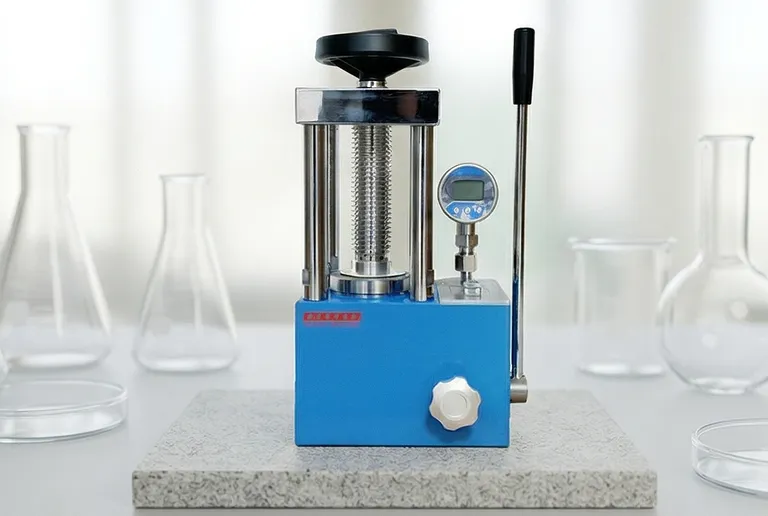
Systematic success requires aligning your hardware with your material goals. Not all presses are created equal because not all rubber applications share the same priorities.
- Priority: Mechanical Peak. If you seek maximum tensile strength, you need a press with ultra-precise PID temperature control to hit the "s90" vulcanization point perfectly.
- Priority: Structural Precision. If the rubber must fit a complex assembly, prioritize hydraulic systems that maintain constant, unyielding pressure during the cooling phase.
- Priority: Iteration Speed. For R&D environments, rapid heating and cooling cycles allow for faster testing of different formulations without risking "scorching" on the surface.
Engineering the Ideal Environment
Precision in vulcanization is a symphony of heat, pressure, and time. At KINTEK, we understand that a laboratory press is more than a tool—it is the steward of your material’s integrity.
Our comprehensive range of pressing solutions is designed to meet the rigorous demands of modern rubber and battery research. Whether you require the simplicity of a manual press, the repeatable precision of an automatic heated model, or the specialized environment of a glovebox-compatible system, KINTEK provides the stability your science depends on.
From cold and warm isostatic presses to multifunctional heated plates, we ensure your molecular transformations are never left to chance.
Related Products
- Split Automatic Heated Hydraulic Press Machine with Heated Plates
- Cylindrical Lab Electric Heating Press Mold for Laboratory Use
- Automatic High Temperature Heated Hydraulic Press Machine with Heated Plates for Lab
- Automatic Heated Hydraulic Press Machine with Heated Plates for Laboratory
- Heated Hydraulic Press Machine With Heated Plates For Vacuum Box Laboratory Hot Press
Related Articles
- The Architecture of Slow: Why Physical Precision Dictates Chemical Destiny
- The Architecture of Certainty: Why the Laboratory Press is the Anchor of Material Science
- The Vanishing Boundary: The Hidden Thermodynamics of LTCC Lamination
- The Alchemy of 160°C: Why Precision Pressing is the Silent Backbone of Rubber Science
- The Architecture of Density: Why Precision Molding Defines High-Entropy Alloy Success



















