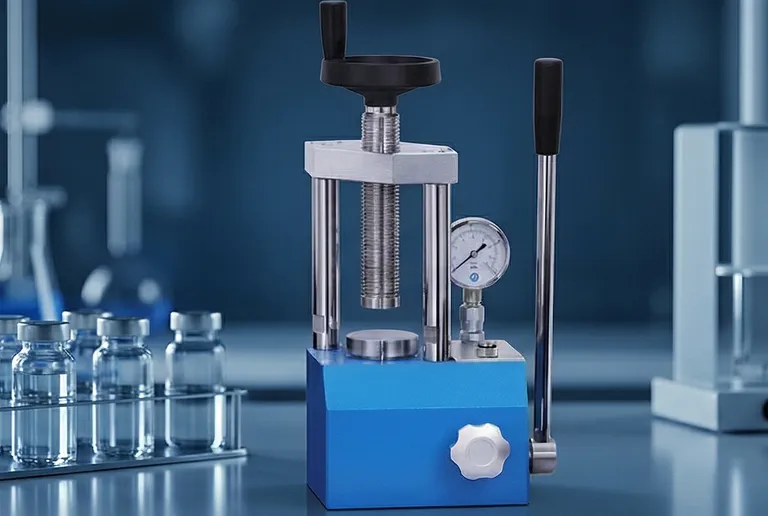
The Invisible Barrier to Innovation
In the world of high-performance cooling, we often obsess over the chemistry of the material. We design advanced Thermoelectric Cooling (TEC) modules and complex Phase Change Materials (PCM), yet we ignore the most volatile variable: the interface.
Thermal management is a game of contact. If two surfaces do not meet with crystalline perfection, the most expensive material in the world becomes an insulator.
In the laboratory, the difference between a breakthrough and a failure is often the "human element"—the inconsistent hand of a researcher applying pressure. To achieve the theoretical maximum of a system, we must move from manual guesswork to mechanical certainty.
The Physics of the "Last Millimeter"
The goal of any thermal interface is to achieve the minimal ideal thickness. Every micron of excess thermal grease adds resistance. Every microscopic air bubble acts as a thermal dam.
Eliminating the Air Gap
Air has a thermal conductivity of roughly 0.026 W/m·K. It is, for all intents and purposes, a wall. Precision pressing serves a singular, violent purpose: it forces air out and dictates that the TEC module and the heat sink become one structural unit.
The Dynamics of Constant Clamping
- Axial Force: Maintaining a constant 100 to 200 psig ensures the material reaches its "bond line thickness."
- Surface Utilization: Uniform pressure ensures that 100% of the surface area is active, preventing the "hot spots" that lead to premature TEC degradation.
- Geometric Truth: Precision molds ensure that every sample, every time, is exactly 1.0 mm or the required specification, making data from laser flash methods actually comparable.
Orchestrating the Internal Architecture

Beyond simply squishing two parts together, a heated laboratory press is an architect of the material's internal structure.
When preparing PCM composites, the press manages the "thermal history" of the sample. By holding a stable temperature—often between 150°C and 160°C—the device ensures that binders like paraffin reach a perfect molten state.
Filler Orientation and Crystalline Peace
Under controlled high pressure, conductive fillers such as boron nitride or alumina are not just present; they are organized. The pressure induces a preferential orientation, creating "highways" for phonons to travel.
Furthermore, a controlled cooling rate under pressure prevents internal stresses. It allows for a uniform crystallization environment, ensuring the material doesn't crack or delaminate during its first thermal cycle in the field.
The Fine Line: Balancing Pressure and Fragility
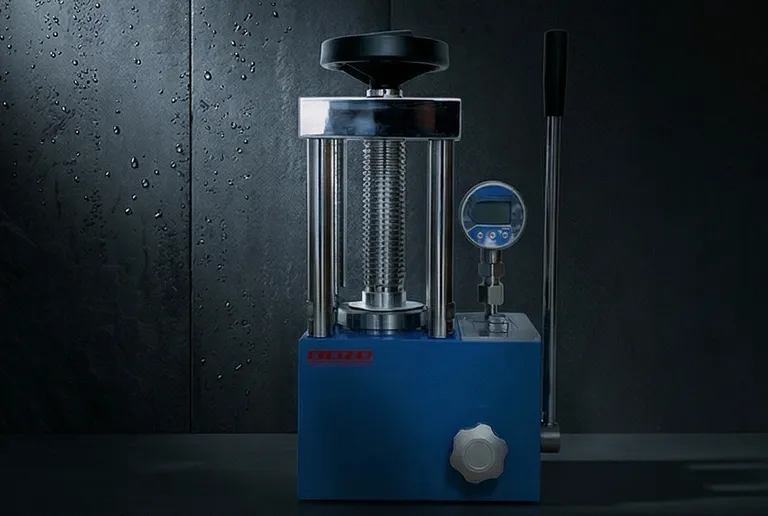
Engineering is the art of trade-offs. The same force that optimizes an interface can destroy a component.
| Risk Factor | Impact | Mitigation Strategy |
|---|---|---|
| Mechanical Stress | Cracking of fragile TEC ceramic plates. | Precision digital pressure regulation (limited to 50 MPa). |
| Thermal Degradation | Chemical breakdown of paraffin binders. | Narrow-window PID temperature control. |
| Material Displacement | "Squeeze-out" resulting in dry spots. | Optimized dwell times and calibrated clamping force. |
Designing for Repeatable Success
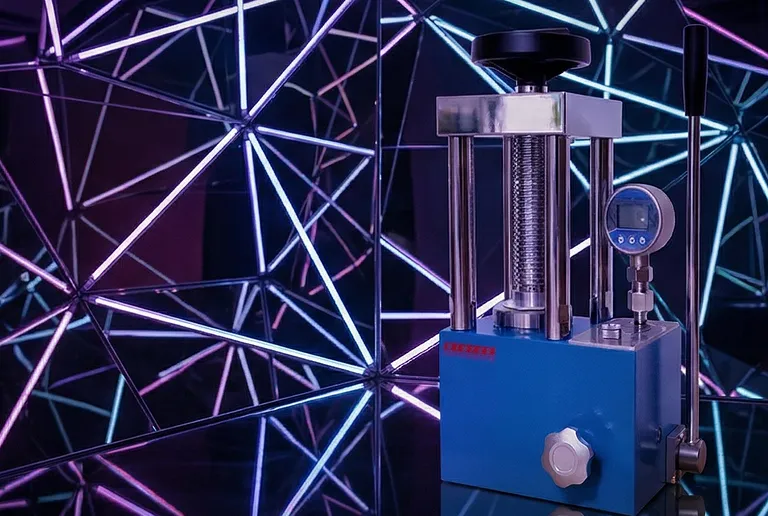
The "Engineer's Romanticism" lies in the pursuit of the repeatable standard. Whether you are maximizing the Coefficient of Performance (COP) or characterizing a new composite, the press is the bridge between a benchtop idea and a scalable technology.
- For COP Optimization: Prioritize clamping precision to minimize interface thickness.
- For Material Characterization: Use heated precision molds to eliminate variables in thermal history.
- For Battery & PCM Research: Utilize isostatic or glovebox-compatible systems to maintain environment-sensitive material integrity.
At KINTEK, we provide the hardware for this precision. From manual and automatic heated presses to advanced cold and warm isostatic systems (CIP/WIP), our solutions are designed to remove the "human variable" from your research. We ensure that your interfaces perform at their absolute theoretical limit.
To find the precise pressing solution for your thermal or battery research, Contact Our Experts
Related Products
- Lab Polygon Press Mold
- Automatic Laboratory Hydraulic Press Lab Pellet Press Machine
- Laboratory Hydraulic Press Lab Pellet Press Machine for Glove Box
- Automatic Lab Cold Isostatic Pressing CIP Machine
- Laboratory Split Manual Heated Hydraulic Press Machine with Hot Plates
Related Articles
- Leverage in Miniature: The Physics and Psychology of the Compact Lab Press
- The Geometry of Energy: Why Graphite is the Soul of Advanced Sintering
- The Architecture of Pressure: Why Precision is the Only Truth in Material R&D
- The Last Millimeter: Why Physical Constraints Define Material Integrity
- The Glass Transition Ritual: Why Heat is the Secret Language of High-Density Materials



















