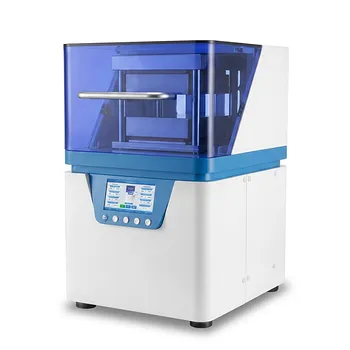
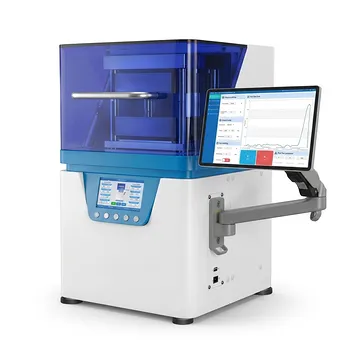
The hydraulic bench press serves as the primary mechanism for uniaxial powder compaction. By applying high axial pressure to Y-TZP and stainless steel powder mixtures within a die, the press achieves preliminary densification and transforms loose material into a solid "green compact." This step defines the initial geometry of the material, such as a disc, while establishing the particle-to-particle contact necessary for all subsequent thermal and mechanical treatments.
The hydraulic bench press bridges the gap between raw powder and a structured material by using controlled pressure to force particle rearrangement and mechanical interlocking. This process creates a "green body" that is dense and strong enough to withstand handling and further processing.
Transforming Loose Powder into Solid Geometry
Uniaxial Pressure and Shape Definition
The press applies precise axial force to the composite powders contained within a rigid mold or die. This uniaxial compaction ensures the powder takes on a specific, repeatable geometric shape, which is a fundamental requirement for consistent material testing and component manufacturing.
Overcoming Internal Resistance
High-pressure application—often ranging from 350 MPa to 600 MPa—is required to overcome the internal friction between individual Y-TZP and stainless steel particles. This force allows the particles to slide past one another, filling voids and significantly reducing the volume of the powder mass.
Establishing Preliminary Densification
While not the final stage of production, the bench press provides the initial densification required for the material's survival. This "preliminary" density is vital because it ensures the specimen does not collapse or crack during the transition to isostatic pressing or high-temperature sintering.
Mechanisms of Particle-Level Interaction
Rearrangement and Void Filling
Under the initial load, the press forces the rearrangement of powder particles, pushing them into a more efficient packing structure. This movement effectively forces air out of the powder mass, minimizing internal porosity that could lead to structural failure in the finished composite.
Elastic and Plastic Deformation
As pressure increases, the particles undergo elastic and plastic deformation, increasing the contact area between the ceramic (Y-TZP) and metallic (stainless steel) phases. This deformation is critical for developing the "green strength" needed to keep the compact intact during handling.
Breaking Oxide Films for Mechanical Interlocking
The high pressure facilitates the breakdown of oxide films on the surfaces of the stainless steel particles. By exposing fresh metal surfaces, the press allows for mechanical interlocking and closer atomic proximity, which are essential prerequisites for effective atomic diffusion during sintering.
Understanding the Trade-offs and Limitations
Density Gradients and Friction
Because the pressure is applied uniaxially (from one or two directions), friction between the powder and the die walls can create density gradients. This means the center or edges of the compact may have slightly different densities, which is why this step is often followed by isostatic pressing to achieve uniformity.
The Risk of Over-Compaction
While high pressure is necessary for densification, exceeding the material's limits can lead to lamination or pressure cracking. If the pressure is released too quickly or is too high for the specific Y-TZP/steel ratio, the elastic recovery of the particles can cause the green body to fail immediately upon exiting the die.
Preliminary vs. Final Density
It is important to recognize that the hydraulic press creates a primary dense body, not a finished product. The green compact remains porous and relatively fragile until it undergoes sintering, where high temperatures trigger the actual bonding and final shrinkage of the material.
Making the Right Choice for Your Material Goals
The success of your Y-TZP and stainless steel composite depends on how precisely the initial compaction is managed.
- If your primary focus is handling durability: Ensure the press reaches at least 400 MPa to maximize the mechanical interlocking and green strength of the compact.
- If your primary focus is final part precision: Use a consistent holding time (e.g., 300 seconds) during the pressing stage to allow for stable particle rearrangement and minimized internal stresses.
- If your primary focus is maximum theoretical density: Use the hydraulic press as a pre-forming step to create the shape, then follow with cold isostatic pressing (CIP) to remove the density gradients inherent in uniaxial pressing.
The hydraulic bench press is the foundational tool that converts a simple powder mixture into a viable, structured precursor ready for the complexities of advanced material synthesis.
Summary Table:
| Stage of Process | Primary Mechanism | Key Benefit for Green Compact |
|---|---|---|
| Powder Compaction | Uniaxial Axial Force | Defines initial geometry and dimensions |
| Densification | Particle Rearrangement | Reduces internal porosity and void space |
| Strength Building | Plastic Deformation | Developed green strength for handling |
| Pre-Sintering | Mechanical Interlocking | Prepares material for atomic diffusion |
Optimize Your Material Synthesis with KINTEK Precision
Achieving the perfect green compact requires precision and control. KINTEK specializes in comprehensive laboratory pressing solutions, offering a versatile range of manual, automatic, heated, multifunctional, and glovebox-compatible models.
Whether you are advancing battery research or developing complex Y-TZP and stainless steel composites, our equipment—including advanced cold and warm isostatic presses—is designed to eliminate density gradients and ensure structural integrity.
Ready to elevate your lab's compaction results? Contact our experts today to find the ideal pressing solution tailored to your research goals!
References
- Kelvin Chew Wai Jin, S. Ramesh. Mechanical Characterization of Zirconia Ceramic Composite. DOI: 10.1051/matecconf/201815202006
This article is also based on technical information from Kintek Solution Knowledge Base .
Related Products
- Automatic Hydraulic Heat Press Machine with Multi Stage Programmable Control and Integrated Water Cooling Plate Size 180x180mm
- Automatic Hydraulic Hot Press with Large Plate and Precision Temperature Control for Advanced Material Sample Preparation and Industrial Research
- Automatic High Temperature Heated Hydraulic Press Machine with Heated Plates for Lab
- Laboratory Hydraulic Press 2T Lab Pellet Press for KBR FTIR
- Manual Heated Hydraulic Lab Press with Integrated Hot Plates Hydraulic Press Machine
People Also Ask
- How does a laboratory hydraulic heat press facilitate the molding of cellulose composite specimens? Precision Molding
- How is a hydraulic heat press used for sample preparation? Achieve Uniform, Void-Free Samples for Lab Analysis
- What is the role of a hydraulic heat press in material testing? Unlock Superior Data for Research & QC
- What is a hydraulic heat press? Discover Precision Material Bonding and Sample Preparation
- What are the industrial applications of a hydraulic heat press? Powering Lamination, Bonding, and R&D Efficiency