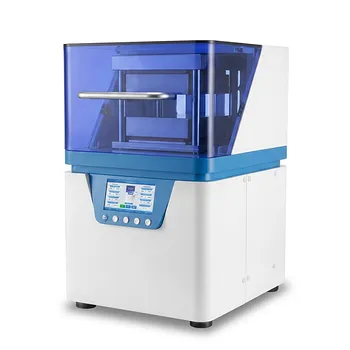
The laboratory hydraulic press serves as the primary engine for material transformation in seaweed particle board production. It applies uniaxial pressure and high temperatures—often exceeding 200°C—to activate internal self-bonding mechanisms between seaweed's natural components. This process is followed by a rapid cooling phase that stabilizes the material and facilitates the removal of the finished board.
A heated and cooled hydraulic press facilitates the "self-bonding" of seaweed particles by fusing natural alginates and cellulose under pressure, then rapidly quenching the temperature to preserve the board's structural integrity.
Activating Molecular Bonding through Heat
The Role of Induction Heating
The press utilizes induction heating plates to rapidly elevate the temperature of the mold. This high-speed thermal transfer is necessary to reach the critical threshold required for chemical changes to occur within the seaweed.
Triggering Alginate-Cellulose Interaction
At temperatures often exceeding 200 degrees Celsius, the natural alginates and cellulose within the seaweed begin to interact. This heat activates a self-bonding mechanism, effectively using the seaweed's own biological makeup as its own adhesive.
Eliminating the Need for External Resins
Unlike traditional wood panels that require synthetic glues, the heated press allows seaweed particles to form chemical bonds independently. This results in a more sustainable, bio-based product that relies on thermal activation rather than chemical additives.
Structural Consolidation via Controlled Pressure
Expelling Air and Increasing Contact
The uniaxial pressure applied by the hydraulic system expels trapped air from the seaweed mat. Removing this air is critical to prevent "blowouts" or delamination when the material is subjected to high heat in the subsequent stages.
Manipulating Material Density
By providing a controlled pressure environment (typically between 2 MPa and 3 MPa), the press allows researchers to dictate the final density of the board. Precise pressure control ensures that the seaweed particles are packed tightly enough to achieve the desired mechanical strength.
Enhancing Surface Hardness
High unit pressures during the press closing time move the maximum density zone closer to the surface of the board. This specific distribution of material significantly improves the load-bearing capacity and the surface hardness of the finished seaweed panel.
The Critical Function of Integrated Cooling
Preventing Thermal Degradation
Seaweed is a sensitive bio-based material that can suffer from thermal degradation if held at high temperatures for too long. The integrated water-cooling system ensures a rapid drop in temperature immediately after the bonding cycle is complete.
Facilitating Efficient Demolding
Cooling the mold under pressure helps the board set into its final shape while still inside the press. This thermal stabilization prevents warping and makes it significantly easier to demold the board without damaging its edges or surfaces.
Optimizing Production Cycles
The ability to switch quickly from heating to cooling reduces the overall "dwell time" inside the machine. This efficiency is vital for laboratory settings where multiple test parameters must be evaluated in a single session.
Understanding the Technical Trade-offs
Temperature vs. Material Integrity
While higher temperatures (above 200°C) are necessary to trigger bonding, excessive heat can carbonize the seaweed fibers. Finding the dwell-time balance is the primary challenge when using a heated press for bio-materials.
Pressure vs. Porosity
Increasing the pressure results in a harder, denser board, but it also reduces the insulating properties of the material. Researchers must trade off structural strength against the desired thermal or acoustic performance of the particle board.
Making the Right Choice for Your Goal
Building a successful seaweed particle board requires balancing the mechanical capabilities of the press with the biological limits of the seaweed.
- If your primary focus is maximum structural strength: Prioritize high unit pressures (3 MPa+) to maximize particle contact and move the density zone to the board surface.
- If your primary focus is environmental sustainability: Rely on temperatures above 200°C to ensure the internal alginates fully activate, eliminating the need for synthetic resins.
- If your primary focus is visual and surface consistency: Utilize the integrated water-cooling system immediately after the heating cycle to prevent scorching and ensure a clean release from the mold.
The precision of a laboratory hydraulic press turns seaweed from an aquatic plant into a viable industrial material through the exact orchestration of heat, pressure, and time.
Summary Table:
| Process Step | Mechanism | Key Benefit |
|---|---|---|
| Induction Heating | Reaches >200°C to activate alginates | Enables resin-free, eco-friendly bonding |
| Uniaxial Pressure | Applied at 2 MPa - 3 MPa | Expels air and controls board density/hardness |
| Water Cooling | Rapid thermal quenching | Prevents material degradation and aids demolding |
| Integrated Control | Precise dwell-time management | Optimizes production cycles and material integrity |
Elevate Your Material Research with KINTEK Precision
Unlock the full potential of your bio-based materials and battery research with KINTEK’s industry-leading laboratory pressing solutions. Whether you are developing sustainable seaweed boards or advanced energy storage components, our equipment provides the exact orchestration of heat, pressure, and cooling required for success.
Our Comprehensive Range Includes:
- Manual & Automatic Hydraulic Presses for versatile lab applications.
- Heated & Multifunctional Models for precise thermal activation.
- Glovebox-Compatible Designs for sensitive environment research.
- Cold & Warm Isostatic Presses (CIP/WIP) for uniform material density.
Ready to enhance your lab's efficiency and achieve superior structural results? Contact KINTEK today to find the perfect pressing solution tailored to your specific research goals!
References
- Jérôme Bauta, Antoine Rouilly. Development of a Binderless Particleboard from Brown Seaweed Sargassum spp.. DOI: 10.3390/ma17030539
This article is also based on technical information from Kintek Solution Knowledge Base .
Related Products
- Automatic Hydraulic Heat Press Machine with Multi Stage Programmable Control and Integrated Water Cooling Plate Size 180x180mm
- 24T 30T 60T Heated Hydraulic Lab Press Machine with Hot Plates for Laboratory
- Automatic Heated Hydraulic Press Machine with Heated Plates for Laboratory
- Automatic Heated Hydraulic Press Machine with Hot Plates for Laboratory
- Automatic Heated Hydraulic Lab Press with Programmable Touch Screen Controls and Precision Temperature Regulation
People Also Ask
- How does a laboratory hydraulic heat press facilitate the molding of cellulose composite specimens? Precision Molding
- How is a hydraulic heat press used for sample preparation? Achieve Uniform, Void-Free Samples for Lab Analysis
- What is the role of a hydraulic heat press in material testing? Unlock Superior Data for Research & QC
- What is a hydraulic heat press? Discover Precision Material Bonding and Sample Preparation
- What are the industrial applications of a hydraulic heat press? Powering Lamination, Bonding, and R&D Efficiency