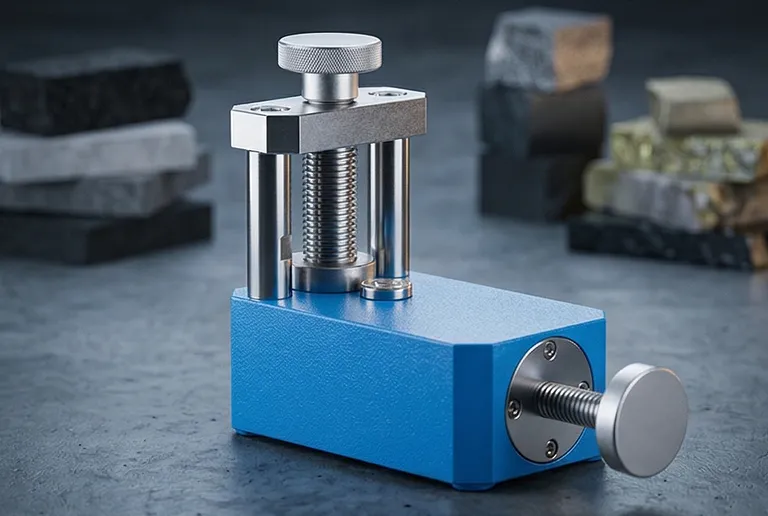
The Invisible Wall of Air
In the quiet of a laboratory, a researcher holds a vial of sulfide electrolyte powder. On a microscopic level, this powder is a landscape of chaos. Each grain is separated by air—a literal void that prevents the movement of ions.
In battery research, air is the ultimate resistor.
The laboratory hydraulic press is the instrument that resolves this chaos. It is not merely a tool for "squishing" material; it is the fundamental architect of a continuous ion transport channel. Without it, the most advanced chemical synthesis remains a collection of high-potential dust.
The Mechanical Intimacy of Sulfides
Sulfide solid electrolytes (SSEs), such as the widely studied Li6PS5Cl, possess a unique physical personality. Unlike their oxide cousins, which are stubborn and brittle, sulfides are remarkably plastic.
Eliminating the Voids
When a press applies loads ranging from 240 MPa to 370 MPa, something transformative happens. The powder doesn't just pack tighter; the particles undergo plastic deformation. They flow into one another, eliminating the internal porosity that otherwise acts as a barrier to lithium ions.
Reducing Grain Boundary Resistance
Conductivity is a game of contact. High-pressure compaction forces particles to bond so tightly that the physical interface between them—the "grain boundary"—nearly disappears. This is the physical prerequisite for reaching conductivity benchmarks like 9 mS cm⁻¹.
The Elegance of Cold-Pressing
In the history of ceramics, densification usually required the violence of heat. Sintering materials at a thousand degrees was the only way to achieve density. But sulfides offer an engineer’s version of a gift: Cold-pressing.
- Thermal Protection: By using mechanical force instead of heat, we preserve the material's chemical soul. There is no risk of thermal decomposition or unwanted phase changes.
- Energy Efficiency: We trade the high energy cost of a kiln for the precise mechanical force of a hydraulic system.
- Speed: A dense pellet is formed in minutes, not hours, allowing for rapid iterative testing.
The Systemic Risks of Pressure
Atul Gawande often writes about the "failures of execution" in complex systems. In the lab, the failure isn't in the science, but in the environment of the press.
The Mold Integrity
Applying 370 MPa is no small feat. If the mold—the vessel of the experiment—is not rated for these extreme stresses, it becomes a point of catastrophic failure. Researchers must balance the need for high-strength steel with the requirement for insulating molds that allow for simultaneous electrochemical measurement.
The Uniformity Problem
Pressure is rarely perfectly uniform. A press that provides raw force but lacks precision control creates "dead zones" within the pellet. These zones of higher porosity are where lithium dendrites find their home, eventually short-circuiting the very battery we are trying to build.
Atmospheric Sensitivity
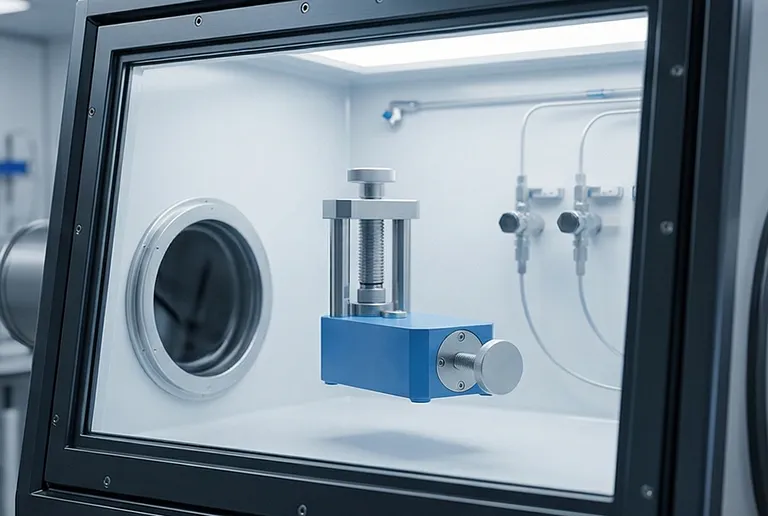
Sulfides are fragile in the presence of moisture. The press cannot be an island; it must be an integrated part of the glovebox environment or utilize vacuum-sealed dies to ensure the material never "breathes" the laboratory air.
From Lab Bench to Gigafactory
The hydraulic press serves as a bridge between the theoretical and the industrial. By recording the pressure-displacement curves during compaction, researchers can predict how these materials will behave on a mass-production line.
We aren't just making a pellet; we are simulating a manufacturing future.
| Metric | Mechanism | Research Impact |
|---|---|---|
| Densification | Compactive Stress | Eliminates ion-blocking air gaps |
| Conductivity | Plastic Deformation | Minimizes grain boundary impedance |
| Integrity | Cold-pressing | Prevents chemical decomposition |
| Scalability | Displacement Data | Provides the blueprint for large-scale production |
Engineering the Future of Energy
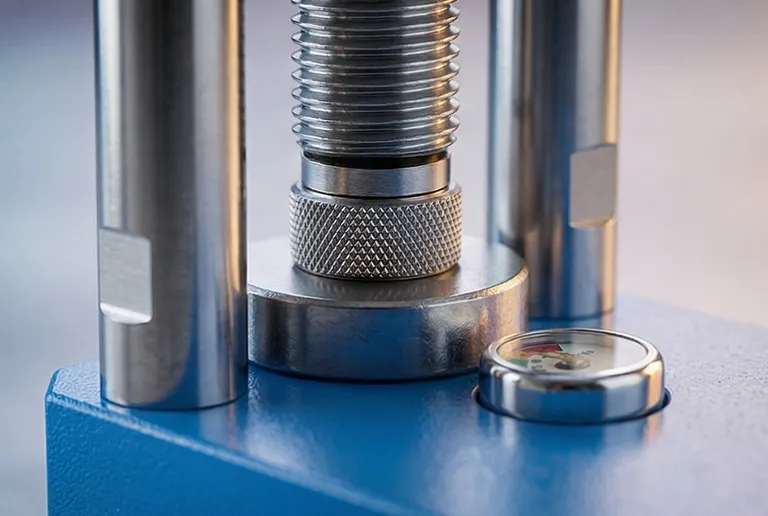
Precision in pressing is the difference between a failed experiment and a breakthrough. Whether your focus is on manual consistency or automated throughput, the equipment must match the ambition of the chemistry.
KINTEK specializes in this intersection of force and science. We provide the comprehensive laboratory pressing solutions—from glovebox-compatible manual presses to advanced isostatic systems—required to turn sulfide powders into the heart of the next generation of batteries.
To find the precise mechanical solution for your solid-state research, Contact Our Experts.
Related Products
- Laboratory Hydraulic Press Lab Pellet Press Button Battery Press
- Laboratory Hydraulic Press 2T Lab Pellet Press for KBR FTIR
- Laboratory Hydraulic Press Lab Pellet Press Machine for Glove Box
- 24T 30T 60T Heated Hydraulic Lab Press Machine with Hot Plates for Laboratory
- Automatic Laboratory Hydraulic Press Lab Pellet Press Machine
Related Articles
- The Physics of Transparency: Why Pressure is the Silent Architect of Spectroscopic Clarity
- The Architecture of Heat: Why Sample Density Dictates the Truth in Metal Hydride Research
- The Geometry of Ionic Flow: Why Precision Pressing Dictates Material Truth
- The Geometry of Electrons: Why Surface Precision is the Silent Partner in SECM Research
- The Architecture of Density: Why Pressure is the Foundation of Precision



















